If you’re running a security business or hiring guards for your property or event, one thing you absolutely can’t ignore is a security guard contract.
It might seem like just another piece of paperwork, but it plays a crucial role in protecting both the client and the guard service provider. And the best part? You don’t need to be a legal expert or spend hours drafting one; we’ve got free downloadable security service contracts to get you started.
In this blog, you’ll find:
- An explanation of what a security contract is
- 5 ready-to-use security contract templates
- A simple guide on how to write a security guard contract
- A list of important legal clauses every agreement should have
What is a Security Guard Contract?
A security guard contract is a formal agreement between two parties: the client (someone hiring guards) and the security company or individual guard (someone providing the service).
The contract outlines everything both sides need to know:
- What tasks the guard will perform
- When and where they’ll work
- How much they’ll be paid
- What happens if either party wants to end the contract
This kind of contract is important because it brings clarity and protection. It ensures everyone is on the same page, reduces misunderstandings, and acts as legal proof if a problem arises.
Whether you’re hiring a guard for a small event or managing a team of guards across multiple properties, having a security service agreement in place is a must.
5 Free Security Guard Contract Templates (Downloadable Templates)
To make your life easier, we’ve created 5 free, customizable security contract templates. These are ideal for different types of clients and jobs. Each comes in an editable format so you can adjust them as needed.
1. Security Guard Service Contract
This is one of the popular forms of contracts that is being adopted by companies of all sizes. Security agencies offer security guard services that can assign them to different individuals or clients. When it comes to getting the right security guard services, the agency and the client must create the security guard service contract and then finalize the deal.
Ideal use case: A general-purpose master agreement between a security agency and a recurring commercial client (retail chain, office building, manufacturing facility) where multiple guards rotate across sites over time. Good starting point for firms standardizing how they paper every new account.
Typical contract length: 12 months with auto-renewal language; some clients negotiate 24 or 36 months in exchange for a rate lock.
Clause to watch: The scope-of-work section. If it says “general security duties” without listing specific posts, hours, and patrol expectations, you will end up doing free work. Spell out post orders by reference, not by vague description.
2. Security Guard Contract For Onsite Security
Most people are not aware of the fact that security guards provide security for a specific location instead of standing anywhere in a premise. There could be multiple examples of on-site security including private events, public gatherings, relocating an item from one place to another, etc.
Ideal use case: Construction sites, gated communities, hospital campuses, and single-tenant office parks where the agency is staffing a specific physical address with named posts (e.g., main gate, loading dock, lobby).
Typical contract length: Construction jobs usually run 3 to 18 months tied to project completion; permanent residential or commercial onsite contracts run 12 months with renewal.
Clause to watch: Site-access and key-handover language. Onsite contracts almost always involve the guard holding keys, access cards, or alarm codes. If the contract does not spell out who is liable when keys are lost or codes leak, the agency carries the entire risk.
3. Sample Security Services Contract for Security Guards
When it comes to hiring security guards, this five-page contract sample gets signed between the two parties. Talk about the contract provision, they are a series of 20 where the last one is highlighted while the other section is in bold.
It could be said that the importance is given to this section that must not be overlooked.
Ideal use case: Mid-sized commercial accounts that want a more detailed and litigated-tested document than Template 1 offers. The 20-provision structure works well for facilities with mixed needs (access control + patrol + alarm response) where a one-page agreement does not give either party enough protection.
Typical contract length: 12 to 24 months; the additional provisions make it worthwhile to commit to longer terms.
Clause to watch: The final highlighted provision (usually an indemnification or limitation-of-liability clause). Read this before signing on either side; it is highlighted for a reason. Negotiate any indemnification cap based on a multiple of annual contract value, not unlimited exposure.
4. Sample Security Service Agreement Contract
This kind of security service contract must be signed between the client and the security contractor and must include details like the address of both the parties. The contract should contain a Security service agreement, Disclaimer of the Liability insurance, Payment agreement, Indemnification, the validity of the contract and service termination letter template, etc.
Ideal use case: Independent contractor or subcontractor relationships, where a larger security firm is subcontracting to a smaller agency, or where a property manager is hiring a specialist firm for a one-off engagement (executive protection, high-risk evictions, sensitive transport).
Typical contract length: Often 3 to 6 months for project-based engagements; 12 months for ongoing subcontract relationships.
Clause to watch: The disclaimer-of-liability and indemnification pair. These clauses interact: an aggressive disclaimer combined with a broad indemnification provision can leave the smaller party carrying risk that should sit with the prime contractor. Read both sections together, not separately.
5. Sample Security Service Arrangement Contract
This kind of security guard contract comes with 9 pages wherein the main sections include the performance of services, terms and termination of the contract, limitation of liability, payment, etc.
If your requirements are like this, you can choose any of the security guard contract templates that match your needs.
Ideal use case: Large enterprise or government accounts where a longer, formal contract is required for procurement or compliance. The 9-page format includes the depth required for accounts with strict legal review, audit clauses, and detailed SLAs.
Typical contract length: 24 to 36 months. Enterprise procurement teams prefer longer commitments to amortize the cost of legal review and onboarding.
Clause to watch: The limitation-of-liability clause. Enterprise contracts often try to cap the customer’s liability at zero while leaving the security firm fully exposed. Push back on one-sided caps; aim for a mutual cap tied to a multiple of fees paid in the prior 12 months.
How to Write a Security Guard Contract (Step-by-Step)
Even if you’re using a security contract template, it’s helpful to understand how these contracts are written. That way, you can confidently review, edit, or create one from scratch.
Here’s a simple step-by-step guide on how to write a security guard contract:
Step 1: Add Basic Information
Include:
- Full legal names of both parties
- Date of agreement
- Service location
Example: “This agreement is made between XYZ Security Services and ABC Corporation on June 20, 2026.”
Step 2: Define Scope of Work
Clearly mention what the guard will be doing. Will they be patrolling, checking IDs, monitoring cameras, or handling emergencies?
Be specific. Instead of “General security duties,” write: “Guard will patrol the parking area every hour, monitor 4 CCTV cameras, and maintain the visitor entry log.”
Step 3: Mention Duration
Specify the start and end dates. Also mention if the contract renews automatically or needs a new agreement.
Example: “This agreement is valid from July 1, 2026, to December 31, 2026, and may be renewed upon mutual agreement.”
Step 4: Outline Payment Terms
Include:
- Rate (hourly/daily/monthly)
- Billing cycle (weekly, monthly)
- Payment method (bank transfer, cheque)
Don’t forget to mention what happens if a payment is delayed.
Step 5: Add Legal Clauses
These will protect both the client and the service provider. We’ll go into more detail on these in the next section.
Step 6: Include Signatures
The agreement is only valid if both parties sign. Include space for:
- Name
- Title
- Company
- Date
- Signature
Why a Security Guard Contract is Essential
In protecting individuals, assets, or confidential data, a security guard contract is more than ink on paper; it’s protection that safeguards the security firm and the customer. Here’s why it’s one hundred percent necessary:
Clearly Outlines Expectations: A sound security service contract details what the guards will do, be it patrolling, CCTV monitoring, access control, or emergency response. This prevents miscommunication and makes both parties aware of what’s required.
Filters Against Liability: Be sure to add liability, indemnity, and necessary insurance coverage clauses. Without them, customers or security providers might unwittingly take on excessive risk.
Compliance Security and Legal and Licensing: Legal and licensing compliance is typically required of Security roles. Contracts guarantee both sides maintain these, noncompliance results in legal charges or voided agreements.
Defines Termination & Payment Terms: Payment schedules, invoicing, and delay penalties should be detailed in contracts. Likewise, termination and renewal clauses laid out clearly prevent confusion or abusive auto-renewals.
Serves as Proof in Disputes: In case of disagreements, an extensive contract allows for the documentation that will be used to solve disputes quickly and in a just manner.
Common Clauses to Include in Every Contract
To make your security guard service agreement legally strong and safe for both sides, you need to include certain standard clauses.
Here are the most important ones:
1. Scope of Work
Clearly outline the guard’s duties. This avoids confusion and scope creep later. This section explains exactly what the security company will do. It might include things like guarding certain areas, watching security cameras, or controlling who can enter the building. By being clear about what services will be provided, both the client and the security company know what to expect.
Example: “The guard will secure the front entrance, manage visitor check-ins, and report suspicious activity.”
2. Payment Terms
List the exact amount to be paid, how often, and how. Mention any taxes or overtime charges. This part tells how and when the security company will get paid. It should include details like the total cost, payment schedule, and what happens if the payment is late. Clear payment terms help avoid any arguments about money.
Example: “Client agrees to pay $2,000 per guard per month, plus applicable taxes.”
3. Liability Clause
Clarify who is responsible if there’s theft, damage, or injury. This section explains who is responsible if something goes wrong. For example, if there’s an accident or damage, who will pay for it? The contract should also say that the security company needs to have enough insurance to cover any problems.
Example: “XYZ Security will not be liable for damages caused due to acts of God or client’s negligence.”
4. Termination Clause
Define how either party can end the contract. Mention the notice period. There should be a clause added in the contract where the terms and conditions for termination of a contract are mentioned. There should be reasons mentioned in the contract like-
- If the term has ended and no renewal was done
- Insolvency of any of the parties involved
- The services were not up to the mark
- The license of the service provider was revoked.
Example: “Either party may terminate the contract by giving a 30-day written notice.”
5. Confidentiality
Guards may have access to sensitive areas or information. Include a clause that restricts them from disclosing it. Security companies often learn private information while they’re working, so this section makes sure that information stays secret. It means the security company can’t share what they know with anyone who isn’t supposed to know it.
Example: “The guard agrees not to share client information with third parties during or after employment.”
6. Insurance
Mention if the security company carries liability or accident insurance for their staff.
Example: “The company shall maintain liability insurance covering all deployed personnel.”
7. Indemnity Clause
Protects one party if the other party causes damage or loss that leads to legal claims.
Example: “The client agrees to indemnify the company for any claims arising from misuse of the services.”
Additional Terms You Need To Know
If you’re thinking about hiring a security company, it’s important to understand some key terms in the contract. Knowing these can help you make sure your business is protected and that both you and the security company are on the same page. Here are a few important terms explained in simple language:
- Indemnity
This term means that if something goes wrong, the security company might have to cover the costs. For example, if their guard makes a mistake and causes damage, they might be responsible for paying for it. It’s important to know what kinds of things the company agrees to cover. These damages may include property damages and any personal injury during the shift. This might be tricky though as it might put you responsible for things that might be out of your hands too.
- Additional Insured
If your business is listed as an additional insured, it means that the security company’s insurance also protects you. This can be really helpful if something happens, like a break-in or an accident, because it means their insurance will help cover the costs.
- Waiver of Subrogation
This is a complicated way of saying that the security company’s insurance won’t try to get money back from another party, like your business, after paying a claim. This protects you from being sued by their insurance if something goes wrong. In simple terms, it means that the insurer can take legal action against the third party. For example, a guard gets injured during the shift and decides to sue the client. Using this clause, the client can shift the liability back to you.
- OCP (Owners and Contractors Protective Liability)
This is a special type of insurance that the security company might have to buy to protect you. It helps cover any legal problems that could come up because of something the security company did. However, this might mean extra costs, so make sure you understand if this is part of the contract. These are rarely used now in the contract, but if you see them in the security contract template, then you can replace them with an indemnity clause too.
- What the Guards Will Do (Scope of Services)
The contract should clearly say what the security guards will be responsible for, where they will work, and for how long. This part makes sure that everyone knows exactly what is expected, so there are no surprises. It might be a fact, but it is always a good idea to have such sentences included. This will save you from any unnecessary legal action.
- Licensing and Training
The contract should also make sure that all security guards have the right licenses and training. This ensures they are qualified to keep your business safe. And you are also aware of the type of services you will be receiving.
Understanding these terms helps you make sure that the security company you hire will protect your business the way you expect. Always take the time to read the contract carefully, and don’t hesitate to ask questions if something isn’t clear.
Common Mistakes in Security Contracts
Even seasoned businesses can commit expensive errors when preparing a security guard contract. These are the most frequent mistakes to be avoided:
Vague Service Descriptions
Simply stating that a guard will “secure the premises” is not enough. A strong security guard contract template should clearly outline duties, such as “patrol the parking lot every hour” or “monitor CCTV cameras at all times.”
Missing Payment and Schedule Information
Some contracts omit the nitty-gritty details of billing and shifts. This will lead to serious problems down the road. Always specify how much will be paid, when invoices must be made, and what if schedules need to be changed suddenly.
Excluding Licensing and Insurance Requirements
If your jurisdiction requires guards to be licensed or security firms to maintain certain insurance, ensure that the security service contract reflects this. Otherwise, you may be fined or have your contracts declared invalid.
No Clear Termination Clause
One of the most common errors is failing to describe how and when each party may terminate the agreement. A properly drafted security guard company contract should include notice periods and any early termination penalties.
Not Including Confidentiality and NDA Clauses
Security guards tend to gain access to confidential areas or information. Failing to include a confidentiality agreement places clients at risk and destroys trust.
Omitting Dispute Settlement Mechanisms
A good sample of security guard service contract will indicate how disputes will be resolved, such as by mediation, arbitration, or through the courts. This helps prevent the escalation of minor problems.
Avoiding these errors will ensure your contracts are more professional, readable, and effective at safeguarding both parties.
Pro Tips for Winning More Security Contracts
Having a satisfactory security guard contract is one thing, but getting contracts in the first place is another hurdle. Here’s how you can boost your chances:
Provide a Professional Template
Give prospective clients a ready-to-use template for a security guard contract. It indicates that you are well-prepared, organized, and serious about your work.
Personalize Every Proposal
Rather than applying the same security service agreement to each client, personalize it according to their specific requirements. State their type of property, risks, and security concerns. This makes the client feel heard.
Emphasize Compliance and Training
Clients need to be assured that you comply with all the legal and industry standards. State clearly in your security guard company agreement your licensing, insurance, and employee training programs.
Showcase Your Track Record
Include short case studies or examples of similar sites you’ve secured. This builds trust and shows your experience.
Use Technology as a Selling Point
If your guards use patrol tracking apps, body cams, or real-time reporting tools, mention them. Many clients choose providers with modern tech in their security guard service agreement sample.
Follow Up and Remain Visible After you have submitted your proposal, follow up with an email or call. Have your name top the client’s mind so they remember you first when ready to sign.
Securing more contracts is usually about demonstrating professionalism, establishing trust, and proving your value right from that initial conversation.
What Changed in 2024-2026 for Security Contracts
Three meaningful shifts have happened to the security-contract landscape between 2024 and 2026, and a contract drafted before 2024 is almost certainly missing language that protects you on all three:
1. Ontario’s Community Safety and Policing Act (CSPA) 2019 came into force April 1, 2024. PSISA (the Private Security and Investigative Services Act) still governs guard licensing, but the CSPA changes how private security guards interact with police services in Ontario. Contracts covering Ontario sites should now include language clarifying which functions the guard performs as a licensed private security agent (deterrence, observation, lawful citizen’s arrest) versus what only sworn officers can do (formal arrests beyond Criminal Code section 494, use-of-force authorities, evidence handling under police protocols). See the Ontario CSPA 2019 statute summary for the full text.
2. Force-majeure clauses are now standard in larger commercial accounts. Before COVID, force-majeure was buried in boilerplate and rarely referenced. Post-2020, enterprise procurement teams expect explicit force-majeure language covering pandemic, government shutdowns, civil unrest, and supply-chain disruption. Smaller firms that skip this clause are taking on risk the client expects them to share.
3. AI and video-surveillance disclosure language is appearing in new contracts. Provincial privacy regulators in Canada and several US state attorneys general have signaled that the use of AI-powered analytics on CCTV footage (facial recognition, behavior detection, automated incident classification) may trigger disclosure and consent requirements. Larger clients, especially in healthcare, education, and government, are starting to require contractors to disclose what AI tools touch their footage. If your firm uses any analytics layer on video, expect this to be in client contracts by 2027.
Top 5 Mistakes in Security Contracts
Beyond the common drafting errors covered later in this post, these five specific mistakes show up in security contract disputes most often:
Vague scope of work. “General security duties” is the single most expensive phrase in a security contract. In one mid-sized commercial case the firm could not prove the guard had any obligation to check a specific service entrance, and the contract language did not save them when a theft happened there. Always reference written post orders by document number and date, and update them in writing when scope changes.
No auto-renewal opt-out language. Many template contracts auto-renew for another full term unless one party gives notice. If the notice window is 90 days but the contract is silent on how notice must be delivered, disputes erupt over whether an email counted. Specify the notice method (certified mail, signed return-receipt email) and the window in calendar days, not “months.”
Missing indemnification cap. Open-ended indemnification is the most asymmetric clause in most security contracts. A firm earning $80,000 per year on a contract can be on the hook for millions in indemnification claims with no cap. Negotiate a cap tied to a multiple (commonly 1x to 3x) of fees paid in the prior 12 months, with carve-outs only for gross negligence or willful misconduct.
No notice-of-incident clause. When something happens on a client’s property (assault, theft, fire, medical), how fast must the security firm notify the client, and through which channels? Without a notice-of-incident clause, clients learn about incidents from the news or police, then claim breach of contract. Specify a notification timeline (often within 1 hour for major incidents) and the contact tree.
No key-handover provision. Keys, access cards, alarm codes, and badge inventories should be tracked in a written log signed at start of contract, at every change of personnel, and at termination. Without this, end-of-contract disputes over missing keys and rekeying costs are routine. State explicitly who pays for rekeying if items are not returned.
2026 Legal Compliance Updates for Security Guard Contract
Security regulations and legislations evolve, and 2026 has continued the trend of stricter licensing and contract requirements that started shifting in 2024. Recent updates that may influence your security guard agreement:
Tighter Licensing Regulations: Licensing requirements for guards are now stricter in most areas. Additional background checks, re-training, and more renewal of licenses are some new requirements introduced by some states and nations. If your security guard agreement template is not updated with the new rules, it might become obsolete very soon.
Enhanced Insurance Requirements: Insurance policies are changing, with some areas requiring increased liability coverage from security providers. Your security service contract must specify the specific insurance coverage levels necessary for your operations.
Data Protection and Privacy Legislation: Surveillance technology has increased, and as a result, privacy legislation has tightened. If your guards work with personal data or use cameras, your security guard company contract must be written to include compliance with local data protection law.
Shift Rules and Worker Rights: Certain jurisdictions have enacted legislation restricting the duration of shifts and imposing mandatory breaks for guards. A good sample of security guard service agreement should include these terms of work to keep the firm out of trouble with the law.
Requirements of Transparent Contracts: In some jurisdictions, contracts should be drafted in clear, concise language and contain explicit termination rights for both parties. It is an attempt at making service agreements more transparent and equitable.
Some new legislation to search for:
Employment & Licensing Changes
In certain states, new requirements ask security companies and employees to register or license according to given standards. For instance, Maryland presently expects both security guards and employers to register with license and insurance verification procedures by 2025
Contract Oversight Requirements
Newer legislation such as the Personnel Oversight and Shift Tracking Act (POST Act of 2025) in the United States seeks to bring private security staff under greater scrutiny-even mandating testing, analysis, and training procedures for contract employees. If your company does business with government contracts, these changes may affect the way your contracts are required to be written.
Licensing Trends in Regions
In places such as California, licensing numbers are still very high, more than 333,000 security guard licenses and over 44,000 firearm permits issued up to early 2025. Persistent monitoring and enforcement highlight the value of true, compliant contracts
By staying current with these updates and having them in your contracts, you demonstrate to customers that you are in compliance legally, morally, and professionally. It also helps you stay safe from penalties or lawsuits.
Why You Need a Security Guard Contract
A security guard contract is essential for several reasons:
- Clarity: It clearly defines the duties and responsibilities of the security guard.
- Legal Protection: It protects both parties in case of disputes.
- Professionalism: It sets a professional tone and expectations for the job.
Pro Tip: Consider consulting with a legal professional to ensure your security guard contract is comprehensive and legally sound.
Final Thoughts
Using a security guard contract isn’t just about legality; it’s about running your business professionally. It shows your clients that you care about structure, safety, and standards.
Whether you’re a solo security guard or running a team of 100, using a security contract template is a smart step. It saves you time, keeps you protected, and builds trust with your clients.
And if you’re tired of juggling schedules, contracts, and incident reports on paper, give Novagems a try.
We help security companies:
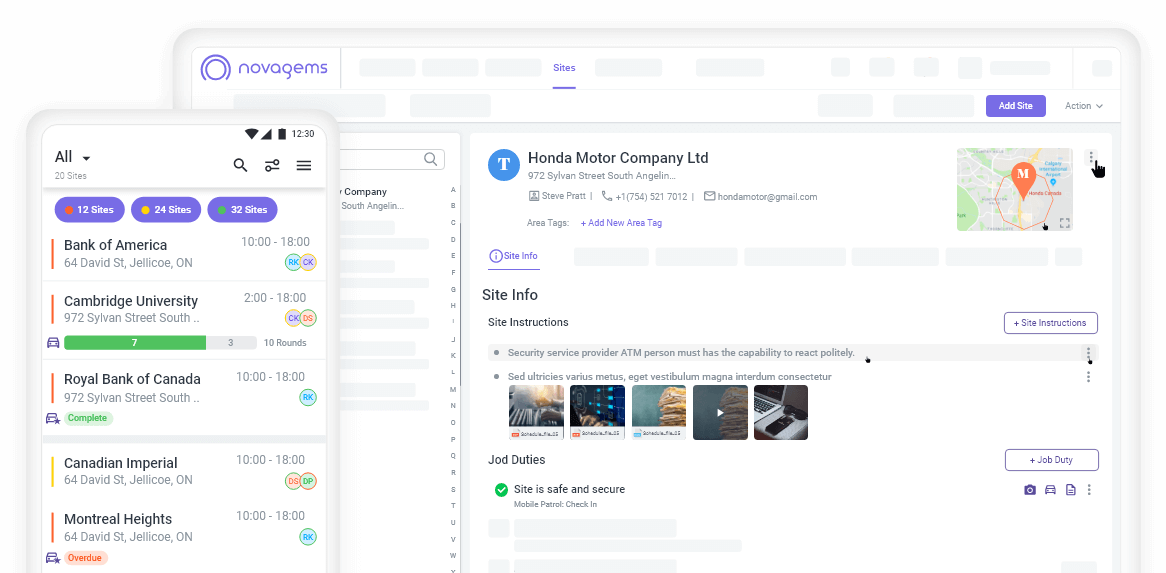
- Schedule guards across multiple sites
- Track time with GPS and mobile check-ins
- Manage contracts, reports, and compliance
Want to simplify your security business? [Book a free demo of Novagems today]
Further Reading
- Types of Security Guard Services, pillar guide covering all 12 security service categories
- How to Price Security Guard Contracts, bill rates, margins, and contract pricing formulas
- Workforce Management for Security Companies, operations platform for security firms
- Best Security Guard Management Software in 2026, the top 8 platforms compared by features, pricing, and best-fit company size
- GPS Tracking and Geofencing, verified patrols and real-time guard location
- 5 Terms in a Security Guard Contract You Should Know, must-have clauses for liability and scope
- Start a Free 14-Day Trial, cancel anytime
- Event Security Services, event pricing, staffing, and crowd management
See Novagems in action
Join 500+ security & cleaning companies that replaced spreadsheets with Novagems.
✓ 14-day free trial · ✓ Free onboarding · ✓ Cancel anytime