AI is reshaping the security guard industry in 2026 through five specific applications, intelligent video analytics, drone-as-first-responder programs, autonomous patrol robots, AI-optimized dispatch, and predictive analytics, but it is not replacing security guards wholesale. The US Bureau of Labor Statistics projects 0% net employment growth for guards through 2034, reflecting technology displacement of incremental roles rather than elimination of the existing workforce. This guide cuts through the hype to show what AI actually does in security operations today, what it doesn’t do, how security companies should adopt it, and what it means for the future of guard work.
The AI conversation in security has been stuck in two failure modes: breathless predictions that robots will replace all guards by 2028, and defensive dismissals that claim AI is just marketing fluff. Neither is accurate. AI is a real technology shift, but it’s happening in specific, limited ways, and understanding exactly where it’s being applied is the difference between a security company that thrives in the next five years and one that gets left behind.
This guide is written for security company owners, operations managers, and career guards who need a realistic picture of where AI actually fits into security work today and how to respond.
Where AI Is Actually Deployed in Security (2026)
Five categories account for nearly all real AI deployment in private security today.
1. AI Video Analytics
What it does: Transforms existing camera feeds from passive recording to active detection. Instead of a human watching 40 monitors, AI continuously analyzes every frame and alerts on specific events:
- Weapon detection
- Loitering in restricted areas
- Crowd density thresholds
- Falls (medical emergencies)
- Tailgating through access control
- Unusual movement patterns (someone entering a lobby at 3am)
- License plate recognition on vehicles
Where it’s deployed: Corporate campuses, retail (loss prevention), schools, healthcare, and high-end residential. Cost typically $5-$30 per camera per month as an add-on to existing surveillance systems.
Impact: A single operator can monitor hundreds of cameras instead of dozens. Response time to actual events improves dramatically because alerts replace constant vigilance.
2. Drone-as-First-Responder (DFR)
What it does: Autonomous drones respond to alarm triggers before human guards are dispatched. The drone flies to the alarm location, transmits live video to dispatch, and allows the operator to verify whether the alarm is real before sending a guard or calling police.
Where it’s deployed: Large industrial facilities, data center campuses, solar farms, mining operations, and some municipal public safety programs. Growing fast, security drone market projected 17.8-21.5% CAGR through 2031.
Impact: Reduces false-alarm response cost dramatically. At a 500-acre solar farm, sending a guard by truck might take 15-30 minutes; a drone arrives in 3-5. 80%+ of alarms in most facilities are false (wildlife, weather, equipment); verifying before dispatch saves enormous labor cost.
3. Autonomous Patrol Robots
What it does: Wheeled or quadruped robots patrol designated routes autonomously, streaming video and sensor data to security operations centers. Boston Dynamics Spot is the most recognized platform; wheeled indoor robots (Knightscope, Cobalt) dominate the indoor segment.
Where it’s deployed: Data centers (fastest-growing segment), power plants, warehouses, factories, and high-security corporate campuses. Limited by capital cost ($80,000-$150,000+ per robot) and maintenance requirements.
Impact: A quadruped robot costs approximately $7-$11/hour in service fees compared to $25-$45/hour for a licensed human guard including company margin. For static overnight patrol of large facilities, the economics work. For anything requiring human interaction or judgment, they don’t.
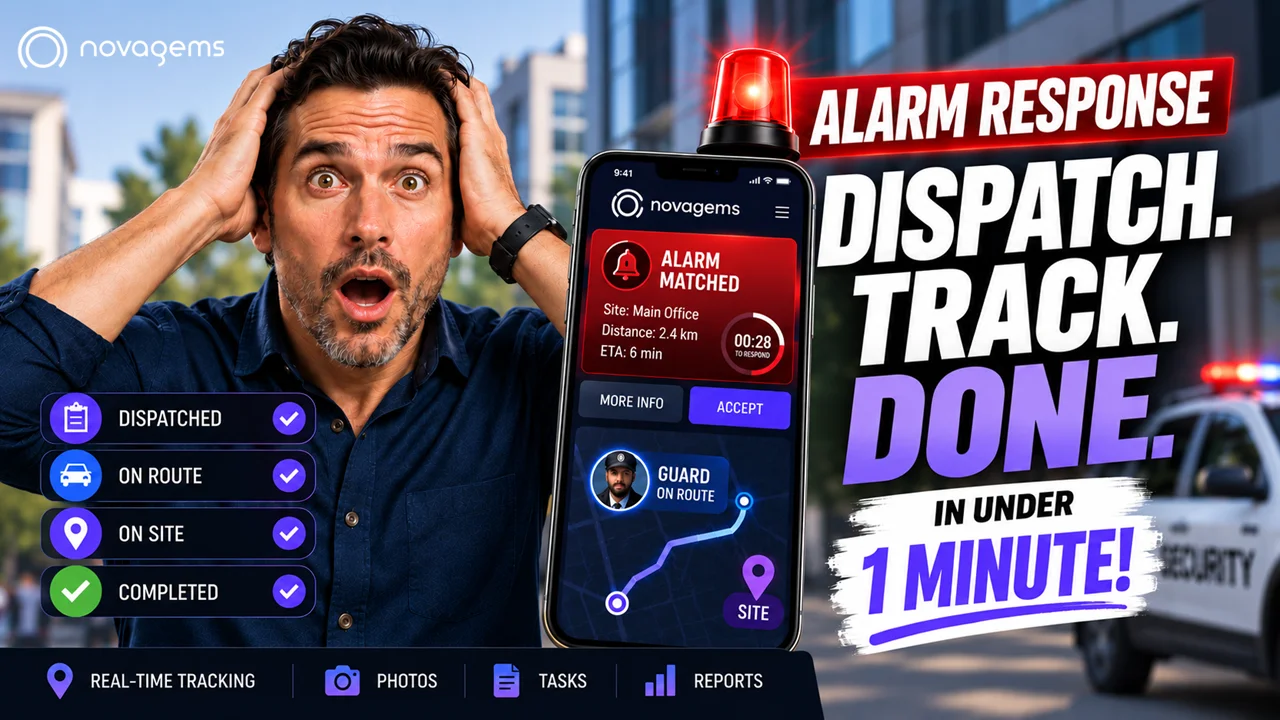
4. AI Dispatch and Routing
What it does: AI optimizes where to send guards based on incident probability, traffic conditions, and workload across a security company’s full fleet. Instead of fixed patrol schedules, routes adapt continuously based on real-time risk factors.
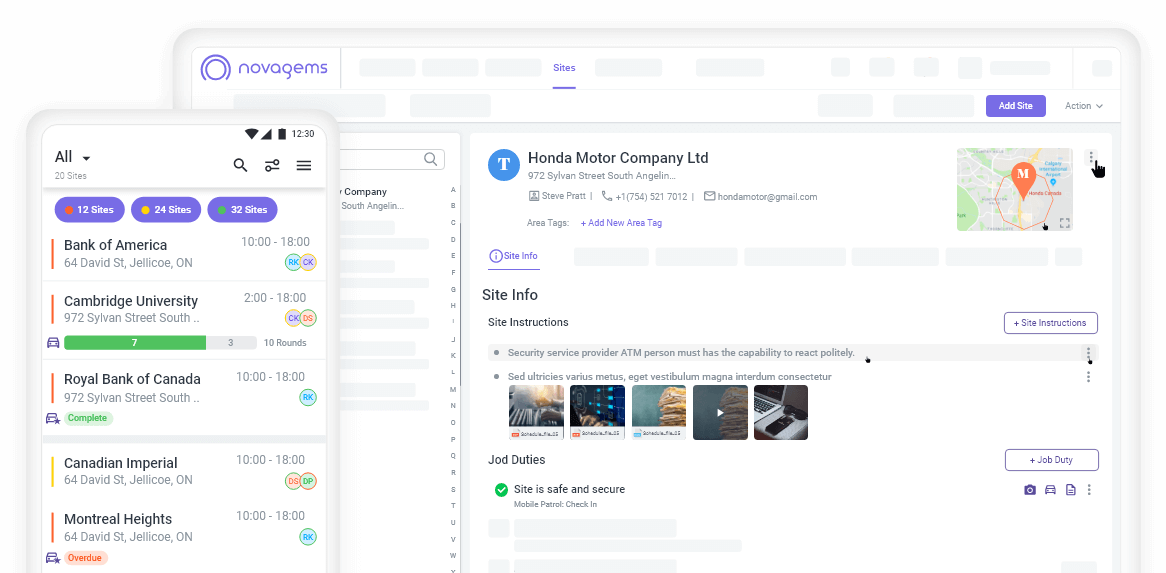
Where it’s deployed: Mobile patrol companies, multi-site security firms, large property management groups. Often embedded inside workforce management platforms like Novagems.
Impact: 10-20% reduction in response time; 15-25% improvement in patrol efficiency; enables one dispatcher to manage 3-5x more posts than manual scheduling allows.
5. Predictive Analytics
What it does: Historical incident data + environmental factors (weather, events, time of day, local crime patterns) feed models that predict where incidents are likely and when. Security resources are pre-staged accordingly.
Where it’s deployed: Large metropolitan security firms, corporate security departments, municipal partnerships. More common at enterprise scale than small-firm.
Impact: Pilot programs reported 25% reduction in incidents. The reduction comes from better placement of deterrence resources before incidents occur, not from responding faster after.
What AI Does Not Replace in Security Work
Equally important: understanding what AI can’t do. Several categories of security work are firmly human and will remain so indefinitely.
| Function | Why AI Can’t Do It |
|---|---|
| Verbal de-escalation | Requires contextual empathy, cultural awareness, reading body language in the moment |
| Physical intervention | Legal, ethical, and practical constraints on robots using force |
| VIP escort / executive protection | Clients want human presence; principal-protector relationship is personal |
| Adaptive decision-making | Novel incidents (mass casualty, active shooter, unprecedented events) require human judgment |
| Customer service / brand ambassador | Concierge and front-desk security is relationship work |
| Arrest / detention (where applicable) | Legal authority tied to sworn officers or citizen’s arrest doctrine |
| Trauma response | First aid, CPR, emotional support during crisis |
| Credentials judgment | AI flags mismatches; humans decide whether the context justifies letting someone through |
| Community policing style presence | Visible human deterrence; robots don’t deter the same way |
| Incident interviewing | Witness statements, investigation interviews |
The work that remains for human guards is higher-skilled, higher-paid, and higher-value than the work AI is replacing. The overnight camera monitor is being replaced; the de-escalation specialist is becoming more valuable.
Impact on the Security Workforce
Understanding what AI does helps predict what happens to security jobs.
What the BLS Data Says
The US Bureau of Labor Statistics projects 0% net employment growth for security guards through 2034. In an industry that previously projected 5-15% growth decade-over-decade, this is a major shift.
But the 0% is net. Inside the number:
- Declining: overnight monitoring, static posts at low-risk sites, wide-area patrol, access control at unmanned sites
- Stable/growing: high-interaction roles (concierge-security, executive protection), specialized verticals (healthcare security, event security, high-net-worth residential), tech-enabled operations (guards who operate drones, manage AI systems, perform digital reporting)
The guard of 2030 looks different than the guard of 2015. Same number, different mix.
Despite 0% Net Growth, 162,300 Annual Openings
Because security has 100-300% annual turnover in some segments, the industry continues to absorb 162,300 new workers per year even at flat total employment. Labor demand isn’t disappearing, it’s shifting toward skilled roles.
Skills Guards Now Need
| Skill | Why |
|---|---|
| Mobile app / digital reporting | Every modern post uses guard management software |
| Technology literacy | Operating drones, robots, checkpoint scanners |
| De-escalation / conflict resolution | The human skill AI can’t replicate |
| Customer service | Security as brand presence, not just enforcement |
| Clear written/photo incident reporting | Client-facing deliverable, not just internal |
| Cybersecurity awareness | 68% of staff now require some training |
| First aid / CPR | Medical response a growing share of guard calls |
| Adaptability | Tech stack changes every 2-3 years |
Entry-level guards without these skills are being hired for declining roles, the static monitoring posts AI is replacing. Experienced guards with these skills are commanding 20-40% higher pay than 5 years ago.
How Security Companies Should Adopt AI
The right adoption strategy depends on company size and client profile.
Small Security Companies (under $2M revenue)
Focus: AI workforce management as first step.
- Invest in a modern security guard management platform with GPS tracking, digital reporting, and automated dispatch ($5-$25 per guard/month)
- Use AI video analytics at existing client sites as optional add-on (pass-through pricing to clients who want it)
- Skip robot and drone investments, capital cost too high for your scale
- Skill up guards on technology literacy as a differentiator
Expected cost: 3-5% of payroll on technology. ROI: 10-20% client pricing premium.
Mid-Size Security Companies ($2M-$20M revenue)
Focus: Technology-enabled operations as competitive moat.
- Full workforce platform with AI dispatch optimization
- AI video analytics as standard offering in new contracts
- Pilot drone-as-first-responder at 1-2 high-acreage clients
- Selective robot patrols at data center or industrial clients if the use case fits
- Cybersecurity training across all field staff
- Build a technology-forward sales narrative — “we don’t just staff guards, we deliver verifiable security programs”
Expected cost: 5-8% of payroll on technology. ROI: expanding market share in higher-margin segments.
Large Security Companies ($20M+)
Focus: AI as operations platform, not just tools.
- Integrated command center pulling data from all sites
- Predictive analytics forecasting incident probability across portfolio
- Fleet robot and drone deployments at qualified clients
- In-house AI/data science team tuning models to your specific portfolio
- Strategic partnerships with AI vendors
Expected cost: 8-12% of revenue on technology. ROI: competitive differentiation at the enterprise tier.
Key Adoption Principle: Layer, Don’t Replace
The single biggest adoption mistake is using AI to replace existing operations before the tech is mature. The right pattern is layering: add AI to existing operations, measure impact, expand what works, retire what doesn’t.
A concrete example: at a 500-acre corporate campus with 6 guards per shift, the right rollout is:
- Month 1: Add AI video analytics to existing cameras. Measure false-alarm reduction.
- Month 3: Deploy one wheeled patrol robot overnight to cover the remote parking area. Guards continue normal posts.
- Month 6: Move one guard from overnight static post to supervisor/response role. Robot handles routine patrol, guard handles response.
- Month 12: Evaluate whether net guard count decreased, stayed flat, or shifted to higher-skilled roles.
The goal isn’t reducing headcount, it’s increasing capability per dollar spent and shifting work to higher-value functions.
What This Means for Security Company Pricing
AI adoption changes pricing dynamics in three ways.
1. Technology Premium Becomes Standard
Clients increasingly expect GPS-verified patrols, digital reporting, and real-time dashboards as baseline. Companies that provide these can charge 10-20% more than companies that don’t. Clients who have been burned by vendors billing for ghost patrols actively seek out technology-backed operations.
2. Labor Cost Increases Offset by Tech Efficiency
Security guard wages are rising (minimum wage increases, labor market tightness). AI-enabled operations let companies absorb some of that cost through efficiency gains, one dispatcher covering more posts, fewer ghost patrols, faster incident resolution.
3. Higher-Margin Specialties Expand
Companies investing in technology often expand into higher-margin specialties: executive protection, healthcare security, high-net-worth residential, event security. These verticals pay 2-3x standard rates and are less price-competitive because clients care more about outcomes than cheapest bid.
For full pricing guidance, see How to Price Security Guard Contracts in 2026.
Ethical and Regulatory Considerations
AI in security raises legitimate concerns that responsible operators should address.
Surveillance Overreach
AI video analytics can enable surveillance at a scale and granularity that was previously impossible. Facial recognition, behavioral profiling, and pattern analysis raise civil liberties concerns. Responsible operators:
- Post clear signage disclosing AI surveillance
- Restrict facial recognition to specific authorized use cases (wanted persons, trespass enforcement)
- Don’t retain biometric data longer than necessary
- Honor opt-out requests where legally applicable
Bias in AI Systems
Machine learning systems can inherit and amplify biases in training data. Video analytics trained on imbalanced datasets may generate more false positives for certain demographics. Responsible operators:
- Audit AI performance across demographic groups
- Have human review of AI-generated alerts before enforcement action
- Use AI for decision support, not autonomous decision-making
Job Displacement
AI is reducing demand for entry-level monitoring jobs. Responsible operators:
- Retrain existing guards for higher-skill roles
- Invest in workforce development, not just tech
- Communicate transparently with staff about operational changes
Data Privacy
Security cameras, body cameras, and drone footage contain personal data subject to GDPR (if operating internationally), state privacy laws (California CCPA, Virginia CDPA, etc.), and contract confidentiality. Responsible operators:
- Document data retention policies
- Encrypt stored and transmitted data
- Train staff on proper handling of captured content
Regulatory Compliance
New laws governing AI in security are emerging. Colorado HB25-1262 takes effect August 2026; other states are following. Federal privacy legislation is likely in the next 2-3 years. Stay current.
What Guards Should Do to Stay Employed
For individual security guards worried about AI displacement:
1. Embrace Technology, Don’t Resist It
The guards who refuse to use mobile apps, digital reporting, or modern checkpoint systems are being priced out. The guards who become fluent, even expert, in these tools become more valuable. Your employer values a guard who can operate the tech stack without supervision.
2. Specialize Into High-Interaction Roles
Roles that require human judgment and customer interaction are the safest from AI displacement:
- Executive protection
- Healthcare security (behavioral health, emergency department)
- Event security (crowd management)
- Concierge-security at high-end residential
- VIP escort
- Threat assessment
These roles often pay 30-100% more than static guard posts and are growing, not shrinking.
3. Get Credentialed
Beyond basic state licensing, additional credentials matter more in the AI era:
- CPR/AED/First Aid
- De-escalation / crisis intervention
- Executive protection training (ASIS, ExecSec)
- Cybersecurity awareness (CompTIA Security+, ISC2 CC)
- Specialty verticals (IAHSS for healthcare security)
Each credential expands the roles you qualify for and the pay you can command.
4. Develop Writing and Reporting Skills
Modern security is data-driven. Clients receive detailed incident reports and expect clarity. Guards who write clear, photo-documented reports become indispensable. Guards who write terse, illegible reports get replaced by guards who do the job well.
5. Build Relationships at the Site
AI doesn’t know the lobby receptionist, doesn’t remember the client CEO’s preferences, doesn’t notice the regular delivery driver’s routine. Human guards who build these relationships become irreplaceable to specific clients. Client-requested guards are the most job-secure guards in the industry.
Looking Ahead: What’s Coming 2027-2030
Based on current trajectories, expect:
- AI video analytics becomes standard at every corporate site (by 2027)
- Drone-as-first-responder adopted at most large industrial sites (by 2028)
- Quadruped patrol robots cost-justified for most data centers and power plants (by 2028-2029)
- Behavioral prediction becomes controversial, regulators will restrict some uses of predictive analytics (especially in mass surveillance contexts)
- Workforce shifts fully toward skilled roles, entry-level static monitoring positions disappear in most markets by 2030
- Guard compensation increases, the labor market bifurcates with higher pay for skilled guards and pressure to eliminate minimum-wage static posts entirely
- New federal regulations on AI in security, expect comprehensive privacy and AI legislation similar to EU AI Act by 2028-2030
Security companies and guards who prepare for this trajectory will thrive. Those who don’t will struggle.
Wrapping Up
AI in security is neither the apocalypse the headlines suggest nor the marketing hype skeptics dismiss. It’s a specific, real shift in how security operations work, affecting some jobs significantly, others not at all, and creating opportunities for companies and guards who adapt.
The security companies thriving in 2026 are not the ones with the most robots or drones, they’re the ones using technology to deliver verifiable, data-driven security at competitive prices. The guards thriving in 2026 are not the ones resisting change, they’re the ones using technology to do higher-value work than was possible a decade ago.
If you’re a security company leader trying to figure out where to invest next, start with workforce management. The platform that handles GPS-verified patrols, digital incident reporting, training tracking, and client dashboards is the foundation every other AI investment builds on. Novagems is built exactly for this. Start a 14-day free trial and see how the right operations platform makes AI adoption straightforward.
Further Reading
- Types of Security Guard Services: A Complete Guide, understand the service categories AI is affecting
- How to Price Security Guard Contracts in 2026, pricing a technology-enabled operation
- NFC Tags for Guard Tours. AI-adjacent verification technology
- GPS Tracking and Geofencing, the first-step technology most security companies should adopt
- Security Dispatch Software, modern AI-enabled dispatch
- Colorado Security Guard License: HB25-1262 Complete Guide, new regulations in the AI era
Frequently Asked Questions
Is AI replacing security guards in 2026?
Not broadly. AI is displacing specific guard functions, overnight camera monitoring, large perimeter patrol, and repetitive credential checks, but it's not replacing the core work that requires physical presence, human judgment, and customer interaction. The US Bureau of Labor Statistics projects 0% net employment growth for security guards through 2034, which reflects technology absorbing incremental demand rather than eliminating the existing workforce. Entry-level monitoring roles are shrinking; skilled roles requiring tech proficiency, de-escalation, and decision-making are holding steady or growing.
What AI technology is actually being used in security in 2026?
Five major categories are deployed at scale. (1) AI video analytics, automatic detection of weapons, loitering, crowd density, and behavioral anomalies from existing cameras. (2) Drone-as-first-responder (DFR) programs, autonomous drones dispatched to alarm triggers for visual verification before guards are sent. (3) Quadruped patrol robots (Boston Dynamics Spot and similar) at data centers, power plants, and industrial sites. (4) AI dispatch optimization, routing guards and mobile patrols based on incident probability, not fixed schedules. (5) Predictive analytics. AI forecasting where incidents are likely and pre-staging resources. Pilot programs reported 25% reduction in incidents.
What does AI not replace in security work?
Functions requiring physical presence, human judgment in ambiguous situations, and customer interaction remain firmly human. This includes: verbal de-escalation of conflicts, VIP escort, credential verification involving ID review and judgment, arrest authority (where applicable), trauma response and first aid, positive community presence and deterrence, and adaptive decision-making during novel incidents. AI can't physically separate two people in a fight; it can't comfort a lost child; it can't respond to a mass-casualty event. Human guards handle these.
How should security companies adopt AI in 2026?
Start by layering AI on top of existing operations, not replacing them. Specific entry points: add AI video analytics to existing camera systems ($5-$20/camera/month), deploy AI dispatch to optimize mobile patrol routes, use GPS-verified patrols with anomaly detection, and pilot autonomous overnight monitoring at one site before rolling out. Budget: expect 3-8% of payroll on tech investments initially, with the ROI coming from reduced incidents, better staffing efficiency, and the 10-20% pricing premium clients pay for technology-enabled operations.
Do security guards need cybersecurity training now?
Increasingly yes. 68% of security staff now require some level of cybersecurity training, reflecting the physical-cyber convergence in corporate and critical infrastructure security. Guards at data centers, financial institutions, and healthcare facilities need to understand tailgating, badge cloning, social engineering, USB drop attacks, and basic incident response. This doesn't mean guards become cyber analysts, it means they know enough to recognize and report physical breaches that enable cyber attacks. Expect cybersecurity awareness to be a standard certification requirement by 2027-2028.
What skills do security guards need to stay employed in the AI era?
Five skill areas matter most: (1) technology proficiency, using mobile apps, dispatch systems, body cameras, and reporting platforms; (2) de-escalation and communication, the human work AI can't do; (3) customer service, security as brand ambassador at corporate and residential sites; (4) digital reporting, writing clear, photo-documented incident reports; (5) adaptability, willingness to learn new tools as the tech stack evolves every 2-3 years. Guards who refuse to use technology are being priced out; guards who embrace it are becoming more valuable.
How much do AI security systems cost?
Costs vary by category. AI video analytics: $5-$30/camera/month depending on features. Quadruped patrol robots (Spot and similar): $80,000-$150,000 purchase or $7-$11/hour service. Drone-as-first-responder programs: $50,000-$200,000 initial setup plus $3,000-$10,000/month operational. AI workforce management platforms: $5-$25 per guard per month. For most security companies, starting with AI workforce management and video analytics gives the best ROI, enterprise robots and drone programs are typically justified only at specific high-security sites.
Will AI reduce security company profit margins?
Short-term yes, long-term no. In the near term, security companies must invest in technology that costs money before generating returns. Mid-term, companies using AI capture a 10-20% pricing premium over non-tech competitors, clients pay more for verifiable, data-driven security. Long-term, the companies that adopted AI will have lower per-contract costs, better retention, and expand into higher-margin services. The companies that refused to invest will be competing on price in a shrinking segment of the market.
See Novagems in action
Join 500+ security & cleaning companies that replaced spreadsheets with Novagems.
✓ 14-day free trial · ✓ Free onboarding · ✓ Cancel anytime