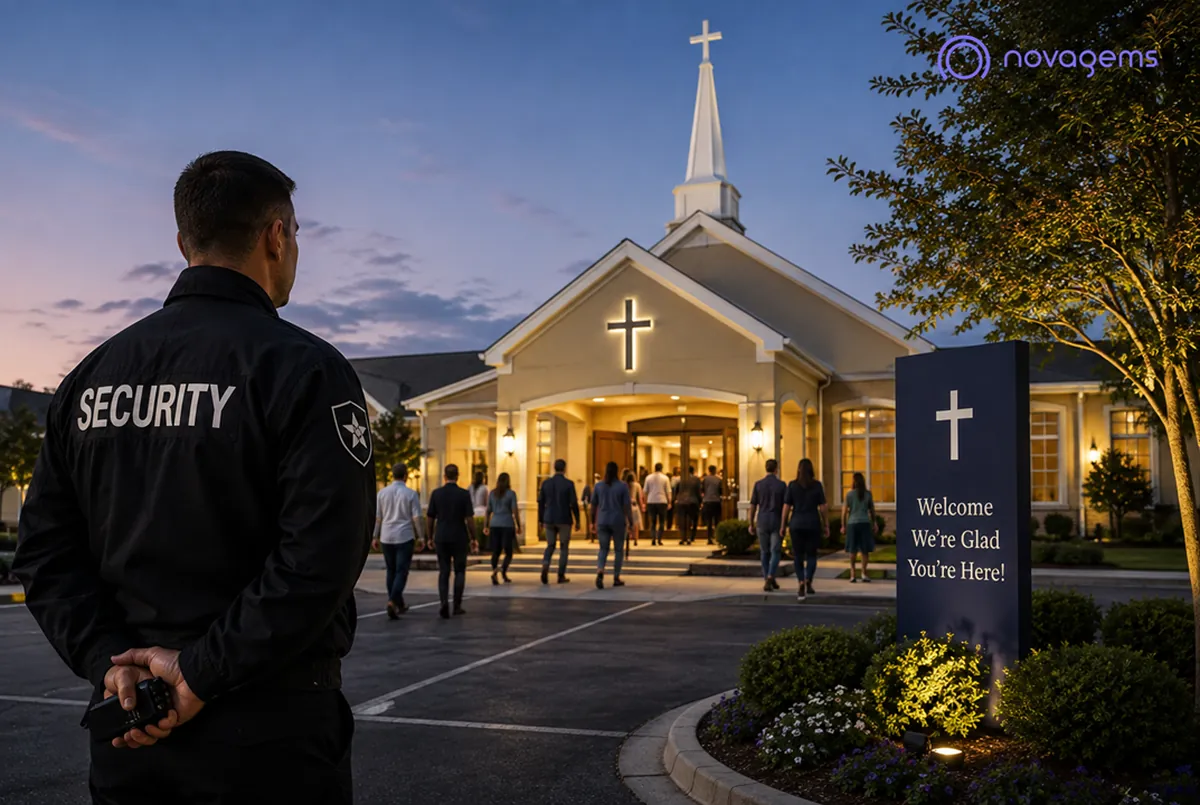
Church security is the combination of trained people, access control, communication, and clear procedures used to protect a congregation, its staff, and its property. For most churches it is not a guard booth and a camera wall. It is a small safety team that knows its posts, watches the right things, and can prove afterwards that the campus was covered.
Houses of worship are unusually hard to secure because everything about them works against control. The doors are meant to be open. Visitors are welcome and unscreened by design. Attendance swings from a quiet weekday to a packed holiday service. Children are on site in a separate space from their parents. A church security plan has to protect all of that without turning the building into something a congregation no longer wants to walk into.
Why church security is different
Most commercial security work starts from a closed perimeter and decides who gets in. Church security starts from an open door and decides what to watch. That inversion changes the whole job:
- Openness is the mission, so visible hard security has a real cost to attendance and atmosphere
- Volunteers, not professionals, make up most teams, with uneven training and high turnover
- Attendance spikes on holidays and special events, exactly when coverage is thinnest
- Children’s ministry creates a custody and check-out problem no retail site has
- Medical incidents outnumber violent ones by a wide margin in an older congregation
- Multi-campus churches run the same service in several buildings with one small team
The practical result is that the most valuable thing a church security team does is not confrontation. It is early observation, calm de-escalation, and a fast, organized response when something goes wrong.
The layers of church security
A workable plan stacks a few simple layers rather than relying on any one of them:
| Layer | What it covers |
|---|---|
| Parking lot presence | Arrival and departure, vehicle break-ins, the first look at anyone approaching |
| Greeters and entrance watch | Friendly contact at the door, early read on behaviour, visitor familiarity |
| Access control | Locked side doors during service, badge or code access to offices and children’s areas |
| Children’s check-in | Matching tags or codes so a child is released only to the right adult |
| Communication | Radios or a phone group that reaches every post at once, including staff on stage |
| Medical response | Trained responders, a stocked kit, an AED, and a known path for paramedics |
| Documented response plan | Written steps for medical, disruption, severe weather, and evacuation |
Notice how much of that is people and procedure rather than equipment. A church that has run a single realistic walkthrough of a medical emergency is better protected than one that bought cameras and never drilled.
Building a church security team
The failure pattern for church safety teams is predictable: a burst of enthusiasm, twenty volunteers at the first meeting, and six months later two people quietly covering every service. Teams that last are built smaller and more deliberately.
- Name one accountable leader. Security by committee produces no decisions and no follow-through.
- Write down what you are actually protecting against. Medical events, parking lot theft, a disruptive individual, a custody dispute at children’s check-in. Rank them honestly by likelihood, not by what is frightening.
- Recruit for temperament, not background. Calm, observant, and reliably present beats tactical experience. Screen and background-check anyone serving, especially near children.
- Assign fixed posts. Main entrance, lobby, parking lot, children’s wing. A volunteer who knows exactly where to stand is worth three who are floating.
- Train on de-escalation first. The overwhelming majority of real incidents end in a quiet conversation.
- Decide the armed question deliberately. It is a board-level decision with licensing and insurance consequences in most states, not something to leave to individual volunteers.
- Run a drill before you need one. A single walkthrough exposes more gaps than a year of planning documents.
For churches that contract professional coverage for evening events or high-attendance services, a licensed security company brings its own licensing, insurance, and trained staff, which is usually the reason to use one.
How software supports a church security team
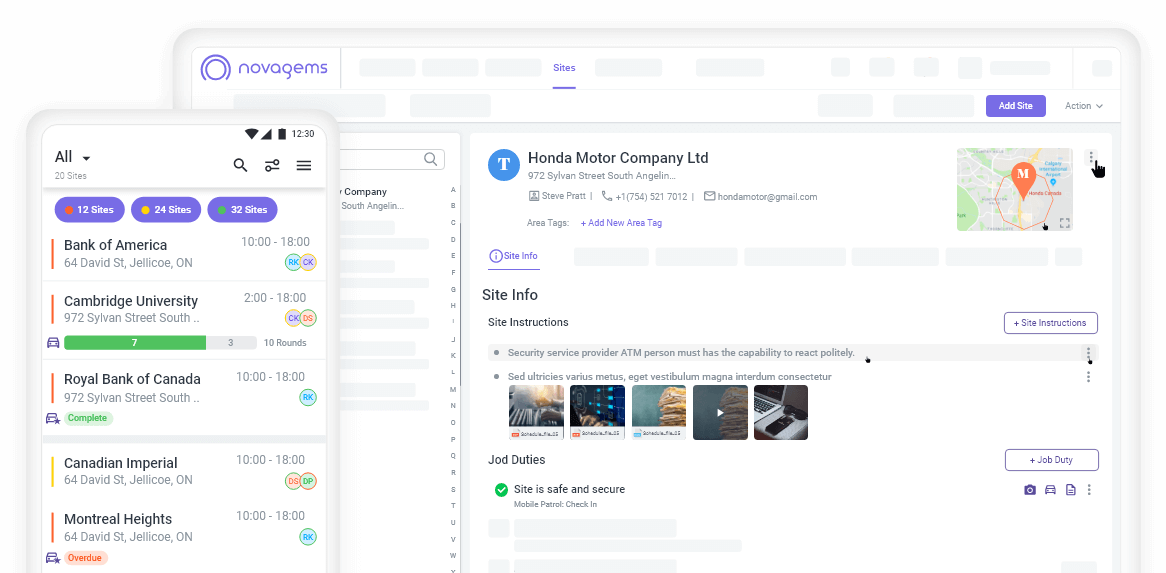
Once a safety team exists, the recurring problem is not strategy. It is knowing who actually showed up, which rounds got walked, and what happened last Sunday. Paper sign-in sheets and a group text do not survive a volunteer coordinator handoff.
Security guard management software closes that gap:
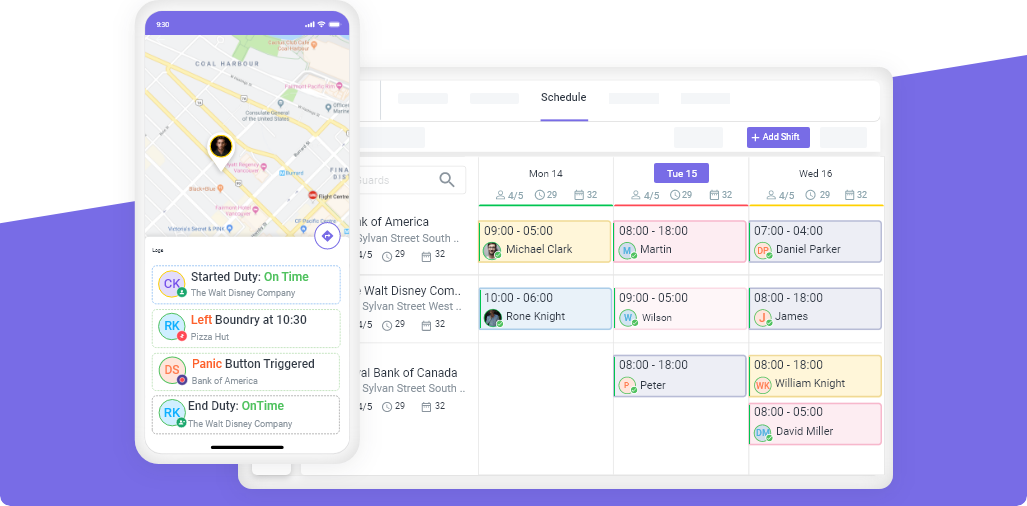
- Scheduled posts and shifts. Build the service rota once, reuse it weekly, and broadcast an open post when someone cannot make it instead of calling around.
- GPS clock-in. Team members check in at their actual post, so leadership knows the parking lot was covered before the service started, not after.
- Checkpoint tours. QR or NFC tags at entrances, stairwells, the children’s wing, and the far end of the lot. Each scan is time and location stamped, so a missed round is visible rather than assumed.
- Incident reporting with photos. A medical response, a vehicle break-in, or a disruptive visitor gets written up from a phone in minutes, with the detail insurance and the board will ask for later.
- Mobile patrol across campuses. Multi-site churches see every campus on one dashboard instead of chasing three separate text threads.
The underlying value is continuity. Volunteer teams turn over constantly, and a documented record is what lets the next coordinator inherit a working programme instead of starting over.
Church security best practices
- Keep the visible posture warm. Greeters who observe are more effective and far less costly to the congregation than uniformed presence at every door.
- Lock the side doors once a service begins and route everyone through one staffed entrance.
- Treat the parking lot as a real post, not an afterthought. Most property incidents happen there.
- Put medical readiness ahead of everything else, including an AED and people trained to use it.
- Brief the team on the specific people and situations already known to staff, such as an ongoing custody dispute.
- Review incidents monthly. Patterns show up in the aggregate that nobody notices week to week.
- Never let the team exceed its training. Observe, communicate, and call for help is a complete and legitimate role.
Cover every service, and prove it
Church security works when a small, trained team covers known posts consistently and can show what happened. Novagems gives safety teams and the security companies that serve them the scheduling, GPS check-in, checkpoint scanning, and incident reporting to do exactly that, across one campus or several.
Start a 14-day free trial and build your first service schedule in under an hour.
Frequently asked questions
What is church security?
Church security is the combination of trained people, access control, communication, and clear procedures used to protect a congregation, its staff, and its property during services and throughout the week. Most churches run it as a safety team of volunteers, contracted guards, or a mix of both, covering greeting and observation at entrances, parking lot patrols, and a planned response to medical and disruptive incidents.
How do you start a church security team?
Start by naming one accountable leader and writing down what you are protecting against, then recruit a small team rather than a large one. Assign fixed posts such as main entrance, lobby, parking lot, and children’s area, document a simple radio or phone communication plan, and run the first few services as a walkthrough. Build in medical response and evacuation before anything else, because those are the incidents churches actually face most often.
Do churches need licensed security guards?
It depends on the state and on what the team does. Unarmed volunteers acting as greeters and observers are generally unregulated, but paid security work, uniformed guard roles, and anything involving a firearm are licensed activities in most states, with requirements set by the state licensing board. Churches that contract a security company are hiring that licensing and insurance along with the guards, which is a common reason to use one for evening events and high-attendance services.
How does software help a church security team?
Patrol software replaces paper sign-in sheets and group texts with a record. Team members clock in with GPS at their post, scan checkpoints on parking lot and building rounds, and file incident reports with photos from a phone. Leadership sees who actually covered which service, which rounds were missed, and what happened, which matters for insurance, for board reporting, and for handing the role to the next volunteer coordinator.
See Novagems in action
Join 500+ security & cleaning companies that replaced spreadsheets with Novagems.
✓ 14-day free trial · ✓ Free onboarding · ✓ Cancel anytime