Event security services are specialized security personnel and operations deployed for temporary gatherings, concerts, festivals, corporate events, conferences, sports, political rallies, private parties, to manage access, control crowds, prevent incidents, and coordinate emergency response. Professional event security costs $25-$75+ per hour per guard depending on event size and risk profile, with industry-standard staffing ratios of 1 guard per 50-100 attendees. This guide covers everything event planners need: pricing by event type, crowd ratios, hiring process, contract terms, and the technology modern event security firms should use.
Every event planner has the same 3 AM nightmare: something goes wrong at their event, a fight breaks out, an unauthorized person enters a restricted area, a medical emergency happens, and security isn’t where they need to be, nobody has a clear plan, and the incident spirals. The difference between events where this happens and events where it doesn’t comes down to how you hire, brief, and manage event security.
This guide gives you the framework to hire event security professionally. Whether you’re planning a 50-person corporate luncheon or a 50,000-person festival, the principles are the same, the scale just changes.
What Event Security Services Cover
Event security is broader than most clients realize. A professional event security firm handles all of the following, either directly or by coordinating with other vendors:
| Function | What It Covers |
|---|---|
| Access control | Credential checks, ticket scanning, entry screening, VIP routing |
| Perimeter security | Fence line patrols, loading dock control, rear exits |
| Crowd flow management | Queue management, exit direction, zone capacity monitoring |
| Conflict resolution | De-escalating disputes, removing unruly guests, alcohol management |
| VIP protection | Close protection for keynote speakers, performers, executives |
| Emergency response | Medical emergency coordination, evacuation leadership, active threat response |
| Asset protection | Equipment, merchandise, cash, exhibitor booth security |
| Liaison with authorities | Coordinating with police, fire, EMS, venue management |
| Documentation | Incident reports, ejection records, property damage logs |
The best event security firms act as the operational layer between the event planner (focused on the attendee experience), the venue (focused on their property), and emergency services (focused on their scope). They make sure every security-related decision gets made fast and documented properly.
Types of Event Security
Event security isn’t one-size-fits-all. The type of guard, their training, and their deployment model change based on the event.
By Event Type
| Event Type | Typical Security Mix |
|---|---|
| Corporate conference (100-1,000 attendees) | Unarmed guards, registration check, conference room coverage, VIP escort |
| Wedding or private party (100-500) | Unarmed guards, gate control, parking, alcohol management |
| Concert / festival (1,000-50,000+) | Tiered security, uniformed perimeter, plainclothes in crowd, armed supervisors, K-9 for bag checks |
| Sports event | Venue security + event-specific teams for VIP sections and visiting team coverage |
| Trade show / expo | Access control at entrances, booth protection during load-in/out, overnight asset security |
| Political rally or protest | Armed security + off-duty police, high-visibility presence, emergency evacuation planning |
| Red carpet / premiere | Executive protection, paparazzi management, close protection for talent |
| Nightclub / bar (ongoing) | Bouncers with TIPS/RBS certification, ID checks, bottle service security |
By Deployment Role
| Role | Purpose |
|---|---|
| Entry screening | Bag checks, credential verification, metal detection |
| Perimeter | Fence lines, loading docks, rear entrances |
| Crowd control | Inside the event, managing flow and spotting issues |
| Fixed post | Guard at a specific location (bar, merch booth, stage door) |
| Roaming / plainclothes | Dressed as attendees, detecting problems early |
| VIP / close protection | Escorting specific individuals |
| Supervisor / lead | Commanding a zone, radio coordination, making calls |
Event Security Pricing
Hourly Rates (2026 US Market)
| Guard Type | Hourly Rate | Typical Use |
|---|---|---|
| Unarmed, basic | $20-$30 | Access control, low-risk events |
| Unarmed, experienced | $30-$40 | Concerts, festivals, crowd management |
| Armed | $40-$65 | High-value cash, VIP, cash handling events |
| Off-duty police | $75-$150 | VIP, political events, arrest authority needed |
| K-9 unit | $75-$150 | Explosive/narcotics detection, festival bag checks |
| Executive protection | $100-$200 | Talent, keynote speakers, C-suite |
| Medical (EMT) | $40-$75 | Events over 1,000 attendees, alcohol served |
Most events have a 4-hour minimum billing regardless of actual event length. A 2-hour corporate luncheon still bills 4 hours per guard.
Pricing by Event Size
| Event Size | Attendees | Typical Security Budget | Guard Count |
|---|---|---|---|
| Small private | Under 100 | $500-$2,000 | 1-2 |
| Medium corporate | 100-500 | $1,500-$5,000 | 3-8 |
| Large corporate / wedding | 500-1,500 | $5,000-$15,000 | 10-25 |
| Small festival / concert | 1,500-5,000 | $15,000-$40,000 | 25-60 |
| Large concert / festival | 5,000-25,000 | $40,000-$150,000 | 60-200 |
| Major festival / sports | 25,000+ | $100,000-$500,000+ | 200-500+ |
Pricing Factors Beyond Hourly Rate
| Factor | Cost Impact |
|---|---|
| Location | NYC/LA/SF = 20-40% above national avg; smaller cities = 10-20% below |
| Time of day | Overnight (10 PM-6 AM) = +10-15% |
| Day of week | Weekends/holidays = +25-50% |
| Rush booking | Under 7 days notice = +20-50% |
| Uniform type | Tux/black tie for gala = +$50-$100 per guard |
| Supervisor ratio | 1 supervisor per 10-15 line guards at supervisor rate |
| Command post | Large events need a command post setup = $2,000-$10,000 |
| Technology | GPS tracking, radio systems, body cameras often included or minimal add |
How Many Guards Do You Need?
The security-to-attendee ratio depends on event risk.
| Risk Level | Ratio | Event Examples |
|---|---|---|
| Low | 1:150-200 | Corporate luncheon, cocktail reception, small wedding |
| Medium | 1:100-150 | Conference, trade show, large wedding, school gala |
| Medium-high | 1:75-100 | Concert (1K-5K), sports event, festival |
| High | 1:50-75 | Large concert, political rally, late-night festival, alcohol-heavy |
| Very high | 1:25-50 | Major festival, political rally, celebrity appearance, high-security |
Add these beyond the base ratio:
- Entry screening: 2-4 guards per entrance during peak ingress (45-60 min before doors)
- Stage/talent area: 2-6 guards dedicated
- VIP section: 2-4 per VIP area
- Parking/transit: 2-4 per parking zone
- Backstage/loading: 1-2 per access point
- K-9 bag check (if used): 1 K-9 team per 500 attendees screening
Example: 2,000-Person Outdoor Concert
| Role | Count | Notes |
|---|---|---|
| Entry screening (bag check) | 8 | 4 per entrance, 2 entrances |
| Perimeter | 6 | Fence line patrol |
| Crowd floor (plainclothes) | 4 | Spotting drug use, fights |
| Stage area | 4 | Barricade + talent protection |
| VIP section | 3 | Separate access + internal |
| Backstage | 2 | Access control |
| Roving supervisors | 2 | Command-and-control |
| EMTs | 2 | Required at alcohol events 1,500+ |
| Total | 31 | ~1:65 ratio |
At $35/hr × 8 hours × 31 guards = $8,680 base labor, plus supervisor premiums, command post setup, and overtime for load-in/out.
Crowd Management
Crowd management is the single most important event security skill. Most incidents at events aren’t security threats, they’re crowd dynamics going wrong: bottlenecks at exits, alcohol-fueled disputes, medical emergencies caused by overcrowding.
The 4 Crowd Management Principles
- Flow direction, guide attendees clearly where to go (entry, exit, bathrooms, exits). Use signage, stanchions, and visible security direction.
- Zone capacity, count attendees entering each zone. When capacity hits 80%, start directing new entries elsewhere. When 100%, stop entries.
- Observation pairs, no guard works alone in a crowd. Pairs can watch in opposite directions and coordinate response.
- Predictive spotting, watch for early warning signs: raised voices, personal space violations, someone obviously intoxicated, crowd “swirling” near a point. Intervene before it escalates.
The 2X Exit Rule
At any point during an event, attendees should be able to exit in 2x the time required for emergency evacuation. If evacuation takes 5 minutes, regular egress should work in 10 minutes. If your exits are bottlenecking at 20 minutes, you have a safety problem.
Emergency Response Planning
Every event needs a documented emergency response plan before the first guest arrives. Professional event security firms create this as part of their pre-event work.
Required Plans
| Scenario | Plan Components |
|---|---|
| Medical emergency | EMT location, path to nearest exit, coordination with 911 |
| Fire | Evacuation routes, assembly point, accountability process |
| Severe weather | Shelter locations, cancellation threshold, notification protocol |
| Active threat | Lockdown vs. evacuate decision tree, coordination with police |
| Power failure | Emergency lighting check, crowd calm protocol, event continuation decision |
| Protest / disruption | Ignore, redirect, or remove decision tree; media protocol |
| VIP medical or security | Separated extraction route, discretion protocol |
Command Post Setup
For events over 1,000 attendees, establish a physical command post:
- Centralized radio communication
- Event layout maps with guard positions
- Incident log (digital preferred)
- Direct lines to police, fire, EMS, venue management
- Live camera feeds (if available)
- First aid supplies
How to Hire Event Security
Step 1: Define Your Requirements
Before contacting vendors, document:
- Event type, date, location, duration
- Expected attendance (and peak hour estimates)
- Alcohol served? (Y/N)
- VIPs attending (and their specific protection needs)
- Known or expected risk factors (media coverage, political content, recent relevant incidents)
- Required licenses/certifications (venue, permit, insurance requirements)
- Budget range
Step 2: Get 3 Quotes from Licensed Firms
Ask each vendor for:
- Exact scope (guard count, hours, roles, supervisor structure)
- Hourly rate breakdown by role
- All fees (command post, travel, equipment, rush fees)
- Insurance certificate (COI) with your event named as additional insured
- State license documentation
- 3 references from similar-size events in the last 12 months
Step 3: Evaluate Proposals
| Green Flags | Red Flags |
|---|---|
| Detailed scope matched to your event | Generic “we provide security” proposal |
| Named project manager | No single point of contact |
| Documented emergency response plan | “We’ll figure it out on site” |
| Technology (GPS, digital reporting) | Paper-only operations |
| References check out | Can’t provide references |
| Transparent pricing | Hidden fees discovered later |
| Insurance meets venue requirements | Insurance below venue minimum |
Step 4: Pre-Event Coordination
Two weeks before the event:
- Walk the venue with the security lead
- Confirm roles, positions, call signs, radio channels
- Review the emergency response plan
- Set briefing time (usually 60-90 min before doors)
- Confirm guard uniform and equipment requirements
Step 5: Event Day
- Arrive early enough for the pre-event briefing
- Maintain a direct line to the security supervisor
- Document any incidents in real-time
- Debrief with the security lead within 24 hours
Technology Modern Event Security Uses
A professional event security firm in 2026 should bring:
| Technology | Purpose |
|---|---|
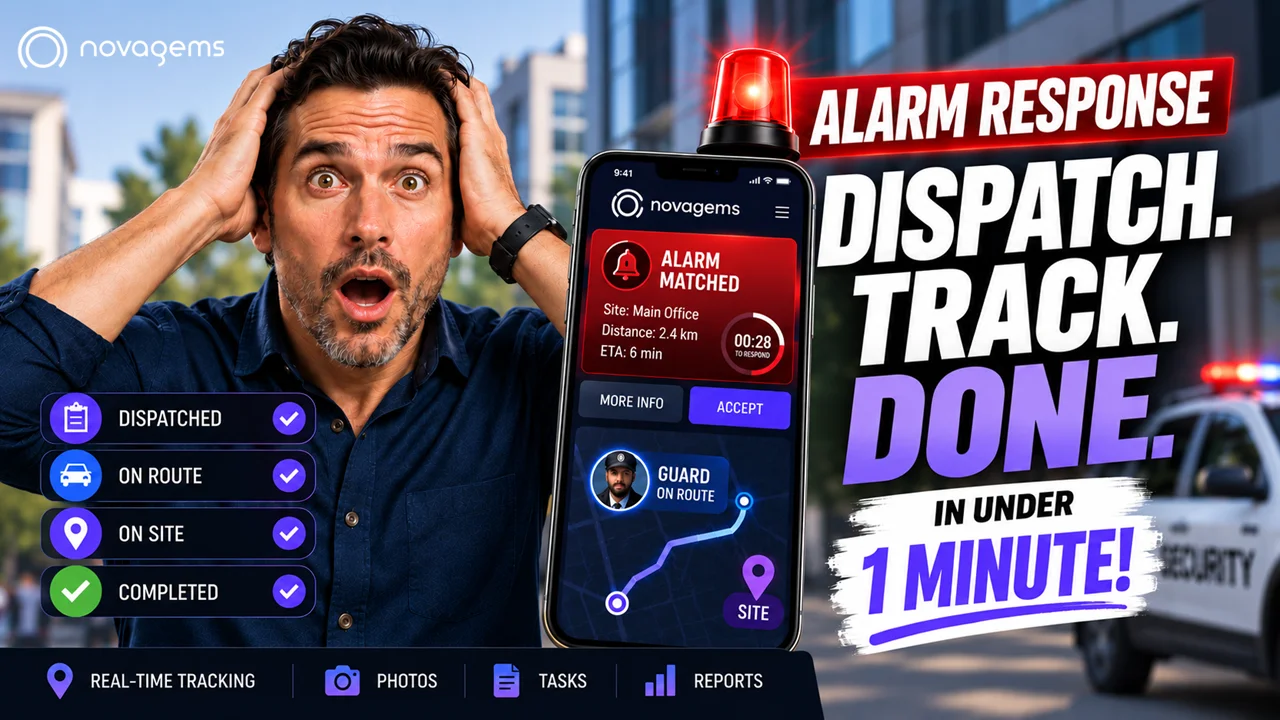
| GPS tracking | Every guard visible on a live map, no more “where is that guard?” |
| Radio systems | Encrypted, multi-channel, push-to-talk across the entire team |
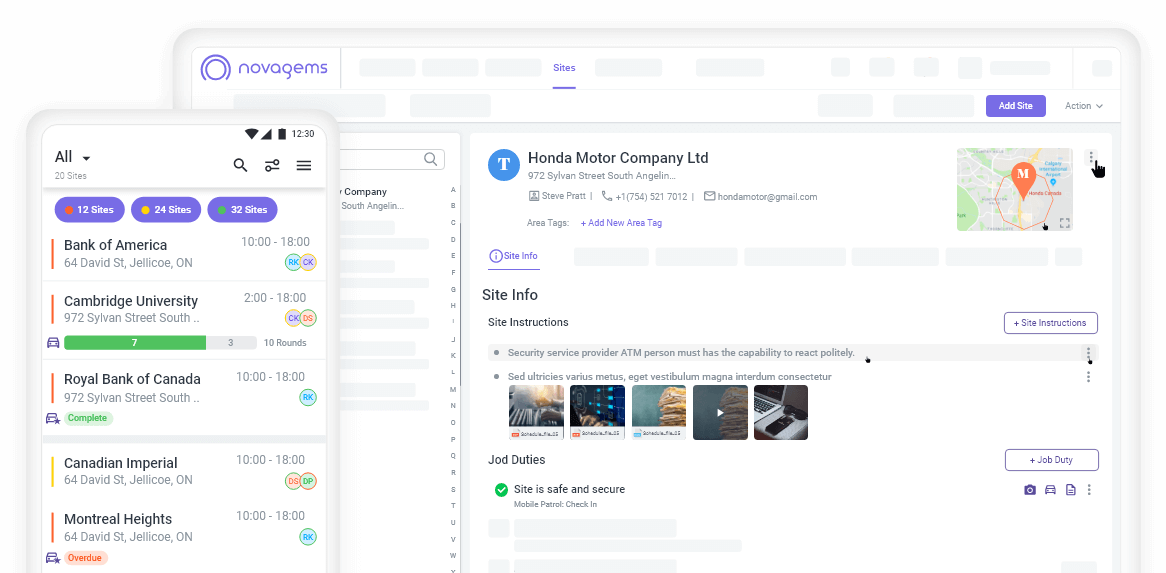
| Digital incident reporting | Real-time documentation with photos and GPS stamps |
| Client reporting | Event planner sees live dashboard of activity |
| Body cameras | De-escalation protection and evidence for any dispute |
| Access control software | Credential scanning, capacity tracking, VIP routing |
| NFC / QR checkpoint scanning | Verify perimeter patrols are completed |
If a security vendor is still doing headcounts on paper and radio check-ins every 30 minutes, they’re 10 years behind industry standard. Ask to see their technology during the sales process. Novagems provides GPS tracking, digital incident reporting, and client reporting as the standard, not an upcharge.
Common Event Security Mistakes
| Mistake | Consequence | Fix |
|---|---|---|
| Under-staffing to save money | Incidents, liability, bad reviews | Use the 1:100 (or stricter) ratio |
| Booking too late | Premium pricing, B-team personnel | Book 4-6 weeks ahead (3-6 months for major events) |
| No emergency plan | Chaos during a crisis | Document scenarios before the event |
| Uninsured vendor | Personal liability for incidents | Require $1M-$2M COI before contracting |
| Skipping pre-event briefing | Guards in wrong positions, confusion | 60-90 min briefing on event day |
| No post-event debrief | Same mistakes next time | 24-hour debrief meeting |
| Ignoring venue rules | Fines, permit issues, relationship damage | Review venue security requirements early |
| Paying cash, no contract | No recourse, tax issues | Always sign a contract with licensed firm |
Getting Started
If you’re planning an event and need security:
- Define your requirements, event type, attendance, risk factors, budget
- Request 3 quotes from licensed, insured firms with event experience
- Verify credentials, license, insurance, references, training documentation
- Negotiate the contract, scope, pricing, insurance, emergency plan
- Coordinate pre-event, venue walk, role assignments, briefing schedule
- Execute and debrief, document everything, review within 24 hours
For a broader overview of the different types of security services available, see our complete guide to security guard services. If you also need residential or executive protection for specific guests, those are separate specialties.
If you run a security company offering event services and want to demonstrate professional operations with GPS tracking, digital reporting, and client reporting, start a free 14-day trial with Novagems and deliver the level of service event planners expect in 2026.
Further Reading
- Types of Security Guard Services, pillar guide covering all 12 security service categories
- How to Price Security Guard Contracts, bill rates, margins, and contract pricing formulas
- Workforce Management for Security Companies, operations platform for security firms
- GPS Tracking and Geofencing, verified patrols and real-time guard location
- Choosing Security Software for Event Security, must-have features for managing event teams
- Miami Art Week 2026 Security Guide, every fair, date and venue, plus a free fair list for South Florida security companies
- Start a Free 14-Day Trial, cancel anytime
Frequently Asked Questions
How much does event security cost?
Event security costs $25-$75 per hour per guard depending on event risk and guard training level. Unarmed guards are $20-$35/hr, armed guards $35-$60/hr, and specialized crowd-control or K-9 units can reach $75-$100/hr. Most events have a 4-6 hour minimum billing. A standard corporate event (50-200 attendees, 4 hours) typically costs $500-$2,000 total. Large concerts or festivals (5,000+ attendees) range from $20,000-$100,000+.
How many security guards do I need for my event?
The industry standard is 1 guard per 100 attendees for low-to-medium risk events. For high-risk events (alcohol served, late-night, celebrity appearance, political events), plan for 1 guard per 50-75 attendees. Concerts and festivals may require 1 per 40-50 depending on the venue and crowd profile. Always add supervisors (1 per 10-15 line guards) and dedicated roles for VIP protection, exit control, and medical response.
How far in advance should I book event security?
Book at least 4-6 weeks in advance for medium events (500-5,000 attendees). For major events (concerts, festivals, corporate galas, VIP appearances), book 3-6 months ahead. Peak seasons (holiday corporate parties, summer festivals, sports championships) require even earlier booking as qualified security teams get reserved quickly. Last-minute bookings (under 7 days) typically carry a 20-50% rush premium.
What's the difference between event security and bouncers?
Bouncers are typically used at bars, clubs, and nightlife venues, focused on ID checks, ejections, and breaking up fights. Event security is broader: credential verification, access control, perimeter security, crowd flow management, VIP protection, emergency response, and liaison with law enforcement. Professional event security firms provide licensed, insured personnel with training for specific event types. Bouncers may or may not carry the same level of certification.
Do event security guards need special training?
Yes. Beyond basic state licensing (guard card in CA, DOS registration in NY, etc.), event security requires training in: crowd dynamics and management, de-escalation and conflict resolution, credential verification, emergency evacuation procedures, customer service, radio communication, and incident reporting. Many events (especially alcohol-serving venues) also require TIPS or RBS certification. Higher-risk events may require CPR/AED and first aid certifications.
What insurance does an event security company need?
Professional event security firms carry general liability insurance ($1M-$2M minimum, $5M+ for high-risk events), workers' compensation, and often professional liability (errors and omissions) coverage. If they carry firearms, they need firearms liability coverage. Always request a certificate of insurance (COI) naming your event/venue as additional insured before contracting. Most venues and permitting authorities require this.
Can I hire off-duty police officers for event security instead?
Yes, and it's common for VIP events or situations requiring arrest authority. Off-duty police typically cost $75-$150/hour per officer, can make arrests under their sworn authority (unlike private security), and wear official uniforms. The trade-off: they're harder to coordinate (scheduled through the department, not the security company), less flexible on scope, and have jurisdictional limits. Many large events combine both, private security for general coverage and 2-4 off-duty officers for visible authority and arrest capability.
What should I look for in an event security proposal?
A professional proposal includes: exact scope (guard count, hours, posts, supervisor structure), clear pricing with no hidden fees, insurance certificate showing required minimums, licensing documentation for your state, references from similar events, training credentials for each role, communication plan (how command-and-control works), technology capabilities (GPS tracking, real-time reporting, incident documentation), and contingency plans (weather, medical emergency, active threat). Reject any vendor that won't provide all of this.
See Novagems in action
Join 500+ security & cleaning companies that replaced spreadsheets with Novagems.
✓ 14-day free trial · ✓ Free onboarding · ✓ Cancel anytime