A Florida security guard license is a credential issued by the Florida Department of Agriculture and Consumer Services (FDACS) that authorizes an individual to work as a security officer in Florida. There are two license types: Class D (unarmed, 40-hour training required) and Class G (armed, additional 28-hour firearms training). Applications are submitted to FDACS, and processing takes 10-30 days for Class D and 2-4 weeks for Class G.
Florida is the third-largest state for private security employment in the United States, with approximately 140,000 active security guards (Bureau of Labor Statistics, 2024). The state has one of the more rigorous licensing requirements, 40 hours of mandatory training for unarmed guards, compared to just 6 hours in Texas or 8 hours in New York. The upside is that Florida-licensed guards are among the best-prepared in the country.
This guide covers everything you need to know: the Class D and Class G licensing process, training requirements, costs, background check details, the application process, renewal, and what employers need to know about managing compliance.
Florida Security Guard License Types
Florida uses a two-tier system. Class D is the baseline; Class G is an add-on for armed work.
| License | Title | What You Can Do | Training | Min. Age |
|---|---|---|---|---|
| Class D | Unarmed Security Officer | Patrol, monitoring, access control, incident reporting, no firearm | 40 hours | 18 |
| Class G | Armed Security Officer | All Class D duties + carry a firearm while on duty | 28 hours (+ Class D) | 18 |
You must hold a Class D license before performing any security work in Florida. Class G is required only if you will carry a firearm. You can apply for both simultaneously.
Class D License: Unarmed Security Officer
Who Needs It
Every person performing security guard, security officer, or private watchman duties in Florida, whether employed by a contract security agency or working as proprietary (in-house) security, must hold a valid Class D license.
Training Requirements (40 Hours)
Florida requires 40 hours of training from a state-licensed training school. The curriculum is standardized by FDACS:
| Topic | Content |
|---|---|
| Florida security laws | Chapter 493, Florida Statutes, licensing, authority, and restrictions |
| Legal use of force | Use-of-force continuum, justifiable force, citizen’s arrest |
| Emergency procedures | Fire response, medical emergencies, active threats, evacuation |
| Observation techniques | Surveillance, threat identification, situational awareness |
| Patrol methods | Foot patrol, vehicle patrol, fixed post, access control procedures |
| Report writing | Incident documentation, statement collection, evidence preservation |
| Communication | De-escalation, verbal commands, radio procedures, client interaction |
| Ethics and professionalism | Standards of conduct, liability, confidentiality |
Online vs. in-person: Florida allows Class D training through live online instruction via a secure website, provided the instructor verifies identity, attendance, and completion. This means you can complete the 40-hour course remotely, a significant convenience, especially for guards in rural areas.
Eligibility Requirements
Before applying, you must meet these criteria:
- Age: At least 18 years old
- Citizenship: U.S. citizen or legal resident with valid work authorization
- Criminal history: No disqualifying convictions (see Background Check section)
- Mental health: No adjudication of mental incompetence or involuntary commitment
- Substance abuse: No history of substance abuse that would impair fitness for duty
- ID: Valid government-issued photo identification
How to Apply
- Complete 40-hour Class D training at a state-licensed school
- Get fingerprinted at a LiveScan or FDACS-approved location
- Submit your application to FDACS with:
- Completed application form
- Training completion certificate
- Fingerprint receipt
- Application fee (~$45)
- Fingerprint processing fee ($30-$40)
- Passport-quality photo
- Wait for processing (10-30 days)
- Receive your Class D license via mail
Temporary license: Florida may issue a temporary Class D license allowing you to begin working while your full application is processed. This is a significant advantage, in states like California, you cannot work at all until your full license is issued.
Costs
| Item | Cost |
|---|---|
| 40-hour Class D training | $100-$200 |
| FDACS application fee | ~$45 |
| Fingerprinting (LiveScan) | $30-$40 |
| Total | $175-$285 |
Class G License: Armed Security Officer
Who Needs It
Any security officer who carries a firearm while performing licensed security duties in Florida must hold a Class G license in addition to Class D.
Training Requirements (28 Hours)
Class G training is focused entirely on firearms and must include both classroom instruction and live-fire range qualification.
| Component | Hours | Content |
|---|---|---|
| Firearms safety | 6+ | Safe handling, storage, and transport of firearms |
| Florida gun laws | 4+ | Chapter 790, use of deadly force, Stand Your Ground, civil liability |
| Firearms handling | 4+ | Loading, unloading, clearing malfunctions, maintenance |
| Range qualification | 8+ | Live-fire marksmanship, DPS-approved qualification course |
| Written exam | 2+ | Must pass to receive Class G certificate |
| Shooting qualification | 4+ | Must achieve qualifying score on range course |
In-person requirement: Unlike Class D, Class G training cannot be completed online. The firearms range component must be done in person at a licensed facility with live ammunition.
Minimum range score: You must achieve a qualifying score on the FDACS-approved firearms course of fire. The specific course and minimum score are set by your training provider in accordance with state standards.
How to Apply
- Hold a valid Class D license (or apply simultaneously)
- Complete 28-hour Class G training at a licensed training facility
- Pass written exam and firearms qualification
- Submit application to FDACS with:
- Class G application form
- Firearms training completion certificate
- Range qualification score sheet
- Application fee (~$112)
- Additional fingerprinting (if not done with Class D)
- Wait for processing (2-4 weeks)
No temporary permit: Unlike Class D, Florida does not issue temporary permits for armed security work. You must have your full Class G license in hand before carrying a firearm on duty.
Costs
| Item | Cost |
|---|---|
| 28-hour Class G training (including range) | $150-$300 |
| Ammunition (range qualification) | $30-$50 |
| FDACS application fee | ~$112 |
| Additional fingerprinting (if needed) | $30-$40 |
| Total | $322-$502 |
| Combined Class D + G total | $497-$787 |
Background Check Process
FDACS conducts thorough criminal background checks on all applicants.
How It Works
- Submit fingerprints at a LiveScan location or FDACS-approved provider
- Fingerprints are sent to the Florida Department of Law Enforcement (FDLE) and the FBI
- FDACS reviews your criminal history against Chapter 493 disqualification criteria
- Decision is factored into your license application
Disqualifying Offenses
Florida law (Chapter 493.6118, Florida Statutes) specifies grounds for denial:
| Offense Category | Impact |
|---|---|
| Any felony conviction | Disqualifying (unless civil rights restored) |
| Misdemeanor involving dishonesty (fraud, theft, perjury) | Likely disqualifying |
| Misdemeanor involving violence | Likely disqualifying |
| Drug-related offenses | May disqualify |
| Domestic violence convictions | Disqualifying (especially for Class G) |
| Sex offenses | Disqualifying |
| Outstanding warrants | Application held until resolved |
| Adjudication of mental incompetence | Disqualifying |
Florida also considers:
- Whether adjudication was withheld (may still be disqualifying)
- Time elapsed since offense
- Evidence of rehabilitation
- Nature and severity of the offense
Renewal Process
Class D Renewal
| Detail | Requirement |
|---|---|
| License term | 2 years |
| Renewal fee | ~$45 |
| Continuing education | Not required for Class D renewal |
| Renewal method | Submit through FDACS before expiration |
Class G Renewal
| Detail | Requirement |
|---|---|
| License term | 2 years (biennial) |
| Annual firearms requalification | 4 hours each year of the 2-year term |
| Renewal fee | ~$112 |
| Range qualification | Must pass firearms course during requalification |
| Renewal method | Submit through FDACS with requalification certificates |
Critical: Class G holders must complete firearms requalification every year, not just at renewal. Missing an annual requalification means you cannot carry a firearm on duty, even if your license hasn’t expired yet.
What Employers Need to Know
Employer Obligations in Florida
| Requirement | Detail |
|---|---|
| Verify all guards hold valid FDACS licenses | Check before first shift assignment |
| Verify Class G for all armed posts | Assigning a Class D guard to armed duty is a violation |
| Track license and requalification dates | Prevent compliance lapses |
| Maintain employee records | FDACS may audit |
| Report changes | Notify FDACS of guard terminations and status changes |
Managing Compliance at Scale
For security companies with 20+ guards, tracking Class D expirations, Class G annual requalifications, and ensuring proper license-to-post matching becomes complex quickly.
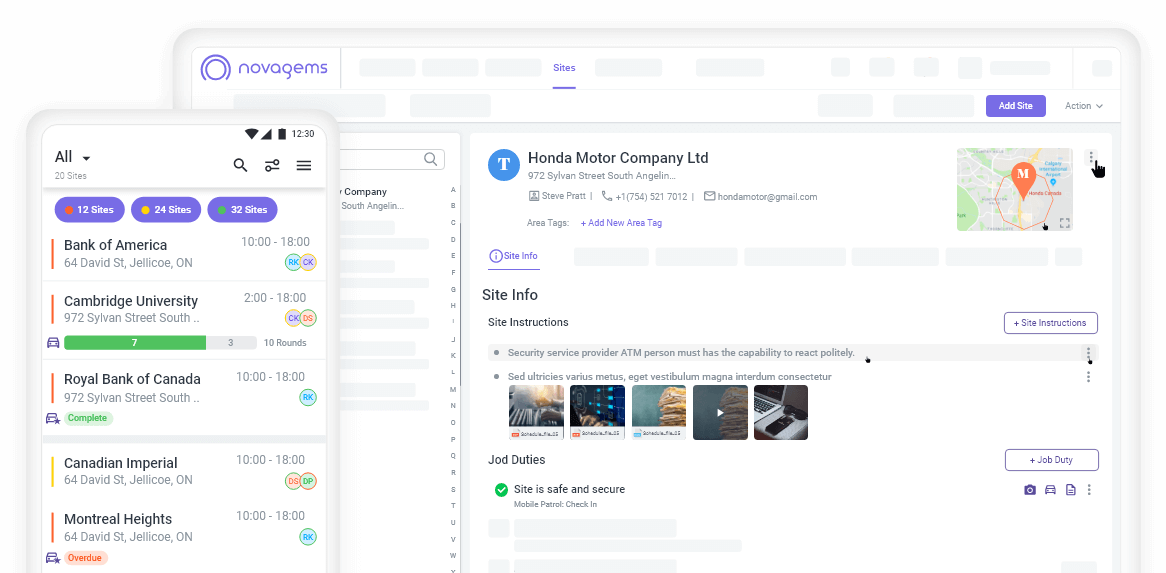
Security guard management software like Novagems automates credential tracking, storing license types and expiration dates for every guard, sending alerts before licenses expire or requalifications are due, and ensuring only properly licensed guards are scheduled at posts requiring specific credentials.
Florida vs. Other States: How Requirements Compare
| Requirement | Florida | California | Texas | New York |
|---|---|---|---|---|
| Unarmed training hours | 40 hours | 40 hours | 6 hours | 8-16 hours |
| Armed training hours | 28 hours | 14-16 hours | 45 hours | 47 hours |
| Online training allowed | Yes (Class D) | No | Partial | No |
| Temporary license | Yes (Class D) | No | No | No |
| Application processing | 10-30 days | 3-6 weeks | 2-4 weeks | 4-8 weeks |
| License term | 2 years | 2 years | 2 years | 2 years |
| Total cost (unarmed) | $175-$285 | $109-$150 | $35-$120 | $100-$200 |
Florida’s 40-hour training requirement ties with California as the most comprehensive in the US. However, Florida’s allowance of online training and temporary licensing makes the process more accessible.
Getting Started
The fastest path to a Florida security guard license:
- Class D (unarmed): Complete 40-hour training (available online), get fingerprinted, apply to FDACS. A temporary license may be available within days. Total cost: $175-$285.
- Class G (armed): Complete Class D + 28-hour firearms training with range qualification. Total cost: $497-$787.
If you are a security company owner managing guard licensing, scheduling, and operations, start a free 14-day trial with Novagems and see how automated credential tracking, GPS monitoring, and checkpoint tours work for your team.
Further Reading
- Types of Security Guard Services, pillar guide covering all 12 security service categories
- How to Price Security Guard Contracts, bill rates, margins, and contract pricing formulas
- Workforce Management for Security Companies, operations platform for security firms
- GPS Tracking and Geofencing, verified patrols and real-time guard location
- Start a Free 14-Day Trial, cancel anytime
- School & Campus Security Services. K-12 and university security
Frequently Asked Questions
How do I get a security guard license in Florida?
To get a Florida security guard license (Class D), you must be at least 18 years old, complete 40 hours of training at a state-licensed school, pass a criminal background check with fingerprinting, and submit your application to the Florida Department of Agriculture and Consumer Services (FDACS). Processing takes 10-30 days. A temporary license may be available while your application is being processed.
How much does a Florida security guard license cost?
A Florida Class D (unarmed) license costs approximately $175-$285 total, including the FDACS application fee (~$45), fingerprinting ($30-$40), and the required 40-hour training course ($100-$200). A Class G (armed) license adds approximately $250-$400 for the additional firearms training, fees, and range costs.
What is the difference between Class D and Class G security licenses in Florida?
Class D is for unarmed security officers and requires 40 hours of training. Class G is an additional armed security license that requires 28 hours of firearms training and allows you to carry a firearm on duty. You must hold a Class D license before applying for Class G, or apply for both simultaneously.
How long does it take to get a Florida security guard license?
FDACS typically processes Class D applications in 10-30 days. A temporary license may be available to begin working while your permanent license is processed. Class G applications take 2-4 weeks, and no temporary permit is issued for armed work.
Can I get a Florida security guard license with a criminal record?
It depends on the offense. FDACS conducts a criminal background check through fingerprinting. Disqualifying offenses include felonies, certain misdemeanors involving violence or dishonesty, drug offenses, and any crime involving a firearm. FDACS reviews each application individually.
Can I take Florida Class D training online?
Partially. Florida allows Class D training to be conducted through live online instruction via a secure website, provided that identity, attendance, and successful completion are verified by the instructor. The training must be from a state-licensed school. Some components may require in-person attendance depending on the school.
How do I renew my Florida security guard license?
Class D licenses renew every 2 years with a renewal fee of approximately $45. Class G licenses require annual firearms requalification (4 hours) and renew biennially with a fee of approximately $112. Submit renewal through FDACS before your license expires.
Does Florida have reciprocity with other states for security guard licenses?
No. Florida does not have reciprocity agreements with other states for security guard licenses. If you hold a license in another state and want to work in Florida, you must complete the full Florida licensing process including the 40-hour Class D training, background check, and FDACS application.
See Novagems in action
Join 500+ security & cleaning companies that replaced spreadsheets with Novagems.
✓ 14-day free trial · ✓ Free onboarding · ✓ Cancel anytime