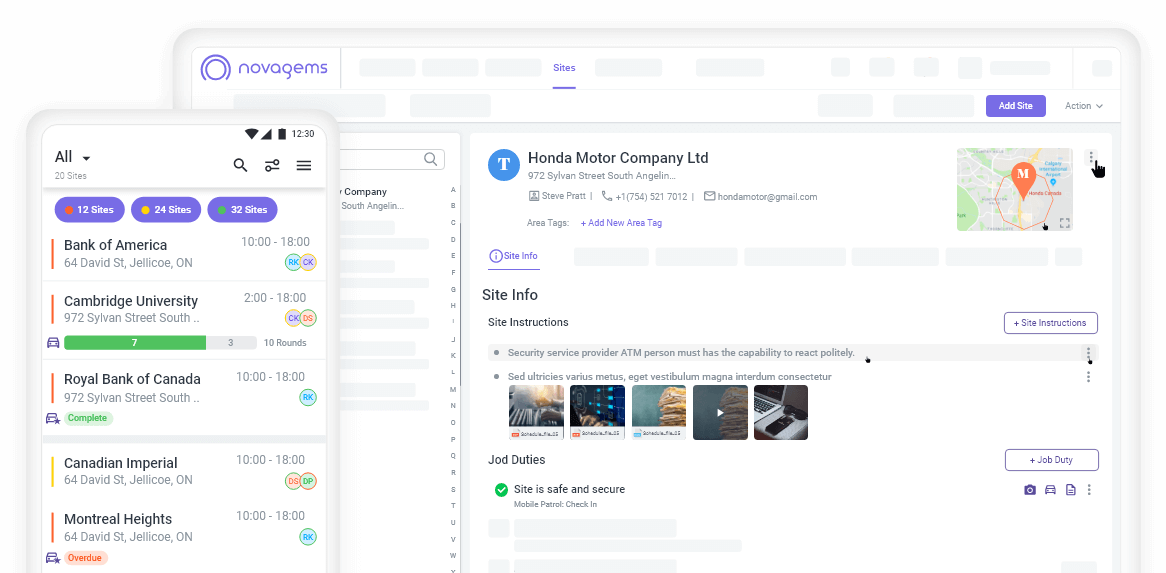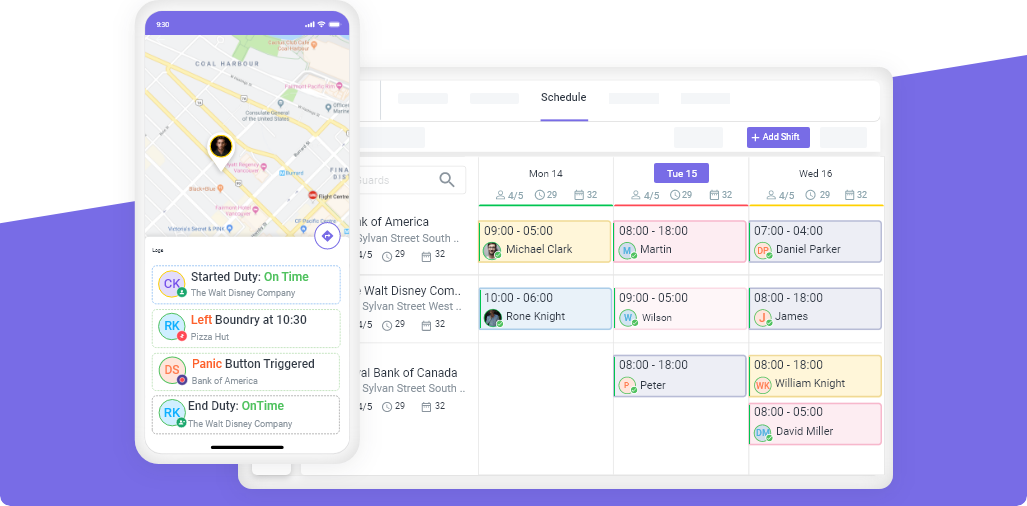
A guard tour system is software that verifies security guards completed their patrol routes by having them scan checkpoints at designated locations. Each scan creates a time-stamped digital record — proving the patrol happened, when it happened, and who did it.
Guard tour systems replace paper sign-in sheets, manual logs, and phone check-ins with automated, tamper-proof proof of patrol.
How a Guard Tour System Works
- Checkpoints are placed at key locations around a site — entrances, stairwells, parking areas, server rooms
- Guards scan each checkpoint using their smartphone (via NFC tap or QR code scan)
- The system records the guard’s name, location, and exact time of each scan
- Supervisors monitor patrol progress in real time from a dashboard
- Reports are generated automatically and can be shared with clients
If a guard misses a checkpoint or is late completing a round, the system alerts the supervisor immediately — rather than the client discovering the missed patrol the next morning.
Types of Guard Tour Systems
There are three main checkpoint technologies used in guard tour systems today:
NFC (Near Field Communication)
How it works: Guards tap their phone against a small NFC tag (a sticker or card) attached to a wall, door, or post.
Pros:
- Cannot be scanned from a distance — guard must physically be at the location
- Tags are small and discreet
- Works reliably indoors where GPS is unreliable
- Cost: NFC tags typically cost $0.50–$2.00 each
Cons:
- Requires a phone with NFC capability (most modern Android phones; iPhones with iOS 14+)
- Tags can be damaged in harsh environments
Best for: Indoor locations, high-security areas, sites where proof of presence matters most
QR Code
How it works: Guards scan a printed QR code posted at each checkpoint location.
Pros:
- Works on any smartphone with a camera
- No special hardware beyond printed codes
- Easy to replace if damaged
- Most affordable option
Cons:
- Can theoretically be photographed and scanned remotely (though good systems require real-time GPS matching)
- Less tamper-proof than NFC without GPS verification
Best for: Budget-conscious companies, outdoor sites, large sites with many checkpoints
GPS-Based Checkpoints
How it works: Instead of physical tags, checkpoints are defined as GPS coordinates. The guard’s phone must be within a set radius to “complete” the checkpoint.
Pros:
- No physical hardware to install or maintain
- Works for vehicle patrols covering large areas
- Easy to add or move checkpoints
Cons:
- GPS is unreliable indoors
- Less precise than NFC (a guard could be 50 metres away and still “check in”)
- Requires consistent data signal
Best for: Vehicle patrols, outdoor-only sites, large perimeters
Which Is Best?
Most modern guard tour systems — including Novagems — support all three methods, letting you choose the right technology for each site. NFC is generally considered the most reliable for indoor locations where precision matters; GPS works well for outdoor vehicle patrols.
What a Guard Tour System Includes
A complete guard tour system typically includes:
| Feature | What It Does |
|---|---|
| Mobile app | Guards use their phone to scan checkpoints and report incidents |
| Checkpoint management | Admin dashboard to create routes and set checkpoint sequences |
| Real-time monitoring | Supervisors see patrol progress live |
| Missed checkpoint alerts | Automatic notifications when a guard fails to scan on time |
| Incident reporting | Guards can log incidents with photos directly during a tour |
| Automated reports | Client-ready patrol reports generated automatically |
| Offline mode | Scans are saved locally and synced when connectivity returns |
Why Companies Use Guard Tour Systems
1. Proof of Patrol for Clients
The most common reason security companies implement guard tour systems is client retention. When a client asks “Can you prove your guard was at our building at 2 AM?", a guard tour system provides an instant, timestamped answer.
According to security industry operators, client requests for proof of patrol are one of the top three reasons contracts are lost when security companies can’t provide verifiable records.
2. Guard Accountability Without Micromanaging
Guard tour systems let supervisors verify patrol completion without being on-site. A supervisor managing 10 sites can monitor all of them from a single dashboard, receiving alerts only when something goes wrong.
3. Incident Documentation
Guards can report incidents directly from their patrol app, attaching photos and notes to the specific checkpoint where an incident occurred. This creates an accurate incident log tied to a specific location and time — far more useful than a handwritten report completed hours later.
4. Liability Protection
If a slip, fall, theft, or security incident occurs at a client’s property, a guard tour system provides a legal record of what was patrolled and when. Many security companies have avoided costly lawsuits by producing digital patrol records during litigation.
5. Reduce Missed Patrols
A study by the security industry indicates that manual patrol verification systems miss an estimated 15–25% of actual patrol failures because supervisors can’t catch every missed round. Automated guard tour systems catch every missed checkpoint.
Guard Tour System vs. GPS Tracking
Many people confuse guard tour systems with GPS tracking. They work differently:
| Guard Tour System | GPS Tracking | |
|---|---|---|
| Purpose | Verify patrol route completion | Monitor guard location continuously |
| How it works | Checkpoint scans at fixed locations | Continuous location data from phone/device |
| Best for | Proving patrols happened at specific spots | Monitoring guard movement and response time |
| Indoors | ✅ Works well (NFC/QR) | ❌ Often unreliable |
| Outdoors | ✅ Works well | ✅ Works well |
The two technologies complement each other. Guard tour systems prove a guard was at a specific location at a specific time. GPS tracking shows where a guard is continuously. Platforms like Novagems include both.
How to Implement a Guard Tour System
Step 1: Map Your Checkpoints
Walk each site and identify the locations that matter most — main entrance, back entrance, parking level, server room, fire exits. Aim for 6–15 checkpoints per site depending on size.
Rule of thumb: Space checkpoints so a complete patrol takes 20–45 minutes. Too few checkpoints and the system loses its accountability value. Too many and guards spend their shift scanning rather than observing.
Step 2: Install Checkpoint Hardware
- NFC: Order NFC tags and attach them to walls or surfaces at checkpoint locations. Test each one before going live.
- QR: Print QR codes from your software and mount them in weatherproof holders for outdoor locations.
- GPS: No hardware needed — just define coordinates in your admin dashboard.
Step 3: Set Up Patrol Routes
In your guard tour software, create named routes and assign which checkpoints belong to each route. Set the expected sequence and time window for each checkpoint (e.g., “Checkpoint 3 should be scanned within 90 minutes of checkpoint 2”).
Step 4: Train Your Guards
Guards need to understand how to:
- Open the mobile app and select their assigned route
- Scan checkpoints correctly
- Report incidents during a tour
- What happens if they miss a checkpoint
Training time is typically 15–30 minutes per guard.
Step 5: Configure Alerts
Set up supervisor alerts for:
- Missed checkpoints (guard didn’t scan within the expected window)
- Late round starts
- Incomplete rounds (not all checkpoints scanned)
- SOS alerts (panic button for lone worker safety)
Step 6: Share Reports With Clients
Set up automated client reports to send after each patrol cycle. Most clients want a weekly summary; high-security clients may want daily reports.
What to Look for in Guard Tour System Software
When evaluating guard tour software, ask these questions:
Does it work offline? Sites with poor connectivity (basement levels, remote locations, large warehouses) need a system that saves scans locally and syncs later. Not all systems support this.
Does it support multiple checkpoint types? Look for NFC, QR, and GPS support so you can choose the right technology for each site rather than being locked into one method.
How are alerts delivered? The fastest systems push alerts to a supervisor’s phone immediately when a checkpoint is missed. Some systems only show missed patrols in a next-day report — too late to act.
Can guards report incidents mid-tour? Guards should be able to log incidents with photos without leaving the patrol flow.
Are reports client-ready? Reports should be automatically formatted and brandable — not raw data exports that require manual formatting.
What does it cost? Pricing typically ranges from $50–$200/month for small companies to several hundred dollars per month for larger operations. NFC hardware (tags) adds a one-time cost of approximately $1–3 per checkpoint.
Frequently Asked Questions
What is a guard tour system?
A guard tour system is software that verifies security guards completed their patrol routes by requiring them to scan physical checkpoints (using NFC tags, QR codes, or GPS) at designated locations around a site. Each scan creates a time-stamped digital record that proves the patrol happened.
How much does a guard tour system cost?
Guard tour systems typically cost $50–$300/month depending on the number of guards and sites. NFC checkpoint hardware (tags) costs approximately $0.50–$2.00 per tag. QR code checkpoints cost almost nothing — just printing. GPS-based checkpoints require no hardware.
What is the difference between NFC and QR guard tours?
NFC guard tours require guards to physically tap their phone against a small NFC tag at each checkpoint — the tag cannot be scanned from a distance. QR tours require scanning a printed code with the phone camera. NFC is more tamper-proof; QR is less expensive and works on any camera-equipped phone.
Can a guard tour system work without internet?
The best guard tour systems — including Novagems — support offline mode. Guards can complete patrol scans without an internet connection, and the data syncs to the server automatically when connectivity returns. This is essential for sites with poor signal.
How do guard tour systems prevent fraud?
NFC tags cannot be scanned remotely — the guard must physically be present. GPS verification can be layered with QR codes to confirm location. Time-stamp verification detects impossible scan patterns (e.g., two checkpoints 10 minutes apart that would take 20 minutes to walk between). Most platforms also require guards to be logged in with their specific account.
What is a guard tour system used for?
Guard tour systems are used to: verify patrol route completion, generate proof-of-patrol reports for clients, document incidents during patrols, hold guards accountable without micromanaging, and protect security companies from liability claims.
Ready to Implement a Guard Tour System?
Novagems includes guard tour management with NFC, QR, and GPS checkpoint support — alongside scheduling, real-time GPS tracking, incident reporting, and automated client reports.
Start your 14-day free trial →
Set up your first patrol route in under 30 minutes.
Last updated: March 2026
See Novagems in action
Join 1,000+ security & cleaning companies that replaced spreadsheets with Novagems.
✓ 14-day free trial · ✓ Free onboarding · ✓ Cancel anytime