To get security guard contracts, focus on three channels: direct outreach to commercial property managers (fastest), government RFPs through SAM.gov and state procurement sites (longest terms), and networking through industry associations like BOMA and ASIS (best for referrals). The average security company wins its first contract within 1-3 months of active prospecting, and companies with professional technology (GPS tracking, client reporting, digital reporting) win contracts at significantly higher rates than those using manual processes.
Every security company owner eventually asks the same question: “I have guards, I have licenses, I have insurance, how do I actually get contracts?”
The answer is not one strategy. It is a system. The security companies that grow consistently use multiple channels simultaneously, direct sales, government bids, referrals, and online presence, and they invest in the operational capabilities (technology, reporting, compliance) that make clients say yes.
This guide covers 10 proven strategies for getting security guard contracts in 2026, including where to find opportunities, how to price your services, what to include in proposals, and how to close the deal.
The Security Contract Landscape in 2026
Before diving into strategies, understand where contracts come from:
| Contract Type | % of Market | Avg. Contract Value | Typical Term | Sales Cycle |
|---|---|---|---|---|
| Commercial property | 40% | $50,000-$500,000/yr | 1-3 years | 2-6 weeks |
| Government (federal) | 20% | $100,000-$5M/yr | 1-5 years | 30-90 days |
| Government (state/local) | 15% | $30,000-$1M/yr | 1-3 years | 30-60 days |
| Event security | 10% | $2,000-$50,000/event | Per-event | 1-4 weeks |
| Construction site | 8% | $20,000-$200,000/project | Project-based | 1-3 weeks |
| Residential/HOA | 7% | $15,000-$100,000/yr | 1 year | 2-4 weeks |
Key insight: 55% of the market is commercial property and government, both favor companies with professional operations, documented processes, and technology capabilities.
Strategy 1: Target Commercial Property Managers Directly
This is the single fastest path to contracts for most security companies.
Why property managers: They manage dozens or hundreds of properties, each needing security. Win one property manager’s trust and you may get 5-10 sites over time. They also switch security vendors regularly, industry average contract turnover is 2-3 years.
How to reach them:
- Identify property management companies in your market, search Google Maps, LinkedIn, and local business directories for “commercial property management [city]”
- Find the decision-maker, titles to look for: Director of Security, VP of Operations, Property Manager, Facilities Director
- Send a personalized introduction, not a generic sales email. Reference their specific properties. Mention a security concern relevant to their portfolio.
- Offer a free site security assessment, walk the property, identify vulnerabilities, and present a professional report. This costs you 2 hours and demonstrates expertise before asking for anything.
- Follow up within 48 hours, replying to emails or calls within 1 hour differentiates you from 90% of security vendors
Where to network with property managers:
| Organization | What It Is | Why It Matters |
|---|---|---|
| BOMA (Building Owners and Managers Association) | Local chapters in every major metro | Property managers attend monthly events |
| IFMA (International Facility Management Association) | Facility management professionals | Decision-makers for security contracts |
| IREM (Institute of Real Estate Management) | Property management certification body | High-value connections |
| Local Chamber of Commerce | General business networking | Smaller property owners attend |
Strategy 2: Bid on Government RFPs
Government contracts offer the longest terms (1-5 years), most predictable revenue, and often the largest contract values. The trade-off: more paperwork, longer sales cycles, and prevailing wage requirements.
Where to Find Government Security RFPs
| Platform | Scope | Cost |
|---|---|---|
| SAM.gov | All federal contracts | Free |
| State procurement portals | State government contracts | Free |
| City/county purchasing websites | Local government contracts | Free |
| BidNet Direct | Aggregates government bids | Paid subscription |
| GovWin (by Deltek) | Federal + state bids with intelligence | Paid subscription |
| FindRFP | Aggregated RFPs with search filters | Paid subscription |
Start with SAM.gov, it’s free and lists every federal security contract. Search for NAICS codes:
- 561612. Security Guards and Patrol Services
- 561613. Armored Car Services
- 561621. Security Systems Services
Government Contract Requirements
Most government security contracts require:
- Active state security company license
- General liability insurance ($1M-$2M minimum)
- Workers’ compensation insurance
- Fidelity bond (for some contracts)
- SAM.gov registration (free, required for all federal contracts)
- Proof of payroll capability
- Past performance references (minimum 2-3 similar contracts)
Set-Aside Opportunities
Federal contracts under $250,000 are often set aside for small businesses. Additional advantages if you qualify:
- SBA Small Business certification
- 8(a) Business Development program
- HUBZone certification
- Service-Disabled Veteran-Owned Small Business (SDVOSB)
- Women-Owned Small Business (WOSB)
- Minority Business Enterprise (MBE)
These certifications significantly reduce competition, some set-asides have only 3-5 bidders instead of 20+.
Strategy 3: Build a Referral Engine
The highest-converting leads in the security industry come from referrals. A recommendation from a trusted colleague converts at 3-5x the rate of a cold outreach.
How to build a referral system:
- Ask every satisfied client for referrals, specifically: “Do you know other property managers who might benefit from the service we provide you?”
- Offer a referral incentive, one month of free additional coverage, a discount, or a gift card
- Build referral partnerships with complementary businesses:
- Fire alarm and security system installers
- Commercial cleaning companies
- Commercial real estate brokers
- Insurance brokers who serve property managers
- Construction general contractors
- Make it easy, provide referral partners with your one-pager, business cards, and a direct line to your sales contact
Strategy 4: Optimize Your Online Presence
In 2026, the first thing every potential client does is Google your company name. What they find determines whether they take your call.
Minimum online presence:
| Channel | Priority | Action |
|---|---|---|
| Google Business Profile | Critical | Complete profile with photos, services, hours, reviews |
| Company website | Critical | Professional, mobile-friendly, with service pages and contact form |
| Google Reviews | Critical | Minimum 10 reviews, 4.5+ star average |
| LinkedIn company page | High | Active page with company updates and team profiles |
| Industry directories | Medium | ASIS, local security associations, BBB |
What clients look for on your website:
- Services offered with specific details (not vague marketing copy)
- Service areas (cities and states you cover)
- Client testimonials or case studies
- Insurance and licensing documentation
- Technology capabilities (GPS tracking, reporting, client reporting)
- Contact information (phone number visible on every page)
Strategy 5: Offer Free Site Security Assessments
This is the single most effective door-opener in the security industry.
How it works:
- Contact a prospect and offer a complimentary security assessment of their property
- Walk the site for 1-2 hours, document entry points, lighting gaps, patrol routes, camera blind spots
- Deliver a professional written report within 48 hours
- Include recommendations, some the client can implement themselves, and some that require security services
- Follow up with a proposal for the services they need
Why it works: You are providing genuine value before asking for money. The assessment demonstrates your expertise, professionalism, and attention to detail. Prospects who accept a free assessment convert at 40-60%, far higher than cold sales.
Strategy 6: Price Your Services Correctly
Wrong pricing kills more contracts than bad proposals. Price too high and you lose the bid. Price too low and you either can’t deliver or lose money.
The Security Guard Pricing Formula
Bill Rate = Guard Pay + Payroll Burden + Overhead + Profit Margin
| Component | How to Calculate | Typical Range |
|---|---|---|
| Guard pay rate | Market rate for your area and service type | $16-$25/hr |
| Payroll burden | FICA + FUTA + SUTA + workers’ comp + benefits (25-35% of pay) | $4-$8.75/hr |
| Overhead | Software, admin, vehicles, insurance, office (typically $2-4/hr per guard) | $2-$4/hr |
| Profit margin | Your target margin (10-20%) | $2.50-$7.50/hr |
| Bill rate | Sum of all above | $24.50-$45.25/hr |
Example Pricing
| Service Type | Guard Pay | Burden (30%) | Overhead | Margin (15%) | Bill Rate |
|---|---|---|---|---|---|
| Unarmed standing guard | $18 | $5.40 | $2.60 | $3.90 | $29.90 |
| Armed guard | $24 | $7.20 | $3.00 | $5.13 | $39.33 |
| Mobile patrol | $20 | $6.00 | $4.00 | $4.50 | $34.50 |
| Event security | $22 | $6.60 | $3.00 | $4.74 | $36.34 |
Critical rule: Never price below your fully burdened cost. Winning a contract at a loss is worse than not winning it.
Strategy 7: Write Proposals That Win
A proposal is your company on paper. Here is what separates proposals that win from proposals that get filed in the trash.
Winning Proposal Structure
| Section | What to Include | Why It Matters |
|---|---|---|
| Cover letter | Address the client by name, reference their specific property, state why you are the right fit | Shows you did homework, not a copy-paste |
| Company overview | Years in business, number of guards, service area, licenses, insurance | Establishes credibility |
| Understanding of need | Restate the client’s requirements in your own words | Proves you read and understood the RFP |
| Scope of work | Exact services: hours, guard count, post types, patrol frequencies | Removes ambiguity |
| Guard qualifications | Training standards, certifications, background check process | Builds confidence in your personnel |
| Technology | GPS tracking, client reporting, digital reporting with sample reports | Differentiates you from paper-based competitors |
| Pricing | Clear breakdown, hourly rate, estimated monthly/annual cost, what is included | Transparency builds trust |
| References | 2-3 current clients in similar industries with contact info | Social proof that you deliver |
| Insurance certificates | Current COI showing coverage limits | Required for virtually all bids |
Proposal Mistakes That Lose Contracts
- Generic cover letter that could be sent to anyone
- Missing or vague pricing (client has to guess what they will pay)
- No technology or reporting capabilities mentioned
- No references or testimonials
- Submitted after the deadline
- Formatting errors, typos, wrong client name
Strategy 8: Leverage Technology as a Sales Tool
In 2026, clients expect digital operations. Security companies that demonstrate technology during the sales process win contracts at significantly higher rates.
What to show during proposals and presentations:
| Technology | How to Demonstrate | Client Impact |
|---|---|---|
| GPS tracking | Show a sample live map with guard locations | “You’ll see where every guard is, 24/7” |
| Client reporting | Give prospect a demo login | “You log in and see your reports anytime” |
| Patrol reports | Share a sample report with GPS routes and timestamps | “This is what you receive after every shift” |
| Incident reporting | Show a sample incident report with photos | “Your guards document everything professionally” |
| Checkpoint tours | Show proof-of-patrol with checkpoint scans | “Every patrol point is verified, not estimated” |
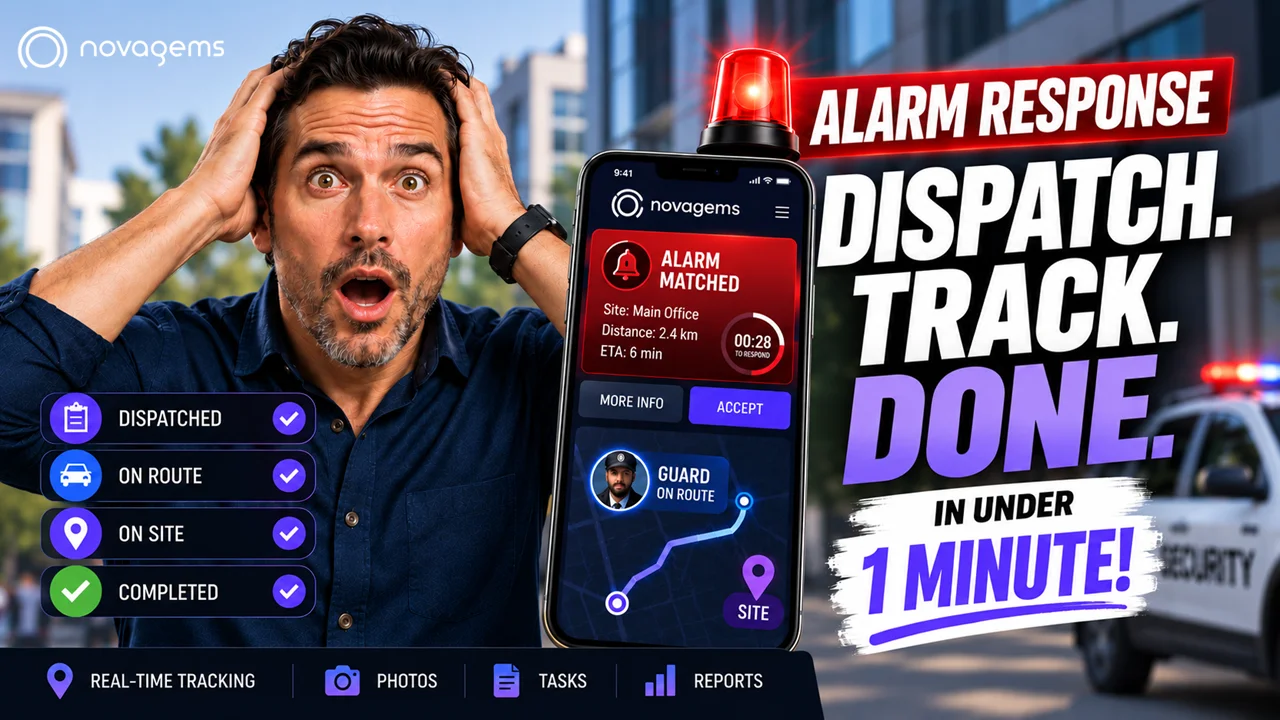
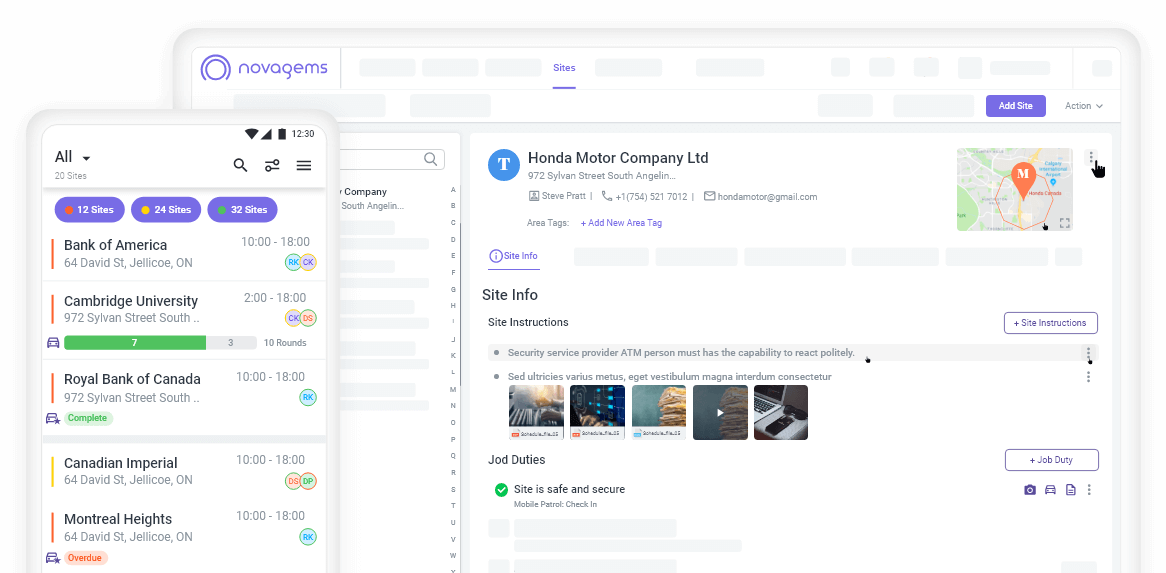
Novagems provides all of these capabilities. GPS tracking, client reporting, automated reports, incident reporting, and checkpoint tours, in one platform. Companies using Novagems in proposals report that technology demonstrations are the single most effective differentiator in competitive bids.
Strategy 9: Start Small and Scale
New security companies often make the mistake of bidding on large contracts they cannot fulfill. Start with contracts you can execute flawlessly, then use those as stepping stones.
Recommended progression:
| Stage | Target Contract Size | Goal |
|---|---|---|
| Year 1 | 1-5 guards per site, single-site contracts | Build track record, collect testimonials, refine operations |
| Year 2 | 5-15 guards, multi-site clients | Demonstrate ability to manage multiple locations |
| Year 3+ | 15-50+ guards, government bids, enterprise clients | Scale with proven operational systems |
Each successful contract becomes a reference for the next, larger one.
Strategy 10: Retain Clients to Fuel Growth
The cheapest contract is the one you already have. Retaining existing clients requires less effort than winning new ones, and retained clients provide referrals, testimonials, and expansion opportunities.
Retention strategies:
- Monthly check-ins, call or meet with every client once a month to discuss performance
- Proactive reporting, send reports before clients ask for them
- Address issues within 24 hours, when something goes wrong, speed of response matters more than perfection
- Offer service expansion, when a client is happy, ask: “Do you have other properties that need coverage?”
- Maintain guard consistency, clients want to see the same guards, not a rotating cast
Security companies with strong client retention (90%+ renewal rate) grow faster than companies focused only on new business.
Quick Reference: 10 Strategies at a Glance
| # | Strategy | Best For |
|---|---|---|
| 1 | Target property managers directly | Fastest path to first contracts |
| 2 | Bid on government RFPs | Largest, longest-term contracts |
| 3 | Build a referral engine | Highest conversion rate |
| 4 | Optimize online presence | Credibility and inbound leads |
| 5 | Offer free site assessments | Best door-opener |
| 6 | Price services correctly | Competitive without losing money |
| 7 | Write winning proposals | Close more of the bids you submit |
| 8 | Leverage technology in sales | Differentiate from competitors |
| 9 | Start small and scale | Build track record for bigger contracts |
| 10 | Retain clients to fuel growth | Cheapest source of revenue |
Getting Started
You don’t need all 10 strategies working at once. Start with three:
- Identify 20 property management companies in your market and reach out with a free security assessment offer (Strategy 1 + 5)
- Register on SAM.gov and set up alerts for security guard contracts in your state (Strategy 2)
- Ask your current clients for one referral each (Strategy 3)
If you need the technology to back up your proposals with GPS tracking, client reporting, and automated reporting, start a free 14-day trial with Novagems and have your demo-ready in a day.
Further Reading
- Types of Security Guard Services, pillar guide covering all 12 security service categories
- How to Price Security Guard Contracts, bill rates, margins, and contract pricing formulas
- Workforce Management for Security Companies, operations platform for security firms
- GPS Tracking and Geofencing, verified patrols and real-time guard location
- How to Get Security Contracts This Holiday Season, seasonal sales playbook for retail and events
- How Security Guard Companies Can Win Local Government Contracts, municipal RFP strategies and certifications
- Start a Free 14-Day Trial, cancel anytime
- Event Security Services, event pricing, staffing, and crowd management
Frequently Asked Questions
How do I get my first security guard contract?
Start with your personal network, property managers, business owners, and general contractors you already know. Offer a free site security assessment to open doors. Bid on small commercial contracts (single-site, 1-2 guards) to build a track record and collect testimonials. Most first contracts come from direct outreach, not inbound marketing.
Where can I find security guard contracts to bid on?
Government contracts are posted on SAM.gov (federal), state procurement portals, and city/county purchasing websites. Commercial contracts are found through direct outreach to property management companies, networking at BOMA and IFMA chapters, and industry platforms like BidNet, FindRFP, and GovWin. Many commercial contracts are never publicly posted, they go to companies that build relationships first.
How much should I charge for a security guard contract?
Use this formula: Bill Rate = Guard Pay Rate + Payroll Burden (25-35%) + Overhead + Profit Margin (10-20%). For example: $18/hr pay + $5.40 burden + $2.60 overhead + $4 margin = $30/hr bill rate. Average billing rates in the US range from $22-$35/hr for unarmed guards and $30-$50/hr for armed guards.
How do I write a security guard proposal?
A winning proposal includes: a personalized cover letter referencing the client's specific needs, your company background with relevant experience, a detailed scope of work matching the RFP requirements, a clear pricing breakdown, guard qualifications and training details, technology capabilities (GPS tracking, reporting), insurance and licensing documentation, and references from similar clients.
What types of security contracts are most profitable?
Recurring commercial contracts (office buildings, retail centers, warehouses) provide the most stable revenue. Event security commands the highest hourly rates ($35-$75/hr) but is inconsistent. Government contracts offer long terms (1-5 years) but have lower margins due to prevailing wage requirements. The most profitable approach is a base of recurring commercial contracts supplemented by event and government work.
How long does it take to win security guard contracts?
Commercial contracts typically take 2-6 weeks from initial contact to signed agreement. Government contracts take 30-90 days from RFP response to award. Your first contract as a new company usually takes 1-3 months of active prospecting. After building a track record, referrals and repeat business shorten the sales cycle significantly.
Do I need insurance to get security guard contracts?
Yes. Most clients require proof of general liability insurance ($1M-$2M per occurrence), workers' compensation, and often commercial auto insurance if you operate patrol vehicles. Many RFPs list specific minimum coverage amounts. Without insurance documentation, you will be disqualified from virtually all commercial and government bids.
How can technology help me win security contracts?
Security companies that demonstrate real-time GPS tracking, digital incident reporting, client reporting, and automated patrol reports win contracts over competitors relying on paper logs and phone calls. During proposals, showing a sample GPS patrol report or client reporting demo differentiates you immediately. Technology is now a baseline expectation, not a differentiator.
See Novagems in action
Join 500+ security & cleaning companies that replaced spreadsheets with Novagems.
✓ 14-day free trial · ✓ Free onboarding · ✓ Cancel anytime