
To start a security guard company in Illinois you must hold a Private Security Contractor Agency license from the Illinois Department of Financial and Professional Regulation (IDFPR). The path: appoint a full-time licensee-in-charge (a licensed Private Security Contractor), form your business, carry at least $1,000,000 in general liability insurance, get the agency licensed through IDFPR, then hire guards who each hold a PERC card. Budget roughly $1,500 in IDFPR license fees to launch and plan several weeks to a few months for approval.
Illinois, anchored by the Chicago metro, is one of the largest security markets in the Midwest, and demand for licensed guards keeps growing (U.S. Bureau of Labor Statistics). Illinois also runs a structured licensing system through IDFPR, with a personal PERC for every guard and a Private Security Contractor Agency license for the company. This guide covers the full journey, from your first decision to your first signed contract.
Free resource
The Illinois Security Startup Checklist
- Every step across 6 phases, from your licensee-in-charge to your first contract
- Tick items off online, your progress saves automatically
- Download the whole thing as a printable PDF
Decide what security services you'll offer
You do not have to pick a single niche. Plenty of Illinois firms offer several services at once, then lean into whichever wins the most contracts. The point of this step is to decide what you can realistically staff and sell on day one.
- Common service lines: static guards, mobile patrol, construction-site security, retail and loss prevention, events, residential and HOA patrol, and healthcare.
- Armed or unarmed: armed officers need a Firearm Control Card (FCC) and a valid FOID card plus extra firearm training, so most new companies launch unarmed and add armed services later.
Appoint your licensee-in-charge (a licensed Private Security Contractor)
This is the gate. IDFPR will not issue a Private Security Contractor Agency license without a full-time licensee-in-charge, an individually licensed Private Security Contractor legally responsible for the company's security operations. That person must:
- Be at least 21 years old and hold a high school diploma or equivalent.
- Have at least three years of experience in a security-related field, or an equivalent combination of education and experience, as required by the Act.
- Pass the IDFPR Private Security Contractor licensing exam and clear a fingerprint-based background check.
If you do not personally have the three years of experience, you can hire or partner with someone who qualifies and name them as your full-time licensee-in-charge.
Name your company
You will register your company name with the state and use it on your IDFPR agency application. Pick something professional and available before you file.
- Check the name is free on the Illinois Secretary of State business search, and grab the matching domain.
- Avoid words that imply law enforcement (such as "police" used misleadingly), which regulators can reject.
Choose your business structure (Inc or LLC)
Security is a high-liability industry, so the structure you choose matters. Many Illinois security firms form a corporation to put the strongest shield between the business and the owner's personal assets; an LLC is simpler and still separates liability, while a sole proprietorship offers no protection at all. Talk to an attorney or CPA about what fits your situation.
- Register your entity with the Illinois Secretary of State.
- Get a free federal EIN from the IRS.
- Open a business bank account and obtain your local city or county business license.
Get your Private Security Contractor Agency license (IDFPR)
With your licensee-in-charge and business in place, apply for the agency license through IDFPR Online Services. Plan for the full cost, not just the headline fee.
- Private Security Contractor (individual) license: $500, for the licensee-in-charge.
- Private Security Contractor Agency license: $1,000 for the company.
- Fingerprinting: a livescan vendor fee on top, plus your insurance and business-formation costs.
- Timeline: IDFPR does not publish a fixed processing time, so plan for several weeks to a few months once fingerprints clear.
Your Illinois licensing path
Get the right insurance
IDFPR will not issue your agency license without proof of insurance, and your clients will ask for it too.
- General liability (required by IDFPR): a minimum of $1,000,000 of commercial general liability coverage. You must show proof of insurance before the agency license is issued.
- Client requirements often go higher: many commercial contracts ask for $1M per occurrence and $2M aggregate, so quote that when you price insurance.
- Workers' compensation: legally required in Illinois the moment you hire your first guard.
- Commercial auto: needed if you run mobile patrol or company vehicles.
Hire and license your guards
Every guard you employ in Illinois must hold a valid PERC (Permanent Employee Registration Card) issued by IDFPR before they work a shift.
- Training: 20 hours of basic security training, with additional training after hire and an annual refresher as required by the Act.
- Background check: each guard clears a fingerprint-based background check through IDFPR.
- Cost: the PERC application fee is $55, plus the livescan fingerprinting fee and the training course. Armed guards additionally need a Firearm Control Card (FCC) and a FOID card.
For the full breakdown, see our guide to Illinois security guard license requirements.
Price your services and bid on contracts
Underpricing is the fastest way to fail in contract security. Build your hourly bill rate from the ground up so every shift is profitable.
- Start with true cost: guard wage + payroll taxes + workers' comp + general liability + uniforms and equipment.
- Add overhead and margin: your office, software, recruiting, and a profit margin that survives a bad payroll cycle.
- Write clear proposals: spell out scope, post orders, hours, rates, and what is included so clients compare value, not just price.
Not sure where to land? Use our free security guard pricing calculator to set a defensible bill rate in minutes.
Win your first clients
A license lets you operate; sales is what keeps the lights on. Your first contracts usually come from close to home.
- Where first deals come from: local property managers, construction firms, retailers, event organizers, and your own network and referrals.
- Look credible fast: a simple website, a Google Business Profile, clean uniforms, and a one-page capability sheet.
- Sell proof, not promises: clients want to know you will actually cover the post and prove the patrols happened.
Set up the systems you'll need to run it
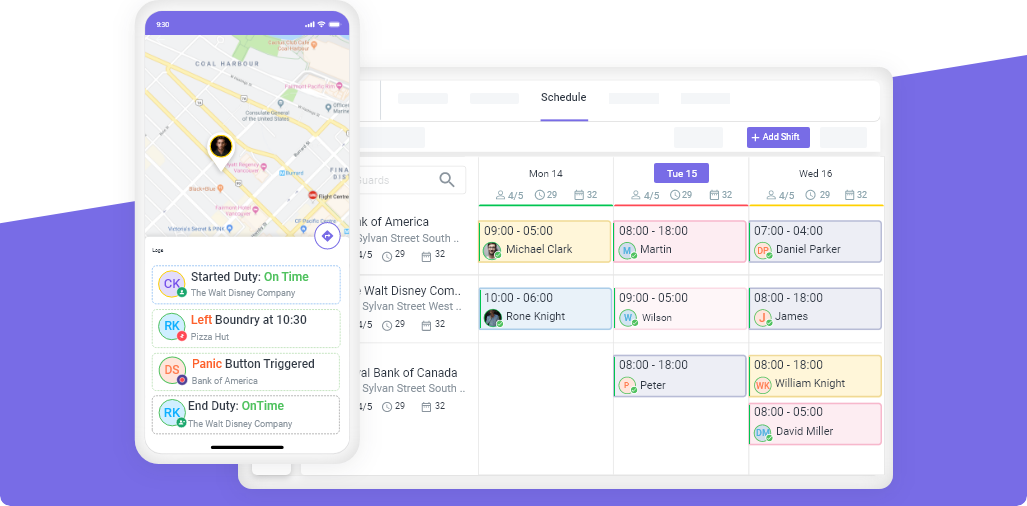
Once contracts start, manual scheduling and paper reports break down fast. The right software is also what clients increasingly ask for as proof of service.
- Scheduling so posts are always covered and overtime stays under control.
- GPS-verified clock-in and checkpoint tours to prove guards were on site and patrols happened.
- Incident reports and payroll-ready timesheets so billing and pay are accurate.
Novagems gives new Illinois operators one app for guard scheduling, GPS-verified clock-in, checkpoint tours, and incident reports, so you look established from your very first contract.