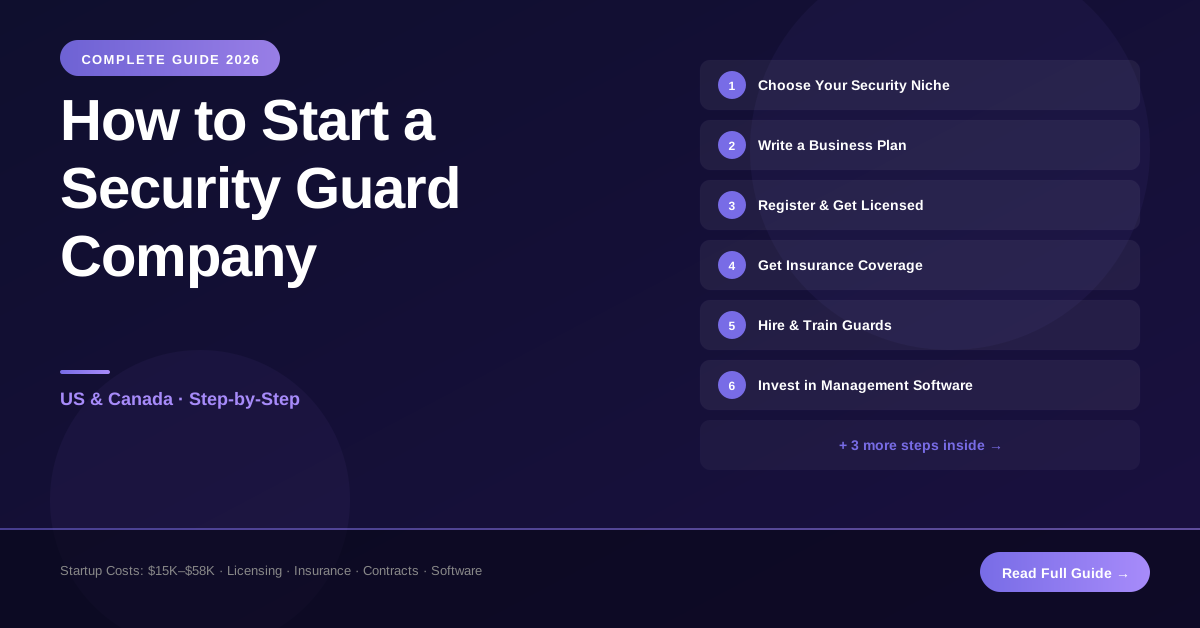
Starting a security guard company is one of the more accessible businesses you can launch in 2026 — but “accessible” doesn’t mean easy. The private security industry in the US and Canada generates over $50 billion annually, and demand continues to climb as businesses, property managers, and event organizers prioritize safety. There’s real money here. But the companies that fail (and many do within the first two years) almost always fail for the same reasons: they skip the licensing homework, underprice their services, or try to run a professional operation with spreadsheets and phone calls.
This guide covers everything you need to go from zero to your first signed contract. No fluff, no generic advice — just the specific steps, costs, and requirements for starting a security guard company in the United States and Canada in 2026.
Is Starting a Security Guard Company Profitable in 2026?
Short answer: yes, if you run it like a real business.
The Bureau of Labor Statistics projects security guard employment to grow 6% through 2032, faster than the average for all occupations. The Canadian security industry is growing at a similar pace, driven by urbanization, commercial construction, and increased liability awareness among property owners.
Here are the numbers that matter:
- Average billing rate for a uniformed guard: $22–$35/hour (US), $20–$30 CAD/hour (Canada)
- Average pay rate for guards: $14–$20/hour (US), $17–$22 CAD/hour (Canada)
- Gross margin on guard services: 25–40% after direct labor costs
- Net profit margin for well-run companies: 8–15%
- Break-even point for most startups: 6–12 months with 3–5 recurring contracts
The math works. A company billing 10 full-time-equivalent guards at $25/hour generates roughly $520,000 in annual revenue. After paying guards, insurance, overhead, and taxes, a 10% net margin puts $52,000 in your pocket — and that’s before you scale. Companies with 50+ guards routinely clear $200,000–$500,000 in annual profit.
The key differentiator between profitable and struggling companies isn’t size — it’s operational efficiency. Companies using security management software to automate scheduling, track patrols, and generate client reports operate at significantly higher margins than those managing everything manually.
Step 1: Choose Your Security Niche
Don’t try to be everything to everyone on day one. The security companies that grow fastest pick a niche, dominate it locally, and then expand.
Common Security Niches
| Niche | Avg. Billing Rate (US) | Contract Type | Barrier to Entry |
|---|---|---|---|
| Commercial property (offices, retail) | $22–$28/hr | Recurring monthly | Low |
| Construction site security | $20–$26/hr | Project-based (weeks–months) | Low |
| Event security | $28–$45/hr | Per-event | Medium |
| Residential community/HOA | $20–$25/hr | Recurring monthly | Low |
| Healthcare facility security | $24–$32/hr | Recurring monthly | Medium |
| Executive protection | $50–$150/hr | Per-engagement | High |
| Mobile patrol | $18–$24/hr per patrol | Recurring monthly | Low |
| Loss prevention (retail) | $22–$30/hr | Recurring monthly | Medium |
Best niches for startups: Commercial property security and construction site security have the lowest barriers to entry, the shortest sales cycles, and the most predictable revenue. Many new companies start here and add services like mobile patrol or event security as they grow.
Highest-margin niches: Executive protection and event security command premium rates, but they require specialized training, higher insurance, and more experienced staff.
Pick your niche based on three factors: (1) what you have experience in, (2) what’s in demand in your local market, and (3) what you can staff reliably.
Step 2: Write a Business Plan
You don’t need a 50-page MBA thesis. You need a clear document that answers these questions:
- What services will you offer? (Standing guard, mobile patrol, event security, etc.)
- Who is your target client? (Property managers, construction companies, event planners, etc.)
- What geographic area will you serve? (Start with a 30-mile radius — guards won’t commute far for $16/hour.)
- How will you price your services? (Research competitors’ published rates in your area.)
- What are your startup costs? (See the breakdown below.)
- How will you find your first 3–5 clients?
- What’s your 12-month revenue projection?
If you’re seeking a bank loan or SBA financing, you’ll need a formal business plan. The SBA (sba.gov) has free templates. For Canadian entrepreneurs, the BDC (bdc.ca) offers equivalent resources.
One thing most guides don’t tell you: Your business plan should include a technology section. Clients in 2026 expect real-time reporting, GPS-verified patrols, and digital incident reports. If your plan says “we’ll use paper logs and phone check-ins,” sophisticated clients will pass.
Step 3: Register Your Business (LLC vs Corp)
Most security company startups choose one of two structures:
LLC (Limited Liability Company) — Best for most startups. Protects your personal assets, offers tax flexibility (pass-through taxation), and requires minimal paperwork. Formation costs range from $50 (Kentucky) to $500 (Massachusetts).
S-Corporation — Better once you’re earning $60,000+ in annual profit. Allows you to pay yourself a reasonable salary and take remaining profits as distributions, potentially saving on self-employment taxes.
C-Corporation — Rarely needed for startup security companies. Consider this only if you plan to raise outside investment.
Registration Checklist
- Choose and register your business name (check your state’s Secretary of State database)
- File LLC/Corp formation documents with your state or province
- Get an EIN (Employer Identification Number) from the IRS — free, takes 5 minutes online
- Register for state/provincial tax accounts (sales tax, payroll tax, unemployment insurance)
- Open a dedicated business bank account (never mix personal and business funds)
- Get a business address (PO Box or virtual office works fine to start)
In Canada: Register federally through Corporations Canada or provincially through your province’s registry. You’ll need a Business Number (BN) from the CRA instead of an EIN.
Budget $500–$1,500 total for business registration, including filing fees and a basic operating agreement prepared by a local attorney.
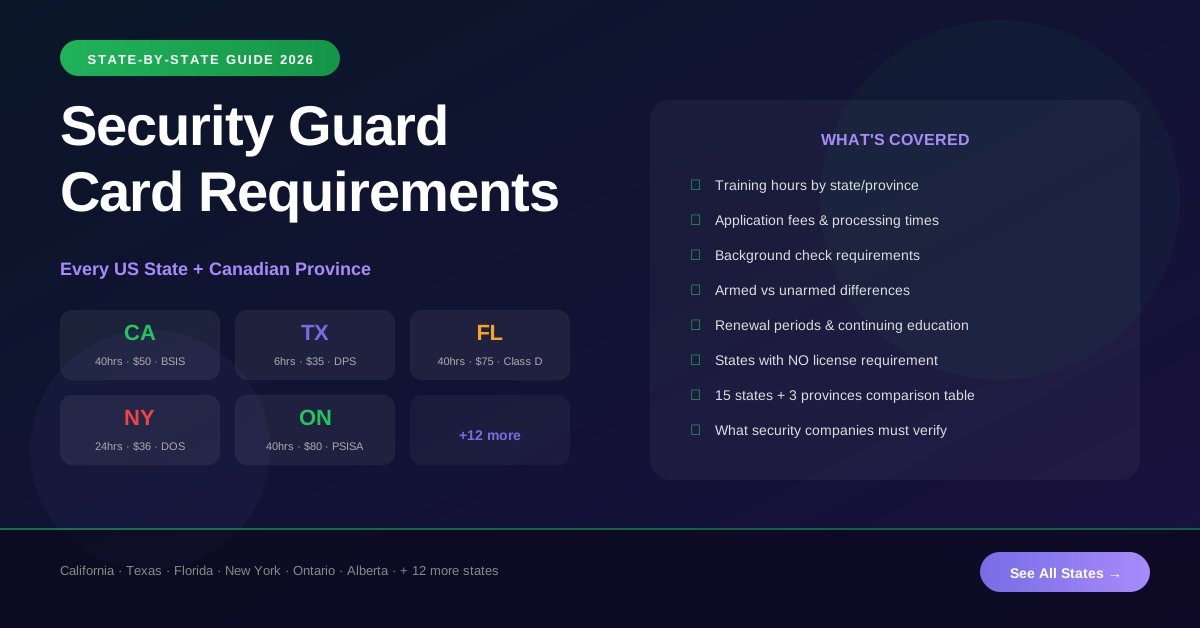
Step 4: Get Licensed (State-by-State Requirements)
This is where most aspiring security company owners get stuck — and where cutting corners will kill your business. Operating without a proper license is a criminal offense in most jurisdictions, and it invalidates your insurance.
Every state has different requirements. Here are the four largest markets:
California (BSIS — Bureau of Security and Investigative Services)
- License required: Private Patrol Operator (PPO) License
- Experience requirement: 1 year of security experience as a guard, law enforcement, or military
- Background check: LiveScan fingerprinting, FBI/DOJ check
- Exam: Written PPO exam (administered by PSI)
- Insurance required: $1M general liability, $1M workers’ comp
- Application fee: $600 initial, $575 biennial renewal
- Processing time: 60–90 days
- Individual guard requirement: Each guard needs a BSIS Guard Card ($50, 40 hours of training)
California is one of the strictest states. Don’t start your application until you have your insurance quotes in hand — BSIS won’t process without proof of coverage.
Texas (DPS — Department of Public Safety, Private Security Bureau)
- License required: Security Services Contractor License (Level C)
- Experience requirement: 2 years of security-related experience (can include military or law enforcement)
- Background check: Fingerprinting, FBI check
- Exam: None for company license (but your commissioned officers need separate licensing)
- Insurance required: $1M general liability
- Application fee: $500 (2-year license)
- Processing time: 30–45 days
- Individual guard requirement: Each guard must register with DPS ($35 fee, Level II training)
Texas is relatively straightforward. The biggest delay is usually the FBI background check, which can take 3–4 weeks.
Florida (FDACS — Department of Agriculture and Consumer Services)
- License required: Class “B” Security Agency License
- Experience requirement: Company manager must have a Class “D” Security Officer license with 2 years of experience OR a Class “MB” Manager license
- Background check: Electronic fingerprinting, FBI/FDLE check
- Exam: None for agency license
- Insurance required: $300,000 general liability (lower than most states)
- Application fee: $450 (2-year license)
- Processing time: 30–60 days
- Individual guard requirement: Class “D” license ($45, 40 hours of training)
Florida’s insurance minimum is low, but most commercial clients will require you to carry $1M regardless. Budget for the higher amount.
New York (DOS — Department of State)
- License required: Watch, Guard or Patrol Agency License
- Experience requirement: 2 years as a licensed watch, guard, or patrol agent OR equivalent experience in law enforcement
- Background check: Fingerprinting, FBI/DCJS check
- Exam: Written exam administered by DOS
- Insurance required: $500,000 surety bond
- Application fee: $1,100 (2-year license)
- Processing time: 60–120 days (New York is notoriously slow)
- Individual guard requirement: 8-hour pre-assignment training, annual 8-hour in-service training
New York is the most expensive and time-consuming state for licensing. The surety bond alone costs $2,500–$5,000 annually depending on your credit score.
State Licensing Comparison
| Requirement | California | Texas | Florida | New York |
|---|---|---|---|---|
| Company license fee | $600 | $500 | $450 | $1,100 |
| Experience required | 1 year | 2 years | 2 years | 2 years |
| Written exam | ✓ | ✗ | ✗ | ✓ |
| Insurance minimum | $1M | $1M | $300K | $500K bond |
| Guard registration required | ✓ | ✓ | ✓ | ✓ |
| Avg. processing time | 60–90 days | 30–45 days | 30–60 days | 60–120 days |
| Armed services available | ✓ (separate license) | ✓ (Level C, commissioned) | ✓ (Class “G” license) | ✓ (separate license) |
For all other states: Search “[your state] private security company license” or check ASIS International’s state licensing directory for current requirements. Requirements change frequently — always verify directly with your state’s regulatory agency before applying.
Step 5: Canadian Provincial Requirements (Ontario, Alberta, BC)
Canada’s security licensing is handled at the provincial level, similar to the US state-by-state system.
Ontario
- Governing body: Ministry of the Solicitor General (Private Security and Investigative Services Branch)
- License required: Security Guard Agency License
- Requirements: Applicant must pass a background check, be at least 18, and be a Canadian citizen or permanent resident
- Training: All guards must complete the Ministry-approved training course and pass the provincial test
- License fee: $1,000 (agency license, 2 years)
- Processing time: 30–60 days
Alberta
- Governing body: Ministry of Public Safety and Emergency Services (Security Services and Investigators Branch)
- License required: Security Services Business License
- Requirements: Clean criminal record check, Alberta residency
- Training: Guards must complete the Alberta Basic Security Training (ABST) — 40 hours minimum
- License fee: $1,000 (business license, 3 years)
- Processing time: 30–45 days
British Columbia
- Governing body: Security Programs Division, Ministry of Public Safety
- License required: Security Business License
- Requirements: Background check, BC residency
- Training: Completion of the BC Basic Security Training (BST) program through JIBC
- License fee: $750 (business license, 2 years)
- Processing time: 30–60 days
Canada-wide note: If you plan to bid on federal government contracts, you may also need reliability or secret clearance from the Canadian Industrial Security Directorate (CISD). This process takes 3–6 months, so start early if government work is part of your plan.
Step 6: Get Insurance Coverage
Insurance is non-negotiable. Without it, you can’t get licensed, can’t sign contracts, and a single lawsuit could bankrupt you.
Required Insurance Policies
General Liability Insurance ($1M–$2M) — Covers bodily injury, property damage, and personal injury claims. This is the policy clients will ask to see first. Annual premiums: $3,000–$8,000 for a small company.
Workers’ Compensation Insurance — Required in almost every state and province once you hire your first employee. Covers medical expenses and lost wages if a guard is injured on the job. Premiums are based on payroll and your classification code. Security guard workers’ comp rates are higher than average — expect $5–$12 per $100 of payroll depending on your state.
Commercial Auto Insurance — Required if you operate any patrol vehicles. Even if guards drive their own cars to job sites, you may need hired and non-owned auto coverage. Annual premiums: $1,500–$4,000 per vehicle.
Professional Liability / Errors and Omissions — Covers claims that your company failed to provide adequate security or made a professional error. Not always required, but strongly recommended. Annual premiums: $1,000–$3,000.
Umbrella / Excess Liability — Extends your coverage limits beyond your primary policies. Many large commercial clients and property management firms require $2M–$5M in total coverage. Annual premiums: $1,500–$4,000.
Insurance Tips
- Get quotes from at least three brokers who specialize in security industry insurance (not a general business broker).
- Your rates will be significantly lower if you can demonstrate written training programs, GPS-tracked patrols, and documented standard operating procedures.
- Most policies exclude armed guard services. If you plan to offer armed security, disclose this upfront — adding armed guard coverage increases premiums by 30–50%.
Step 7: Hire and Train Security Guards
Your guards are your product. If they’re late, unprofessional, or poorly trained, no amount of marketing will save your company.
Where to Find Guards
- Indeed, ZipRecruiter, Craigslist — High volume, but expect a lot of unqualified applicants. Post clear requirements.
- Military transition programs — Veterans make excellent security guards. Connect with your local Transition Assistance Program (TAP) or Veterans Affairs Canada.
- Community colleges and criminal justice programs — Students pursuing law enforcement or criminal justice degrees often work security part-time.
- Employee referrals — Once you have a few good guards, offer a $100–$200 referral bonus for successful hires.
Training Requirements
Beyond your state or province’s mandated minimum training, invest in:
- Site-specific orientation (2–4 hours per site) — Post orders, emergency procedures, client expectations
- De-escalation training (4–8 hours) — Reduces liability and improves client satisfaction
- Report writing (2–4 hours) — Guards who write clear, detailed incident reports are worth more to every client
- Technology training (2–4 hours) — Guard tour systems, mobile patrol apps, GPS check-ins, incident reporting tools
Retention matters more than recruitment. The security industry has a 100–200% annual turnover rate. To keep good guards, pay above market rate (even $1–$2/hour more makes a difference), offer consistent schedules, provide uniforms and equipment, and treat them like professionals — not disposable labor.
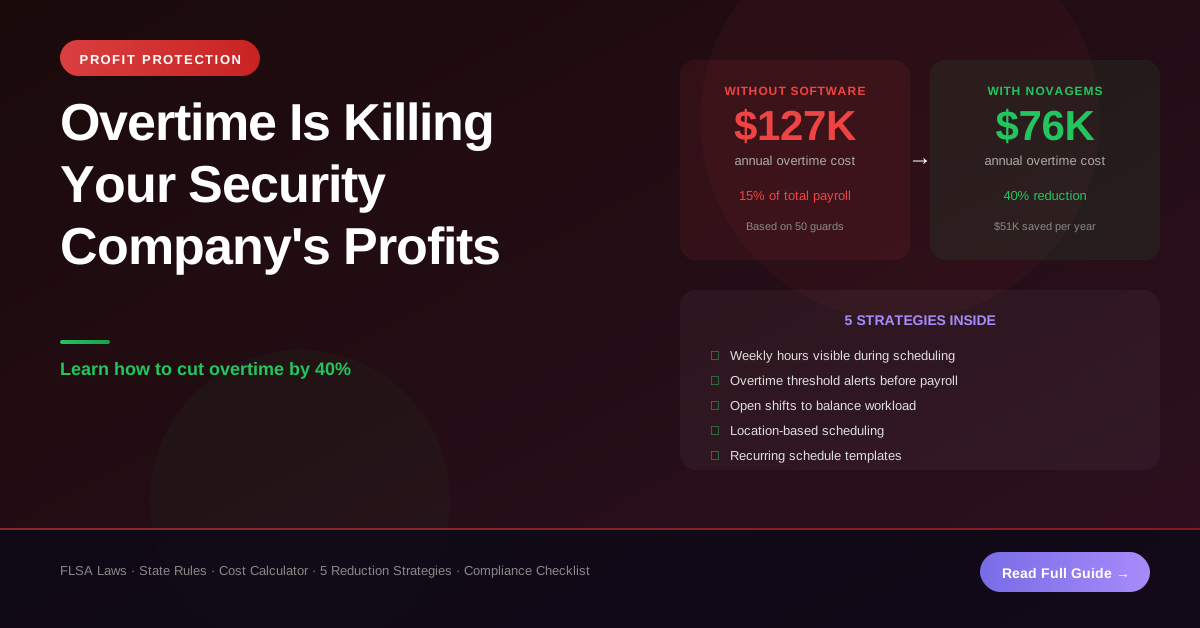
Use employee scheduling software from the beginning. Manual scheduling with spreadsheets breaks down fast when you’re juggling multiple sites, shift swaps, and overtime calculations.
Step 8: Invest in Security Management Software
This is the step that separates companies that plateau at 5–10 guards from companies that scale to 50, 100, or 500+.
In 2026, clients expect digital proof that your guards are where they’re supposed to be, doing what they’re supposed to do. Paper logs and phone check-ins don’t cut it anymore — especially when bidding against competitors who offer real-time client dashboards and automated reporting.
What Your Software Stack Needs
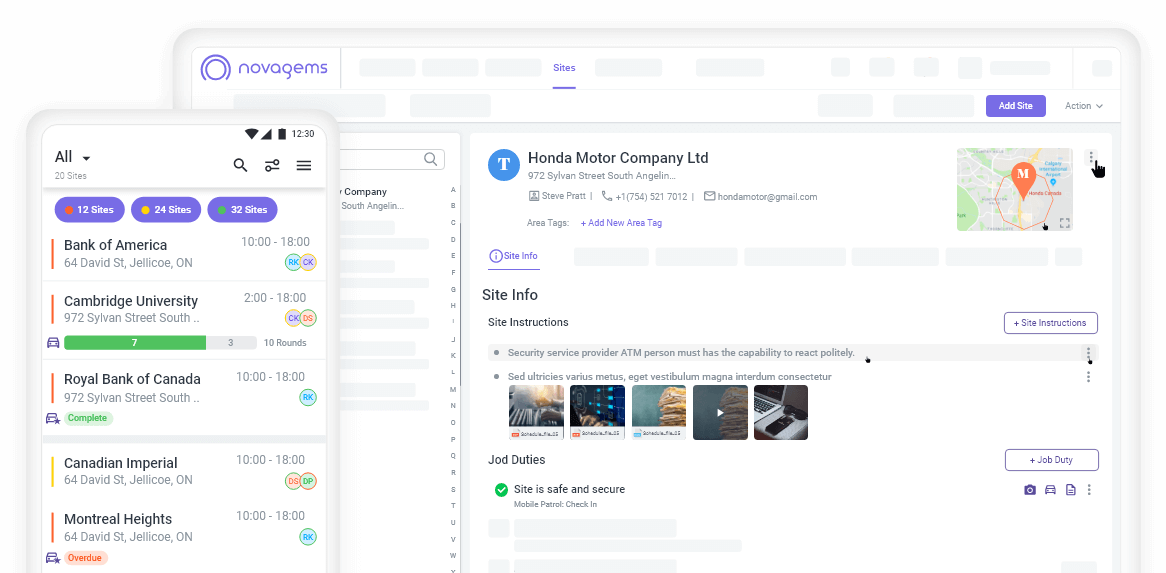
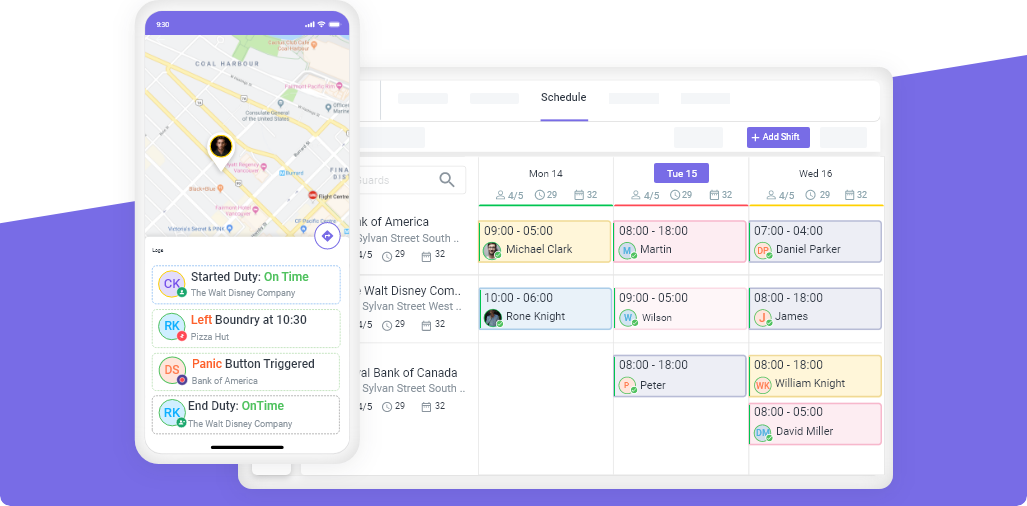
- GPS tracking and geofencing — Real-time guard location monitoring, geofence alerts when guards leave designated areas. Learn more about GPS tracking and geofencing.
- Checkpoint tour verification — NFC tags, QR codes, or Bluetooth beacons placed at key locations that guards scan during their rounds. This creates an auditable trail that proves patrols were completed. See how checkpoint tours work.
- Drag-and-drop scheduling — Assign guards to shifts, manage availability, handle shift swaps, and automatically flag overtime before it happens. Explore scheduling features.
- Mobile incident reporting — Guards submit incident reports with photos, GPS stamps, and timestamps directly from their phones. No more hand-written reports that arrive days late.
- Client portal — Give your clients direct access to patrol reports, checkpoint logs, and incident reports. This is the single most powerful client retention tool you can have.
- Automated reporting — Daily and weekly reports generated automatically and sent to clients. Saves hours of administrative work every week.
Novagems combines all of these features into one platform built specifically for security companies. It’s one of the few platforms designed from the ground up for private security operations — not repurposed from generic workforce management tools. Pricing is per active user, so you’re not paying for guards who aren’t currently working.
The ROI case is straightforward: Software that costs $3–$8 per guard per month easily pays for itself if it helps you win even one additional contract per quarter. And the operational time savings — automated scheduling, digital reports, real-time dashboards — typically free up 10–15 hours per week of administrative work as you scale past 20 guards.
Start your free trial of Novagems to see the platform before you launch.
Step 9: Market Your Company and Win Contracts
You have your license, insurance, guards, and technology. Now you need clients. Here’s what actually works for new security companies:
Immediate Actions (Week 1–4)
- Build a professional website — It doesn’t need to be fancy, but it needs to exist, load fast, and show up in local Google searches. Include your services, service area, contact form, and your licensing/insurance credentials.
- Create a Google Business Profile — This is free and critical for local SEO. Most security buyers search “security guard company near me” or “security company [city name].”
- Register on SAM.gov (US) or your provincial procurement portal (Canada) — Government contracts are competitive but steady. Registration is free and opens you up to federal, state, and municipal RFPs.
- Join your local chamber of commerce and commercial real estate associations — Property managers are the #1 buyer of security services. Get in front of them.
Ongoing Marketing
- LinkedIn outreach — Connect with property managers, facility managers, construction project managers, and event planners in your area. Share content about security best practices.
- Offer free site security assessments — Walk a prospect’s property, identify vulnerabilities, and present a proposal. This works because it demonstrates expertise before asking for money.
- Ask for referrals and testimonials — After your first successful month with a client, ask for a Google review and a written testimonial. Social proof closes deals.
- Bid on RFPs aggressively — You’ll lose most of them at first, but each bid teaches you what procurement teams care about and builds your reputation.
For a deeper dive on client acquisition, read our guide on how to get clients for your security guard company.
What Wins Contracts
Based on what successful Novagems customers tell us, the factors that consistently win contracts (in order of importance) are:
- Proof of accountability — Real-time GPS tracking, checkpoint verification, and automated client reports
- Professional presentation — Uniformed guards, branded vehicles, a real website, and a polished proposal
- Responsiveness — Returning calls and emails within 2 hours during business hours
- Competitive (not cheapest) pricing — Clients who choose the cheapest bid are usually the worst clients anyway
- References from similar clients — A testimonial from a property manager means more to another property manager than a testimonial from an event planner
Startup Costs Breakdown
Here’s a realistic budget for launching a security guard company with 5 guards in the United States:
| Expense | Low Estimate | High Estimate | Notes |
|---|---|---|---|
| Business registration (LLC) | $100 | $500 | Varies by state |
| Company licensing | $450 | $1,500 | State-dependent; see Step 4 |
| Guard licensing/registration (5 guards) | $175 | $1,000 | Per-guard fees vary by state |
| Insurance (first year) | $5,000 | $15,000 | General liability + workers’ comp |
| Surety bond (if required) | $0 | $5,000 | NY, some other states |
| Uniforms and equipment (5 guards) | $1,500 | $5,000 | Shirts, pants, badges, flashlights, radios |
| Training program development | $500 | $2,000 | Manuals, materials, trainer time |
| Guard management software (first year) | $500 | $2,500 | Per-active-user pricing |
| Website and branding | $500 | $3,000 | DIY to professionally designed |
| Marketing (first 3 months) | $1,000 | $5,000 | Google Ads, business cards, networking |
| Office/admin (first 3 months) | $500 | $3,000 | Virtual office to small office |
| Payroll buffer (2 weeks) | $5,000 | $12,000 | You pay guards before clients pay you |
| Legal and accounting setup | $500 | $2,500 | Operating agreement, payroll setup, CPA |
| Total | $15,725 | $58,000 |
Critical note on cash flow: Most commercial security contracts pay on Net 30 terms. That means you’ll pay your guards every week or two, but you won’t receive payment from clients for 30+ days after invoicing. You need at least 4–6 weeks of payroll reserves before signing your first contract. Underestimating this cash flow gap is the #1 financial reason new security companies fail.
For Canadian startups: Costs are roughly comparable in CAD. Insurance tends to be slightly lower, licensing fees are similar, and payroll costs may be slightly higher due to mandatory CPP/EI contributions.
Common Mistakes to Avoid
After seeing hundreds of security companies launch (and watching some of them fail), these are the mistakes that come up again and again:
1. Underbidding to Win Contracts
If you’re billing $16/hour for a guard you’re paying $14/hour, you’re not running a business — you’re subsidizing someone else’s security program. By the time you factor in workers’ comp, insurance, payroll taxes, admin overhead, and software costs, your true cost per guard-hour is typically $18–$22 even when paying $14–$16/hour in wages. Know your fully loaded labor cost before setting prices.
2. Operating Without Proper Licensing
Some entrepreneurs try to start as “security consultants” or “patrol services” to sidestep licensing requirements. State regulatory agencies know these tricks, and the penalties — fines up to $10,000 per violation, criminal charges, and a permanent bar from the industry — aren’t worth the shortcut. Get licensed properly.
3. Ignoring Workers’ Compensation
Skipping workers’ comp insurance to save money is a gamble with catastrophic downside. If a guard is injured on duty and you don’t have coverage, you’re personally liable for medical bills, lost wages, and potential lawsuits. In most states, operating without workers’ comp when you have employees is also a criminal offense.
4. Not Having Written Post Orders
Every site should have detailed, written post orders that cover guard duties, emergency procedures, client contacts, and reporting requirements. “Just walk around and keep an eye on things” is not a post order. Written post orders protect you legally and give your guards clear expectations.
5. Relying on Paper-Based Operations
Paper guard logs, handwritten time sheets, and manual scheduling might work with 3 guards and 1 site. They absolutely will not work at 10 guards and 3 sites. By the time you realize you need software for tracking patrols and tours, you’ll have already lost clients to competitors who offered digital reporting from day one. Invest in technology before you think you need it.
6. Not Having Enough Cash Reserves
As noted above, the Net 30 payment gap catches many new owners off guard. Have enough cash to cover at least 6 weeks of payroll before signing your first contract. If you’re bootstrapping, start with one or two small contracts and grow only as your cash flow allows.
7. Treating Hiring as One-and-Done
In an industry with 100%+ annual turnover, you should always be recruiting — even when you’re fully staffed. Keep job postings active, maintain a pipeline of pre-screened candidates, and have a plan for last-minute coverage when (not if) guards call out.
Final Thoughts: Start Lean, Scale Smart
The most successful security company founders we’ve worked with share one trait: they start with a clear niche, a small team, and professional systems from day one. They don’t wait until they have 50 guards to invest in GPS tracking or digital reporting — they use these tools from guard number one, because that’s what wins contracts and keeps clients.
Your roadmap:
- Pick your niche and geographic area
- Handle the legal foundations (business registration, licensing, insurance)
- Hire a small, reliable team and train them well
- Set up professional technology (scheduling, GPS tracking, checkpoint tours, client reporting)
- Land your first 3–5 contracts through networking, referrals, and RFPs
- Reinvest profits into marketing and hiring as you scale
The security industry isn’t going anywhere. Businesses, property managers, healthcare facilities, and construction sites will always need professional security services. If you follow the steps in this guide and run your company with discipline, there’s no reason you can’t build a profitable, growing security business in 2026 and beyond.
Ready to set up the technology side? Start your free Novagems trial and have your scheduling, GPS tracking, and client reporting live before your first guard clocks in.
See Novagems in action
Join 500+ security & cleaning companies that replaced spreadsheets with Novagems.
✓ 14-day free trial · ✓ Free onboarding · ✓ Cancel anytime