Construction site security services protect active and dormant construction sites from theft (copper, tools, equipment, materials), vandalism, trespass, fire, and unauthorized access, typically through mobile patrol (3-6 randomized visits per night), AI-powered remote camera monitoring, GPS-verified patrols, and rapid alarm response. Construction theft is one of the most underestimated cost lines in commercial real estate development, often consuming 0.5-2% of total project budget when unaddressed. Copper theft surged 77% in 2025 (CargoNet data), and tools/equipment have an active resale market on online marketplaces. This guide covers everything contractors, project managers, and developers need in 2026: threat profile, service categories, 2026 pricing benchmarks, technology stack, OSHA overlap, and vendor evaluation.
Here’s what most contractors don’t realize until it bites them: a typical commercial construction project loses 0.5-2% of total project budget to theft and vandalism over its lifecycle. On a $50 million project, that’s $250,000 to $1 million in pure loss, far more than the security program would cost. The 2025 metals theft surge (77% increase, CargoNet/Verisk data) made it worse. Copper from electrical rough-in, HVAC equipment, and structural steel is now actively targeted by organized groups. Tools left in trailer storage, light fixtures pre-install, even spool ends of unused materials all have active resale markets.
Most contractors who don’t actively manage construction security just absorb the loss. Construction security done right is not a cost center, it’s a cost-positive investment that pays back 3-5x through reduced theft, lower insurance premiums, and reduced project schedule risk (theft delays projects by replacement procurement time).
This guide is for general contractors, construction project managers, real estate developers, owner’s reps, and security companies serving the construction vertical.
What Construction Site Security Services Cover
A complete construction security program addresses several distinct threat vectors:
| Function | What It Covers |
|---|---|
| After-hours mobile patrol | 3-6 randomized visits per night |
| Static overnight guard | Continuous post at high-risk projects |
| Remote camera monitoring | 24/7 AI-powered video review |
| Access control | Gate guards during workday, lock-up overnight |
| Trespass and theft response | Rapid dispatch to triggered alarms |
| Fire watch | Hot work coverage when sprinklers offline |
| Material delivery security | Verify legitimate deliveries vs theft |
| Equipment monitoring | Heavy equipment (excavators, generators) protection |
| Incident documentation | GPS, photo, video evidence for police and insurance |
| OSHA-aware operations | Security at active job site requires safety training |
Smaller residential projects might use only mobile patrol + cameras. Major industrial or hospital projects might run 24/7 multi-guard operations.
The Construction Theft Landscape
Understanding the threat is the foundation of every other decision.
What Gets Stolen
| Category | Why Targeted |
|---|---|
| Copper wiring | 2025 metals surge +77%, easy resale to scrap dealers |
| HVAC equipment | Compressors, copper-rich, high resale value |
| Power tools | Resale market on Facebook Marketplace, OfferUp |
| Lumber | Particularly during 2020-2022 price spike, still elevated |
| Heavy equipment fuel | Diesel theft from generators, excavators |
| Light fixtures pre-install | High-value, easy to remove pre-installation |
| Catalytic converters | From contractor vehicles parked overnight |
| Trailer-stored equipment | Attractive concentrated targets |
Theft Patterns
- Overnight (10pm-5am): highest-risk window
- Weekends: Saturday-Monday is the highest 48-hour theft window
- Major holidays: Thanksgiving, Christmas, New Year’s = extended unsecured periods
- Active construction phase: electrical rough-in (copper exposure), pre-drywall (insulation, mechanicals exposed)
- Project completion windows: unmonitored materials between trades
Repeat Offender Patterns
Most theft isn’t random opportunistic crime. Industry data suggests:
- 60-70% of construction theft involves people connected to the project (former workers, subcontractor staff, visitors who saw the site)
- Organized rings target multiple sites with similar profile
- Tool theft especially follows former-worker patterns
This is why background checks for trade workers, secured tool storage, and access logs all matter alongside physical security.
Service Categories Within Construction Security
Active Build Sites. Mobile Patrol
Best fit: Commercial buildings under $50M, residential subdivisions, mid-size projects.
Setup: 3-6 randomized patrols overnight + AI camera monitoring + rapid alarm response.
Cost: $1,500-$3,500/month. See Mobile Patrol Services for the patrol mechanics.
Major Projects: 24/7 Static Coverage
Best fit: Hospital construction, high-rise residential, large industrial, $100M+ commercial.
Setup: 24/7 static guard + roving patrol + technology stack.
Cost: $15,000-$50,000+ monthly per site.
Dormant Construction Sites
Best fit: Sites paused due to financing, permitting, or weather; long stretches of inactivity.
Setup: Increased mobile patrol (4-8 visits/night) + camera monitoring + emergency response only.
Cost: $2,000-$5,000/month.
High-Value Equipment Storage
Best fit: Sites with bulldozers, excavators, generators, specialty equipment overnight.
Setup: Static overnight guard + GPS tracking on equipment + LPR at gates.
Cost: $5,000-$12,000/month per equipment yard.
Pre-Construction / Demolition Sites
Best fit: Empty buildings being prepped for demolition, dormant pre-permit sites.
Setup: Mobile patrol + perimeter cameras + alarm response.
Cost: $800-$2,000/month.
Multi-Site Project Portfolios
Best fit: Developers with 5+ active projects in one metro area.
Setup: Regional mobile patrol contract + project-specific overlay services + central dispatch.
Cost: Negotiated by project + total volume.
Construction Site Security Pricing in 2026
By Service Type
| Service | Cost |
|---|---|
| Mobile patrol (3-6 visits/night) | $1,200-$2,000/month per site |
| Mobile patrol (hourly visits) | $2,000-$4,000/month per site |
| Static overnight guard (per shift) | $4,500-$9,000/month per post |
| AI camera monitoring | $300-$1,500/month per site |
| Drone patrol (large sites) | $1,000-$3,000/month |
| Alarm response per dispatch | $50-$150 per dispatch |
| Holiday/weekend surge | +25-50% |
As Percentage of Project Budget
| Project Size | Security as % of Budget |
|---|---|
| Small residential (<$5M) | 0.3-0.6% |
| Mid-size commercial ($5M-$50M) | 0.2-0.5% |
| Large commercial ($50M-$200M) | 0.15-0.4% |
| Mega projects ($200M+) | 0.1-0.3% |
What Drives Pricing Up
| Factor | Impact |
|---|---|
| Major metro area | +20-30% |
| Remote/rural site | +25-50% (route inefficiency) |
| High-crime area | +25-50% |
| 24/7 static coverage | 5-7x mobile patrol cost |
| Armed (rare for construction) | +50-100% |
| AI tech stack | $300-$1,500/month |
| Holiday surge programming | +20-40% |
Technology Stack for Modern Construction Security
The 2010 model of “padlock and one drive-by per night” doesn’t work anymore. Here’s what current-generation construction security looks like.
AI-Powered Camera Monitoring
Replaces “guard watching monitors” with automated detection:
- Motion detection in restricted areas
- Person detection vs animal/wind movement
- Vehicle detection at access roads
- Tool/material movement alerts
- Ladder/scaffold use after-hours (theft preparation indicator)
- After-hours light usage in unfinished structures
Solutions like LiveView Technologies, Pro-Vigil, or hardware/SaaS combinations from major security providers cover this segment.
Mobile Patrol with GPS Verification
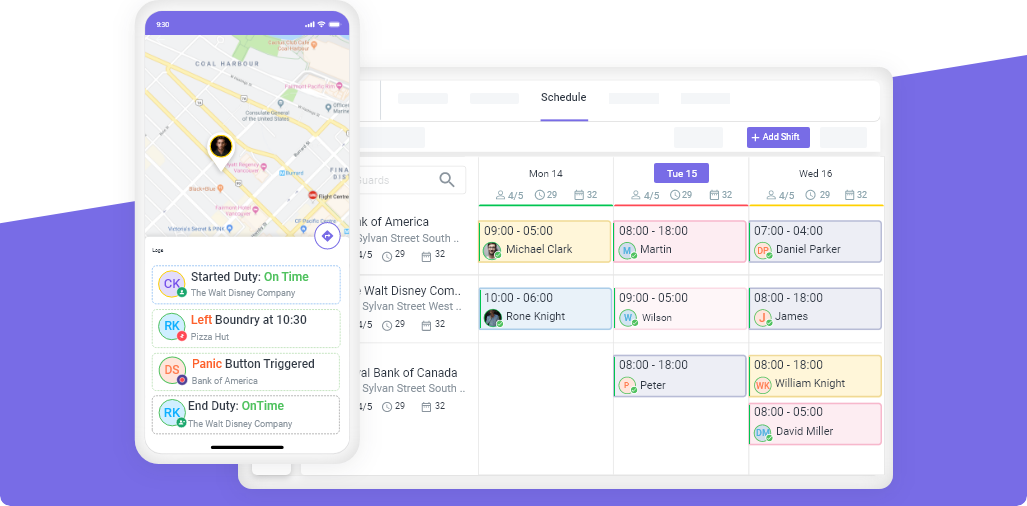
Mobile patrol using GPS tracking and NFC checkpoint scanning provides verifiable physical presence. Critical for insurance documentation and after-incident accountability.
Drones for Large Sites
For projects covering 100+ acres (industrial, infrastructure, large residential developments), drones provide rapid alarm verification. See guards vs robots vs drones.
Access Control at Gates
Modern construction sites use:
- Vehicle gates with badged access for trade workers
- Visitor sign-in (digital, photo capture)
- License plate recognition
- After-hours lock-down
- Time-of-day access restrictions per trade
Heavy Equipment GPS Tracking
Tractors, generators, lifts, and major equipment increasingly have embedded GPS:
- Theft recovery
- Operating hours documentation
- Geofence alerts if equipment moves outside site
- Integration with fleet management
Integrated Dispatch Software
Security dispatch software ties everything together, alarm triggers route to nearest mobile patrol, incident reports go to property manager and insurance broker, monthly performance dashboards available to GC and developer.
AI in Construction Security
For broader AI shift, see AI in the Security Guard Industry.
Best Construction Site Theft Prevention Software in 2026
There is no single best construction site theft prevention software, because the category is really four different products that solve four different failure points. Most sites that actually stop theft run two or three of them together rather than buying one tool and hoping. The question worth asking is not “which product is best” but “which layer is my site missing”.
| Software category | What it actually stops | Typical cost | Worth it when |
|---|---|---|---|
| AI camera monitoring | After-hours intrusion, in progress theft, tailgating at gates | $300-$1,500/mo per site | The site is empty overnight and weekends, which is most active builds |
| Patrol verification (GPS + checkpoint) | Patrols that were billed but not walked, and disputes over whether anyone attended | Bundled with guard software, roughly $4-$10 per guard/mo | You pay a guard company and cannot prove what you received |
| Equipment GPS tracking | Machinery driven off site, and slow recovery after the fact | $10-$30 per asset/mo | Loaders, generators and lifts stay on site overnight |
| Dispatch and incident reporting | Slow alarm response, and claims that fail because documentation is thin | Bundled with guard software | You run more than one site, or your insurer wants evidence |
How to choose between them
Buy in the order your losses happen. If material is walking off overnight, cameras come first, because nothing else detects an intrusion while it is happening. If you are already paying for patrols and losses continue, the problem is usually not coverage but verification, so patrol software comes first. If you lose whole machines rather than boxes of tools, start with equipment GPS.
Ignore feature lists that compare products across categories. A camera platform and a patrol platform are not competing purchases, and a vendor that claims to be best at both is usually weak at one.
Where Novagems fits
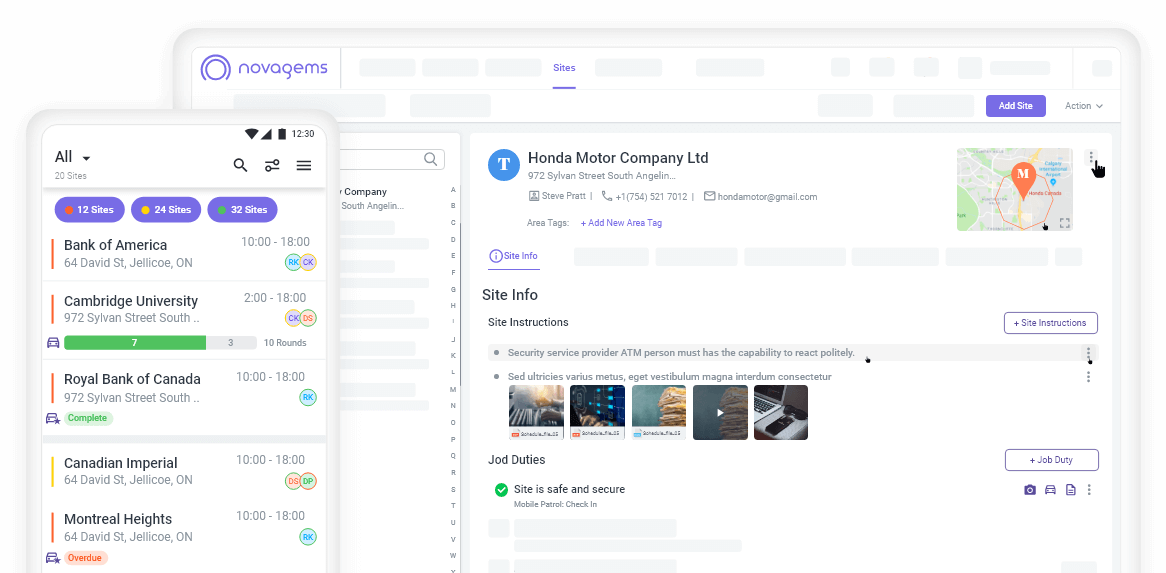
Novagems is patrol verification, dispatch and incident reporting, not cameras. On a construction site that means GPS verified clock-ins at the gate, NFC or QR checkpoint scans at the points that actually get hit (material lay-down areas, the copper run, the equipment corral), incident reports with photos filed from a phone, and a client ready report the general contractor and the insurer can both use.
That solves the verification and documentation layers. It does not solve detection, so pair it with camera monitoring on any site that sits empty overnight. If you are evaluating platforms generally rather than for construction specifically, see best security guard management software.
OSHA, Insurance, and Regulatory Overlap
Construction security operates alongside OSHA, insurance, and contractor safety programs.
OSHA General Duty Clause
OSHA’s General Duty Clause (Section 5(a)(1)) requires employers to provide a workplace “free from recognized hazards.” Security operations support this by:
- Controlling access to active hazards (open excavations, falls, etc.)
- Documenting incidents that may relate to OSHA injury reporting
- Verifying authorized personnel only enter active areas
Builder’s Risk Insurance
Builder’s risk insurance covers physical loss to the project. Insurance carriers increasingly:
- Require documented security operations for projects above certain values
- Offer 5-15% premium discounts for GPS-verified patrols
- Mandate alarm system + monitoring for high-value sites
- Require theft documentation within specific timeframes for claim approval
Engage your insurance broker early on the security program, premium savings often pay for the security program itself.
State Security Licensing
Standard state licensing applies to construction security personnel:
- California. BSIS guard card
- Texas. DPS Level II/III
- New York. NYS DOS registration
- Florida. FDACS Class D
- Colorado. HB25-1262 (effective Aug 2026, see Colorado guide)
Construction-Specific Safety Training
Beyond standard guard training, construction security personnel should have:
- OSHA 10-hour or 30-hour Construction Outreach training
- Hazard awareness for active job sites
- PPE requirements (hard hat, hi-vis, boots)
- Familiarity with site safety plans
Local Permit and Lighting Requirements
Many municipalities require:
- Site lighting to specific lumens at perimeter
- Posted signage for security cameras (notice requirements)
- After-hours noise restrictions affecting alarm response
How to Hire a Construction Security Vendor
Step 1. Project-Specific Risk Assessment
Document each project’s threat profile:
- Geographic location and crime rate
- Project value and asset exposure
- Current construction phase (electrical rough-in, framing, finishing all have different theft profiles)
- Site size and perimeter length
- Existing fencing, gates, lighting
- Adjacent properties and watch coverage
- Historical incidents at similar projects
Step 2. Define Security Scope
Decide between:
- Mobile patrol only (most projects)
- Mobile + AI camera monitoring (best ROI for most)
- Full 24/7 static coverage (only for high-value or specific risk)
- Hybrid by project phase
Step 3. RFP to 3-5 Vendors
Construction-specific must-haves:
| Requirement | Why |
|---|---|
| Construction-sector references (3+ projects) | Sector-specific expertise |
| GPS-verified patrol capability | Insurance and accountability |
| AI camera integration | Modern surveillance |
| OSHA-aware operations | Job site safety overlap |
| State licensing in operating states | Legal requirement |
| Insurance, $1M+ liability + commercial auto | Industry standard |
| Rapid alarm response (under 30 min) | Theft response |
| Builder’s risk insurance familiarity | Premium discount support |
| Multi-site capability | Portfolio scaling |
Step 4. Evaluate Beyond Price
| Criterion | Weight |
|---|---|
| Construction-sector experience | 25% |
| Technology stack (GPS, AI cameras) | 25% |
| Insurance and licensing | 15% |
| Coverage capacity (geographic + scaling) | 15% |
| Pricing transparency | 10% |
| Supervisor structure | 10% |
Step 5. Pilot at One Project
Run a 90-day pilot at one mid-size project:
- Track theft incidents (baseline vs after pilot)
- Patrol completion rate
- Alarm response time
- Insurance documentation quality
- Communication with project team
- General contractor satisfaction
If successful, extend to portfolio standard.
Common Construction Security Mistakes
| # | Mistake | Fix |
|---|---|---|
| 1 | Wait until first theft to hire | Engage at site mobilization |
| 2 | Cheapest vendor without verification | GPS + AI required |
| 3 | No coverage on weekends/holidays | Surge during high-risk windows |
| 4 | Static guard at every site | Mobile patrol covers most projects |
| 5 | Camera monitoring only, no patrol | Cameras detect but don’t deter |
| 6 | Project value not in builder’s risk discussion | Engage insurance broker |
| 7 | No OSHA awareness in security operations | Train guards on site safety |
| 8 | Generic vendor without construction experience | Demand 3+ project references |
| 9 | No incident documentation standards | Digital reporting required |
| 10 | No portfolio-level coordination | Standardize across projects |
Getting Started Checklist
For a project manager or developer engaging security:
- Engage at project planning, security in original budget, not added later
- Risk assessment, by project, not generic
- Insurance broker conversation, premium discount opportunities
- Three vendor RFP, construction-experienced, technology-equipped
- Pilot at one project, 90 days with metrics
- Standardize across portfolio, common vendor, common reporting
- Holiday coverage planning, surge for Thanksgiving, Christmas, July 4
- OSHA integration, security guards as part of safety operations
- Quarterly reviews, performance, incidents, vendor relationship
- Annual vendor review, pricing, scope, alternatives
Wrapping Up
Construction security is one of the highest-ROI security investments in commercial real estate. The combination of construction-specific theft trends (especially the 2025 metals surge), insurance carrier pressure, and technology evolution (AI cameras, GPS-verified patrol) means the operations that worked in 2015 don’t work in 2026.
The contractors and developers winning at security 2026 share three patterns: they engage security at project planning (not as afterthought), they invest in technology that justifies premium positioning with insurance carriers, and they treat security as theft-loss-mitigation rather than just compliance check-the-box.
For security companies serving construction: the demand is there, but the bar is real. GPS-verified patrols, AI camera integration, OSHA-aware operations, and builder’s risk insurance familiarity are required. If you have these, construction is one of the more stable and growing security verticals.
For project managers and developers: ask any vendor you’re evaluating to walk you through their last 6 months of theft incidents at construction projects. Pattern recognition is everything in this vertical, and the best vendors are pattern-matching across their portfolio.
Novagems provides the workforce management platform construction security companies use to deliver verifiable, audit-ready operations across project portfolios. Start a 14-day free trial.
Further Reading
- Types of Security Guard Services: A Complete Guide, pillar
- Mobile Patrol Services, patrol mechanics for construction
- Warehouse Security Services, adjacent industrial vertical
- How to Price Security Guard Contracts, pricing framework
- GPS Tracking and Geofencing, patrol verification
- NFC Tags for Guard Tours, checkpoint scanning
- AI in the Security Guard Industry (2026). AI video analytics
- Security Guards vs Robots vs Drones, drone for large sites
- Security Dispatch Software, modern dispatch
- Workforce Management for Security Companies, operations platform
Sources: CargoNet/Verisk 2025 metals theft data; OSHA Construction Outreach training programs; NICB construction theft trends; state security licensing programs.
See Novagems in action
Join 500+ security & cleaning companies that replaced spreadsheets with Novagems.
✓ 14-day free trial · ✓ Free onboarding · ✓ Cancel anytime