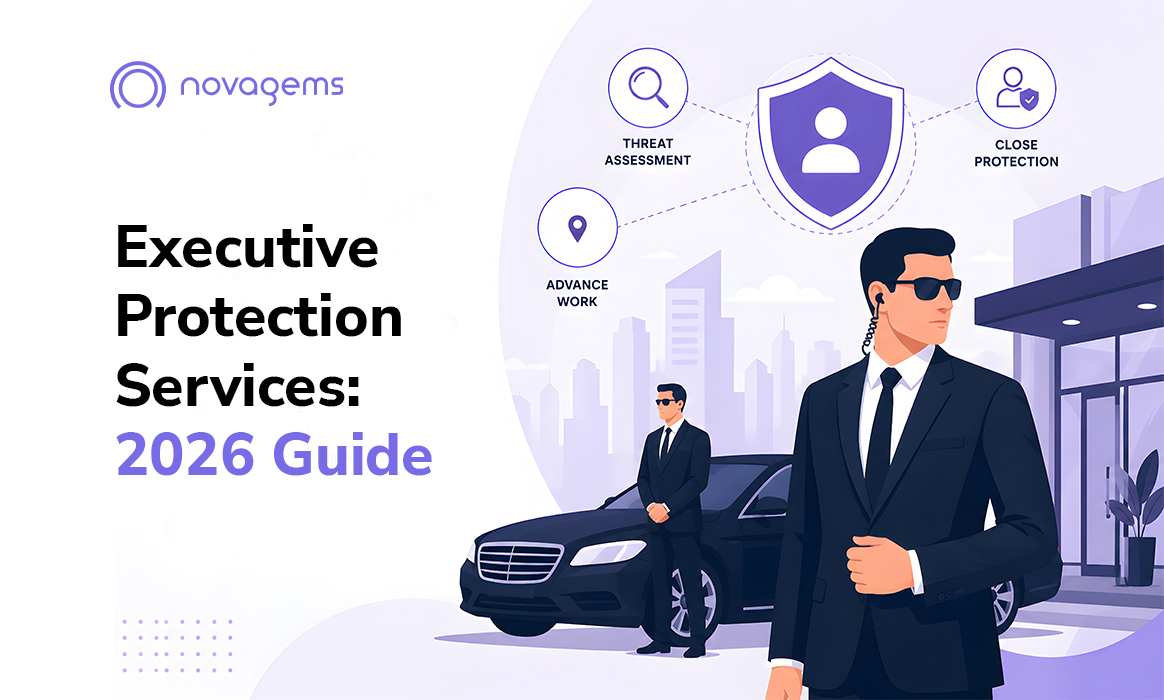
Executive protection (EP), also called close protection or personal security detail (PSD), is specialized security work that protects high-profile individuals from targeted threats including kidnapping, stalking, assault, harassment, and corporate espionage. Effective EP is built on three pillars: threat assessment (identifying which threats are real vs perceived), advance work (securing locations and routes before the principal arrives), and close protection (the visible or low-profile officers who travel with the principal). EP is the most specialized and highest-billing security vertical, with solo officers at $75-$200/hour and full operations for high-profile executives running $500,000-$3 million annually. This guide covers everything corporate boards, family offices, principals, and EP firms need in 2026: threat profiles, service categories, 2026 pricing, training requirements, technology stack, and how to hire vendors.
The defining truth of executive protection: the best EP work is invisible. A successful day for an EP team means nothing happened, the principal moved through their day, conducted business, returned home, and never knew there was a credible threat that the team detected and routed around. The work that gets media attention (a foiled attack, a celebrity scuffle, a public confrontation) represents EP failure, not success. EP teams that have to physically intervene have already failed at advance work and threat assessment.
The 2020s have seen EP demand surge. Corporate executives became targets after high-profile incidents (UnitedHealthcare CEO in late 2024 was an inflection point, many Fortune 500 boards approved EP programs immediately after). High-net-worth individuals face new threats from social media exposure. Public figures (entertainment, sports, politics) face stalking and harassment at unprecedented scale. The industry has expanded rapidly, but most growth is in the high-quality tier, the field is demanding more sophisticated work, not less.
This guide is for corporate boards approving EP programs, family offices managing principals, principals themselves, EP firms, and security companies considering expansion into the EP vertical.
What Executive Protection Services Cover
EP is more than “a guy in a suit who follows you around.” A complete program addresses multiple distinct functions:
| Function | What It Covers |
|---|---|
| Threat assessment | Real-time intelligence on credible threats |
| Advance work | Securing venues and routes before principal arrives |
| Close protection | Officers physically present with principal |
| Residence security | Protection of home, family, staff |
| Travel security | Domestic and international travel coverage |
| Surveillance detection | Identifying hostile observers/stalkers |
| Cyber-physical convergence | Linking digital threats to physical protection |
| Family coverage | Protection for spouse, children, extended family |
| Event security | Protection at galas, conferences, public appearances |
| Crisis response | Active threat response, kidnap/ransom protocols |
| Driver / motorcade | Evasive driving, secure vehicle operations |
| Medical capability | Tactical Combat Casualty Care (TCCC) trained personnel |
The work spans risk analysis, intelligence, operations, and tactical capability. The best EP firms function as small intelligence operations as much as security operations.
Three Pillars of Executive Protection
Pillar 1: Threat Assessment
Every EP program begins with threat assessment. The team evaluates:
- Identified threats, specific individuals or groups making credible threats
- Industry threat profile, sectors with elevated targeting (pharma, finance, energy, controversial industries)
- Geographic risk, countries, cities, or specific locations
- Public visibility, social media exposure, news coverage, public role
- Family exposure, threats stemming from family members’ activities or visibility
- Travel patterns, predictable vs randomized
- Historical incidents, prior threats, harassment, or attacks
Threat assessment is ongoing, not a one-time intake. The best EP firms have dedicated intelligence analysts monitoring threat landscape continuously.
Pillar 2: Advance Work
Advance work is the pre-arrival security operation that secures every location the principal will visit. Done well, advance work prevents most threats before they materialize.
A typical advance includes:
- Site survey, visit location, identify entries/exits, parking, security infrastructure
- Route planning, multiple route options with no predictable patterns
- Venue staff coordination, meet with hotel, restaurant, event security
- Hospital identification, nearest level-1 trauma centers
- Communication protocols, establish radio/phone channels
- Crowd assessment, likely public exposure
- Surveillance detection, identify any pre-positioned observers
- Crisis protocols, evacuation routes, safe rooms, escape plans
For high-profile principals (Fortune 500 CEOs, celebrities, dignitaries), advance teams may arrive 24-72 hours ahead of the principal.
Pillar 3: Close Protection
The visible or low-profile officers who physically protect the principal during the activity:
- Solo officer, single trained protector, low-profile or visible
- Two-person team, driver + close protection, more capability
- Three-to-four-person team, driver, close protection, advance, communications
- Full detail (5-10+ officers), high-profile or high-threat operations
- Motorcade, multi-vehicle operations for major events or international travel
Close protection is the visible work but represents only ~20% of total EP value. The other 80% is advance work and threat assessment.
Service Categories Within Executive Protection
Solo Domestic Protection
Best fit: Mid-tier corporate executives, occasional public figures, principals with manageable threat profiles.
Setup: Single trained officer, drives or accompanies principal during specific high-risk windows (evening events, public appearances, travel days).
Cost: $75-$150/hour, typically 200-400 hours/month for active programs.
Multi-Officer Day Coverage
Best fit: Fortune 500 CEOs, high-profile founders, celebrities with active calendars.
Setup: 2-3 officers (driver, close protection, advance), 8-16 hours/day coverage.
Cost: $1,500-$4,000/day, $400,000-$1.5M/year.
Full 24/7 Coverage
Best fit: Documented kidnap/ransom threats, prominent public figures, controversial executives.
Setup: 24/7 multiple officer rotation, family coverage, residence security, travel coverage.
Cost: $1.5M-$5M+/year.
International Travel Operations
Best fit: Executives traveling to high-risk countries (Mexico, Brazil, Nigeria, parts of MENA, Asia-Pacific high-risk zones).
Setup: Pre-arrival country assessment, in-country advance team, local fixers, return logistics.
Cost: $5,000-$25,000+/day plus expenses.
Family Office EP
Best fit: Multi-generational high-net-worth families with multiple principals.
Setup: Embedded EP director, residence security, school escorts, travel coverage for family members.
Cost: $1.5M-$10M+/year.
Event Security
Best fit: Galas, fundraisers, conferences, board meetings, shareholder meetings.
Setup: Advance team + event-day close protection + post-event coverage.
Cost: $5,000-$50,000 per event depending on scale.
Residence Security
Best fit: Component of full EP program for principals.
Setup: 24/7 residential officers, perimeter monitoring, integrated with home security systems, vetted household staff.
Cost: $300,000-$1M+/year per residence.
Surveillance Detection
Best fit: Principals with active stalking concerns or hostile observation.
Setup: Counter-surveillance teams operating around principal’s known patterns.
Cost: Variable per operation; typically $5,000-$30,000+ per assessment.
Executive Protection Pricing in 2026
By Service Tier
| Service | Hourly Rate |
|---|---|
| Solo EP officer (standard) | $75-$125 |
| Solo EP officer (premium) | $100-$200 |
| 2-officer team | $125-$250 (combined) |
| 4-officer detail | $200-$500 (combined) |
| Advance team | $100-$200 per officer |
| Surveillance detection specialist | $125-$250 |
| Driver (with evasive driving) | $50-$100 |
| Medical-trained EP | +20-30% |
By Annual Budget
| Program Tier | Annual Cost |
|---|---|
| Episodic (events, travel only) | $50,000-$200,000 |
| Part-time (specific risk windows) | $200,000-$500,000 |
| Active (regular coverage) | $500,000-$1,500,000 |
| Full (24/7 + residence + family) | $1,500,000-$5,000,000 |
| Major principal (full ops + international) | $5,000,000-$20,000,000+ |
What Drives Pricing Up
| Factor | Impact |
|---|---|
| International travel | 30-100% premium |
| High-risk destination | 50-200% premium |
| Armed coverage | +30-50% |
| Specialized credentials (former DSS, military special ops) | +30-50% |
| 24/7 coverage | 4-6x daily-only |
| Family coverage | +30-100% |
| Major metro location | +20-30% |
| Crisis response standby | Negotiated retainer |
For complete pricing context, see How to Price Security Guard Contracts.
Training and Background Requirements
EP training is the most rigorous in the security industry. Top-tier officers typically have:
Prior Career Background
| Background | Why Valued |
|---|---|
| Diplomatic Security Service (DSS) | Gold-standard EP training, federal background |
| Military Special Operations | Tactical capability, operational discipline |
| Federal protective services (USSS, FPS) | Federal training and standards |
| Police executive protection units | Domestic threat experience |
| Intelligence community | Threat analysis capability |
| Military police | Foundational training |
EP-Specific Training
Major EP training schools and certifications:
- Executive Security International (ESI), long-established EP school
- Diplomatic Security Service training, federal program
- EP Specialist (EPS) certification
- ASIS CPP (Certified Protection Professional)
- Tony Scotti Defensive Driving, evasive driving
- Tactical Combat Casualty Care (TCCC), medical response
- Surveillance Detection training
- International EP specialization
Most major EP programs require 200+ hours of specialized training plus prior career background.
Continuing Education
EP officers must continuously update on:
- Geopolitical threat landscape
- Surveillance technology evolution
- Cyber threat integration
- Medical response (TCCC standards)
- Evasive driving recertification
- Firearms requalification (where armed)
Technology Stack for Modern Executive Protection
EP technology has evolved significantly. A current-generation program uses:
Threat Intelligence Platforms
- Open-source intelligence (OSINT), social media monitoring, news, dark web
- Commercial threat platforms. Flashpoint, Recorded Future, Liferaft
- Geographic intelligence. TripWise, International SOS
- Custom intelligence operations, for major principals
Operational Technology
- Encrypted communications. Signal, custom radios
- GPS tracking, vehicles and personnel
- License plate recognition, surveillance detection
- Biometric access, at residences and offices
- Drone counter-surveillance, detect hostile drones near residence
- Vehicle-mounted technology, armored vehicles, secure communications
Workforce Management
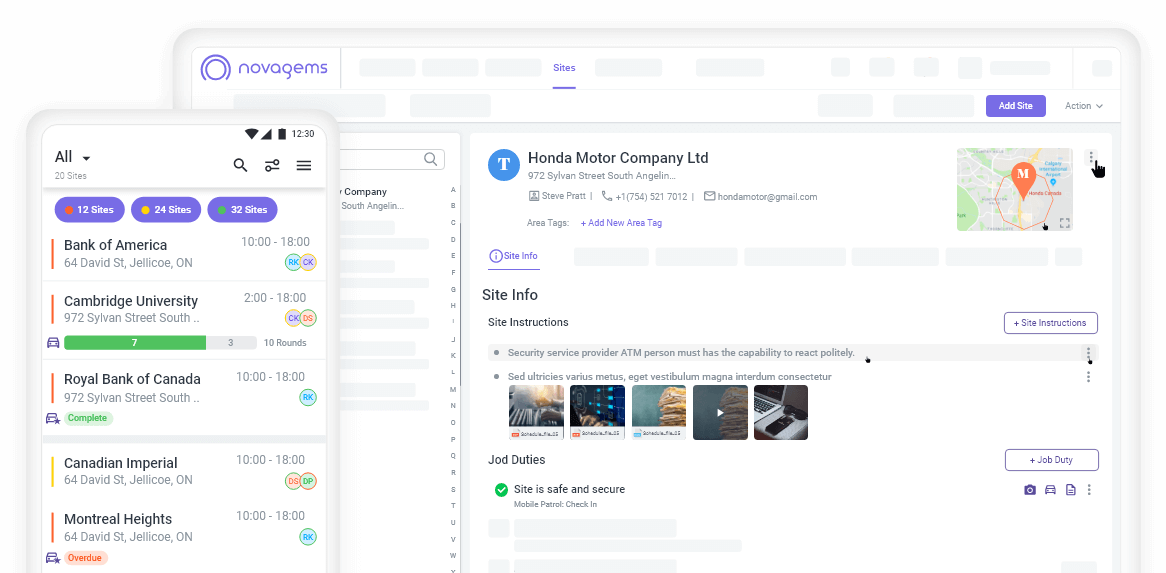
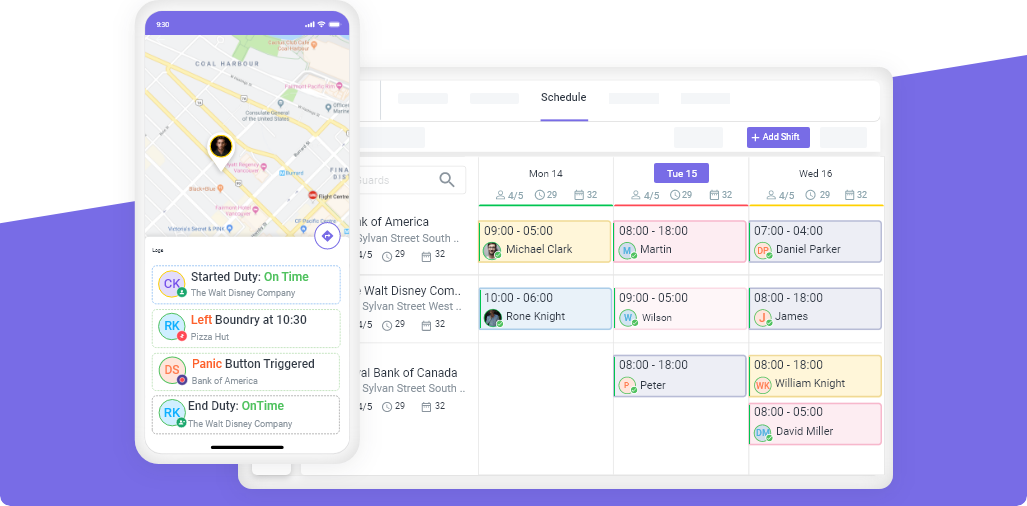
Even in EP, modern operations require workforce management. Platforms like Novagems handle:
- Officer scheduling across complex programs
- Training and certification tracking
- Time and attendance for billing
- Operations documentation
- Multi-principal coordination
For broader operational tech, see Security Dispatch Software and GPS Tracking and Geofencing.
Cyber-Physical Integration
The 2026 trend is cyber-physical convergence. EP teams now coordinate with:
- Corporate cybersecurity teams (executive email, social media, deepfake threats)
- Family office IT (residence smart home security)
- Personal device security (executive laptop, phone, tablet)
- Travel security cyber considerations (hotel WiFi, public networks)
Regulatory and Legal Framework
EP operates in complex regulatory territory.
Firearms. State by State
The single biggest legal complication. Concealed carry permits don’t transfer between states. EP teams must navigate:
- Reciprocity, which states recognize which permits
- Restricted venues, federal buildings, schools, courthouses, many corporate offices
- Carrying in vehicle, varies by state
- Firearms in airports. TSA-regulated, gun cases in checked baggage only
- Magazine capacity restrictions, vary by state
- Specific state permits. California, Hawaii, NY have stringent processes
Most major EP firms have legal counsel on retainer for firearms law navigation.
State Security Licensing
Beyond firearms, standard state security licensing applies:
- California. BSIS guard card, exposed firearms permit
- Texas. DPS Level III/IV (Level IV is specifically Personal Protection Officer)
- New York. NYS DOS registration plus specific armed authorization
- Florida. FDACS Class D / Class G / Class CC
- Colorado. HB25-1262 (effective Aug 2026. Commercial Security Officer with weapon endorsement)
Federal Considerations
- TSA, for travel and airport operations
- State Department, international travel coordination, certain country restrictions
- FBI, for kidnap/ransom and credible threat coordination
- USSS, interaction protocols when principal is near federal protectees
International Operations
- Country-specific licensing, each country has different EP regulations
- Local legal compliance, what operations are legal varies dramatically
- Local fixer relationships, most international ops use embedded local partners
- Insurance considerations, some jurisdictions void coverage on certain operations
Insurance
EP insurance is its own specialty:
- Professional liability — $5M+ standard for failures of protection
- Errors and omissions, for advisory work (threat assessment recommendations)
- General liability — $2M+ for incidents
- Auto insurance, high-value vehicles, evasive driving usage
- International coverage, kidnap/ransom and emergency evacuation
- Workers’ comp, for protectees’ staff
How to Hire an Executive Protection Vendor
Step 1. Threat Assessment
Before hiring, document:
- What specific threats exist? (named individuals, group threats, industry-level)
- What’s the principal’s visibility profile?
- What activities/travel create exposure?
- What’s the tolerance for visible vs low-profile coverage?
- What’s the family situation?
- What’s the budget tier (episodic, part-time, full)?
Step 2. Define Scope
Decide between:
- Episodic (events, travel)
- Part-time (specific risk windows)
- Active (regular coverage)
- Full (24/7 + residence + family)
Step 3. Vendor Selection
EP-specific must-haves:
| Requirement | Why |
|---|---|
| Leadership with federal/special ops background | Industry standard |
| EP-specific training documentation | Beyond general security |
| Similar-tier protectee references | Discretion required |
| Advance work capability | Not just physical protection |
| Threat intelligence operations | Modern requirement |
| State firearms licensing in operating states | Legal compliance |
| International operations capability | If travel scope |
| Insurance — $5M+ liability + professional | Industry standard |
| 24/7 operations center | Crisis response |
| Discretion (low marketing footprint) | Trust signal |
Step 4. Beyond Price Evaluation
EP is the security vertical where price-shopping is most dangerous. The best firms cost more but the cost differential is small relative to the consequences of failure. Weight:
| Criterion | Weight |
|---|---|
| Leadership backgrounds | 30% |
| Training documentation | 20% |
| References from similar tier | 20% |
| Operational capability | 15% |
| International capability (if applicable) | 10% |
| Pricing | 5% |
Step 5. Trial Period
EP relationships are personal and discretion-based. Best practice:
- Start with episodic work (events, travel) before full retainer
- 90-day pilot before committing to full annual contract
- Multiple firms available for comparison
- Reference checks with peer principals (with permission)
Common Executive Protection Mistakes
| # | Mistake | Fix |
|---|---|---|
| 1 | Hiring after the first threat | Engage proactively based on visibility |
| 2 | Cheapest vendor wins | This is the wrong vertical to optimize cost |
| 3 | Visible muscle without intelligence | Invest in threat assessment |
| 4 | No advance work culture | Advance is 80% of EP value |
| 5 | One vendor for everything | Specialized partners for international, specific functions |
| 6 | Family ignored | Family threats often more serious than principal |
| 7 | Cyber and physical separated | Integrate threat picture |
| 8 | Over-marketing of vendor | Discretion is the trust signal |
| 9 | Ignoring residence security | Home is most predictable target |
| 10 | No annual review | Threat landscape changes; coverage should too |
Getting Started Checklist
For a corporate board, family office, or principal considering EP:
- Threat assessment, third-party assessment from qualified EP firm or intelligence consultancy
- Define tier needed, episodic vs full coverage
- Budget alignment, board approval for annual program
- Vendor research — 3-5 qualified EP firms
- Discreet inquiry, most EP firms don’t have flashy websites; ask for introductions through legal/family-office networks
- Reference verification, speak with similar-tier protectees
- Pilot engagement, single event or travel first
- Insurance verification — $5M+ liability minimum
- Legal counsel coordination, particularly for armed coverage and international
- Annual review, threat landscape evolves continuously
The Confidentiality Imperative
The single most important non-technical aspect of EP: discretion. Quality EP firms have:
- Minimal digital marketing footprint
- No client name-dropping
- Rigorous staff confidentiality agreements
- No social media presence for officers
- Vetting beyond standard background checks
- Tight contracts with NDAs
If a vendor is loud about their famous clients, walk away. Discretion is both the operational requirement and the trust signal.
Wrapping Up
Executive protection is the highest-margin, highest-skill, lowest-volume security vertical. The work is fundamentally different from general security, it requires intelligence operations capability, advance planning culture, and deep training that most general security firms can’t replicate.
The principals winning at EP in 2026 share three patterns: they engage based on threat assessment (not after first incident), they invest in firms with documented federal/special ops backgrounds (not bargain-hunters), and they treat security as integrated with cybersecurity, family office operations, and corporate risk management.
For security companies considering expansion into EP: it’s high-margin work with strong client retention, but the bar is real. Federal-quality officers, intelligence operations capability, advance work culture, and discretion are non-negotiable. The transition from general security to EP requires significant investment in talent and training.
For corporate boards and family offices: ask any vendor you’re evaluating about their threat intelligence operations, advance work process, and similar-tier protectee references (with permission). If they can’t articulate all three at depth, you have a vendor gap.
Novagems provides workforce management for the operational side of EP firms, officer scheduling, training tracking, time and attendance, and compliance documentation across multi-principal programs. Start a 14-day free trial.
Further Reading
- Types of Security Guard Services: A Complete Guide, pillar
- Bank Security Services, adjacent regulated vertical
- Hospital Security Services, hospital executive coverage
- Residential Security Services, residence security parallel
- How to Price Security Guard Contracts, pricing framework
- AI in the Security Guard Industry (2026). AI trends
- GPS Tracking and Geofencing, operational tech
- Workforce Management for Security Companies, operations platform
Sources: ASIS International EP standards; Diplomatic Security Service training programs; Executive Security International (ESI) curriculum; state firearms licensing programs; industry pricing benchmarks 2025-2026.
See Novagems in action
Join 500+ security & cleaning companies that replaced spreadsheets with Novagems.
✓ 14-day free trial · ✓ Free onboarding · ✓ Cancel anytime