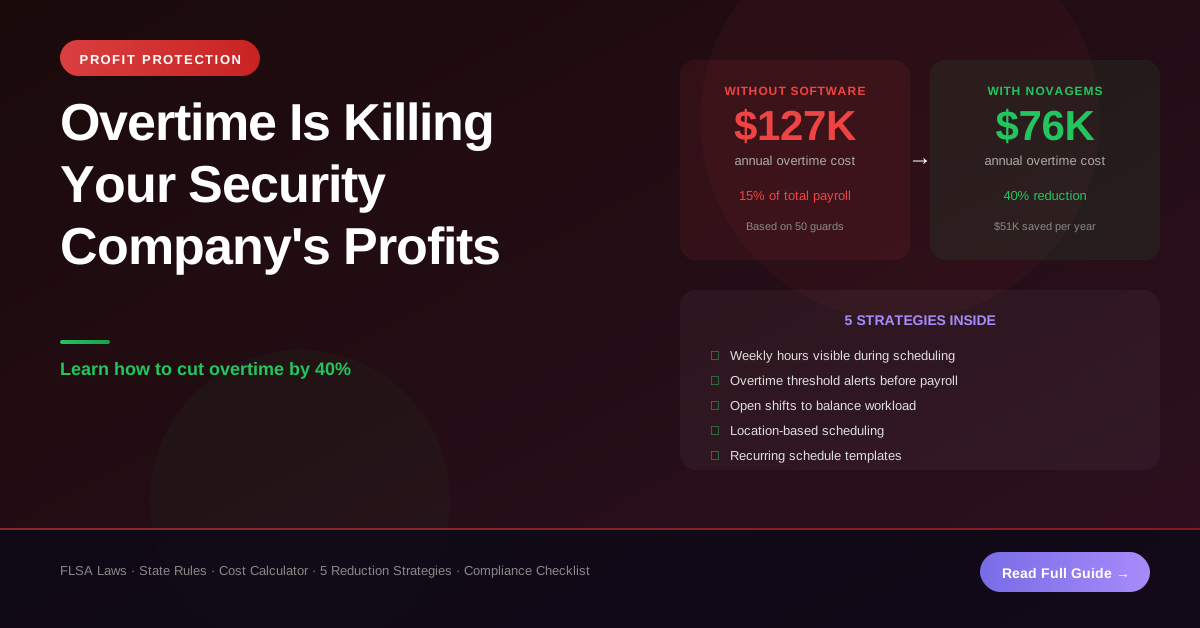
Overtime is the silent profit killer in the security industry. Every security company deals with it, but most do not know exactly how much it costs them or how much of it is preventable.
Here is the math that should concern every security company owner: if you have 50 guards and each one averages just 3 hours of unplanned overtime per week at a burdened rate of $35/hour, that is $273,000 per year walking out the door. Not billed to clients. Not budgeted. Just gone.
This guide breaks down the overtime laws that apply to security guards in the US and Canada, shows you how to calculate the true cost of overtime, and gives you five scheduling strategies that security companies are using right now to cut non-billable overtime by up to 40%.
Why Overtime Is Killing Security Company Profits
The security industry runs on thin margins. Most contract security companies operate between 2% and 8% net profit. Overtime eats directly into that margin because the cost increase is rarely passed through to the client.
Consider these industry realities:
- Guard turnover averages 100-200% annually, which means constant training of new guards who are more likely to trigger overtime due to scheduling gaps.
- Last-minute call-offs force supervisors to extend existing shifts, creating unplanned overtime.
- Travel time between sites pushes guards past the 40-hour mark without adding billable hours.
- Early clock-ins and late clock-outs add 10-20 minutes per shift that compound across a workforce.
A study from the Bureau of Labor Statistics found that security guards working extended hours have significantly higher rates of workplace injuries, adding workers’ compensation costs on top of the overtime expense itself.
The problem is not that overtime exists. Some overtime is necessary and billable. The problem is uncontrolled, non-billable overtime that happens because nobody saw it coming until the payroll report arrived.
Federal Overtime Laws: FLSA Rules for Security Guards
The Fair Labor Standards Act (FLSA) is the baseline for overtime law in the United States. Here is what security company owners need to know:
Key FLSA Rules
- Overtime threshold: Any hours worked over 40 in a single workweek must be paid at 1.5x the regular rate.
- Workweek definition: A fixed, recurring 168-hour period (7 consecutive 24-hour periods). You choose when your workweek starts, but it must be consistent.
- Non-exempt status: Most security guards are classified as non-exempt under the FLSA, regardless of job title. Calling someone a “supervisor” does not make them exempt unless they meet the salary basis test ($684/week minimum) and the duties test (genuine management authority over other employees).
- No daily overtime at the federal level: The FLSA only counts weekly hours. A guard can work a 16-hour shift without triggering federal overtime, as long as weekly hours stay under 40.
- No comp time for private employers: Private security companies cannot offer compensatory time off instead of overtime pay. That option is only available to government employers.
- The 8/80 rule does NOT apply: The healthcare-specific 8/80 overtime provision does not extend to the security industry.
Common FLSA Violations in Security Companies
- Misclassifying guards as independent contractors to avoid overtime obligations
- Not counting travel time between job sites during a shift as hours worked
- Requiring off-the-clock work such as mandatory pre-shift briefings without pay
- Averaging hours across two workweeks (e.g., 35 hours one week and 45 the next does NOT average to 40 — the second week still requires 5 hours of overtime pay)
Violations carry penalties of up to $1,000 per violation under the FLSA, and employees can sue for back pay going back 2-3 years.
State-Specific Overtime Rules (California, Texas, Florida, New York)
Federal law sets the floor, but several states add stricter requirements. If you operate in multiple states, you must comply with whichever law is more favorable to the employee.
| Rule | Federal (FLSA) | California | Texas | Florida | New York |
|---|---|---|---|---|---|
| Weekly overtime threshold | 40 hours | 40 hours | 40 hours | 40 hours | 40 hours |
| Daily overtime | None | After 8 hours (1.5x) | None | None | None |
| Double-time | None | After 12 hours daily | None | None | None |
| 7th consecutive day | None | 1.5x first 8 hrs, 2x after | None | None | None |
| State minimum wage (2026) | $7.25 | $16.50+ | $7.25 | $7.25 | $15.00-$16.00 |
| Mandatory rest periods | None | 10 min per 4 hours | None | None | None |
| Meal break requirement | None | 30 min if shift > 5 hours | None | None | None |
California: The Strictest State for Security Companies
California is the most complex state for overtime management. Key rules:
- Daily overtime kicks in after 8 hours in a single day, not just 40 hours in a week
- Double-time applies after 12 hours in a day
- 7th consecutive day triggers overtime for the first 8 hours and double-time after that
- Alternative workweek schedules (e.g., 4x10) are allowed but require a formal employee vote and written agreement
- Penalties for violations include paying the employee’s attorney fees in addition to back pay
If you run security operations in California, every shift that runs even 30 minutes past 8 hours costs you overtime — even if the guard is only at 30 weekly hours.
Texas and Florida: Follow Federal Rules
Both states follow the FLSA without additional state-level overtime requirements. However, you still must comply with federal overtime, minimum wage, and record-keeping rules.
New York: Higher Minimum Wage Impacts Overtime Costs
New York follows the federal 40-hour weekly overtime threshold but has a significantly higher minimum wage. Since overtime is calculated as 1.5x the regular rate, a higher base wage means a higher overtime rate — making overtime more expensive per hour than in states like Texas or Florida.
Canadian Overtime Rules by Province (Ontario, Alberta, BC)
For security companies operating in Canada, overtime rules vary by province and are governed by provincial employment standards rather than a single federal law.
| Rule | Ontario | Alberta | British Columbia |
|---|---|---|---|
| Weekly overtime threshold | 44 hours | 44 hours | 40 hours (daily: 8 hours) |
| Overtime rate | 1.5x after 44 hrs/week | 1.5x after 44 hrs/week | 1.5x after 8 hrs/day or 40 hrs/week |
| Daily overtime | None | After 8 hours (with some exceptions) | After 8 hours |
| Double-time | None | After 12 hours | After 12 hours daily |
| Averaging agreements | Allowed (written agreement) | Allowed (written agreement) | Allowed (written agreement) |
| Maximum daily hours | No statutory max (reasonable) | 12 hours (unless agreement) | No statutory max |
Key Differences from the US
- Ontario and Alberta use a 44-hour weekly threshold, giving security companies 4 extra hours before overtime kicks in compared to most US states.
- British Columbia uses both daily (8-hour) and weekly (40-hour) thresholds — similar to California.
- Averaging agreements are available in all three provinces, allowing employers to average hours over multiple weeks (typically 2-4 weeks) with a written agreement. This can be valuable for security companies with rotating schedules.
The Real Cost of Overtime (With Calculation Example)
Most security company owners look at overtime cost as simply “time and a half.” The actual cost is significantly higher once you factor in the burdened rate.
What Goes Into the True Overtime Cost
The burdened cost includes everything you pay on top of wages:
- Employer payroll taxes (Social Security, Medicare): 7.65%
- Federal and state unemployment insurance: 2-6%
- Workers’ compensation insurance: 3-8% (security industry rates are higher)
- General liability insurance (if calculated per labor hour): 2-5%
- Benefits allocation (if applicable): Variable
These costs are multiplied by the overtime rate, not the regular rate. That is the detail most owners miss.
Overtime Cost Calculation: Real Example
Let us walk through the math for a single guard:
| Cost Component | Regular Rate | Overtime Rate |
|---|---|---|
| Base hourly wage | $18.00 | $27.00 (1.5x) |
| Payroll taxes (7.65%) | $1.38 | $2.07 |
| Workers’ comp (5%) | $0.90 | $1.35 |
| Unemployment insurance (3%) | $0.54 | $0.81 |
| GL insurance allocation (2%) | $0.36 | $0.54 |
| Total burdened cost per hour | $21.18 | $31.77 |
| Cost premium over regular rate | – | +$10.59/hour (+50%) |
Now scale that across your company:
| Scenario | Weekly Overtime Hours | Overtime Cost per Week | Annual Overtime Cost |
|---|---|---|---|
| 20 guards, 2 hrs OT each | 40 hours | $1,270 | $66,040 |
| 50 guards, 3 hrs OT each | 150 hours | $4,766 | $247,812 |
| 100 guards, 4 hrs OT each | 400 hours | $12,708 | $660,816 |
| 200 guards, 5 hrs OT each | 1,000 hours | $31,770 | $1,652,040 |
A 100-guard security company with an average of 4 hours overtime per guard per week is spending over $660,000 annually on overtime alone. If even half of that overtime is non-billable, that is $330,000 in lost profit — likely more than the company’s entire net income.
Billable vs Non-Billable Overtime — The Hidden Margin Killer
Not all overtime is created equal. The distinction between billable and non-billable overtime is where security company margins live or die.
Billable Overtime
This is overtime that your client requested, contracted for, or agreed to pay for. Examples:
- Client asks for extended coverage during a special event
- Contract specifies holiday pay at overtime rates
- Client requests an additional guard on short notice and agrees to the overtime rate
Billable overtime is manageable because the cost is passed through. Your margin may be thinner, but you are not losing money.
Non-Billable Overtime
This is overtime the company absorbs. It is pure cost with zero revenue attached. Common causes:
- Scheduling errors: A guard is assigned 44 hours without anyone noticing
- Shift overruns: Guards stay 15-30 minutes past their shift end for handoff, report writing, or because the relief guard is late
- Early clock-ins: Guards arrive and clock in 10-15 minutes before their shift starts
- Travel time: Guards traveling between two client sites during a split shift
- Coverage for call-offs: When a guard calls in sick 30 minutes before a shift, the on-duty guard stays and racks up overtime
- Training time: Mandatory training that pushes weekly hours past 40
The Margin Impact
Here is what non-billable overtime does to a typical security contract:
Assume a contract bills at $25/hour and your regular burdened labor cost is $21.18/hour. That gives you a gross margin of $3.82/hour (15.3%).
Now a guard works 4 hours of non-billable overtime at a burdened cost of $31.77/hour. Those 4 hours cost you $127.08 but generate $0 in revenue. To recover that $127.08, you need 33.3 additional regular billable hours at your $3.82 margin.
One guard’s 4 hours of non-billable overtime requires more than 33 hours of regular work to break even. That math is why overtime management is not optional — it is survival.
5 Scheduling Strategies to Reduce Overtime by 40%
These are not theoretical ideas. These are the strategies that security companies use every day to keep overtime under control. The companies that implement all five consistently report 25-40% reductions in non-billable overtime within the first 90 days.
Strategy 1: Make Weekly Hours Visible During Scheduling
The number one cause of unplanned overtime is that the person building the schedule cannot see how many hours each guard has already been assigned for the week.
How it works:
- When assigning a shift, you should see the guard’s current weekly total in real time
- If assigning a 12-hour shift to a guard who already has 32 hours, you know before you publish the schedule that this guard will hit 44 hours
- Use a scheduling tool that shows weekly hours next to each guard’s name — not buried in a separate report
Without visibility: You build the schedule, publish it, and discover overtime in the payroll report two weeks later.
With visibility: You see the overtime risk before the shift is assigned and choose a different guard.
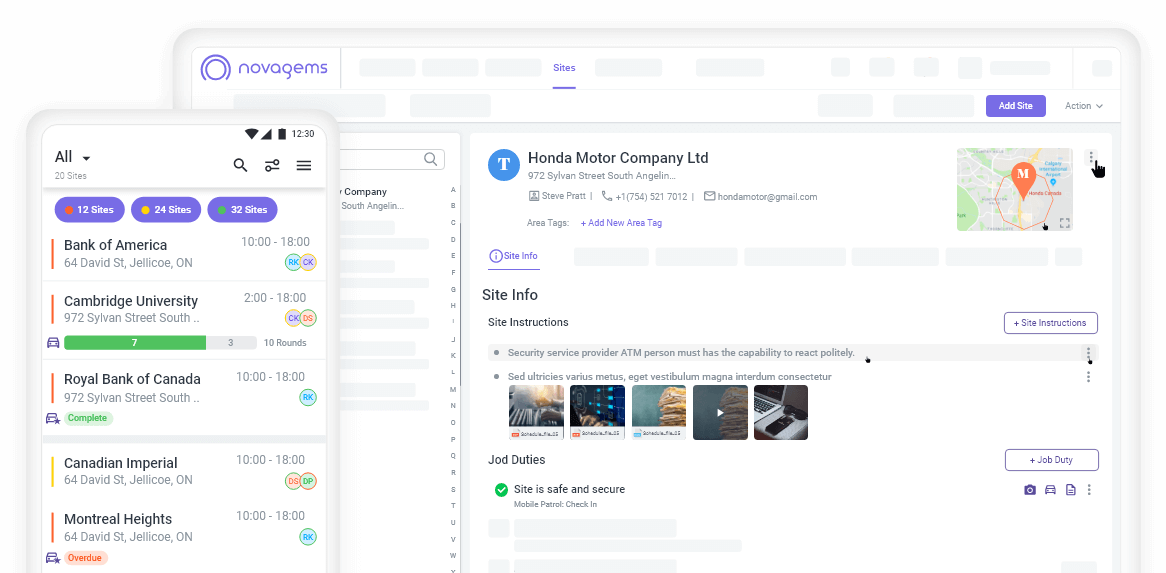
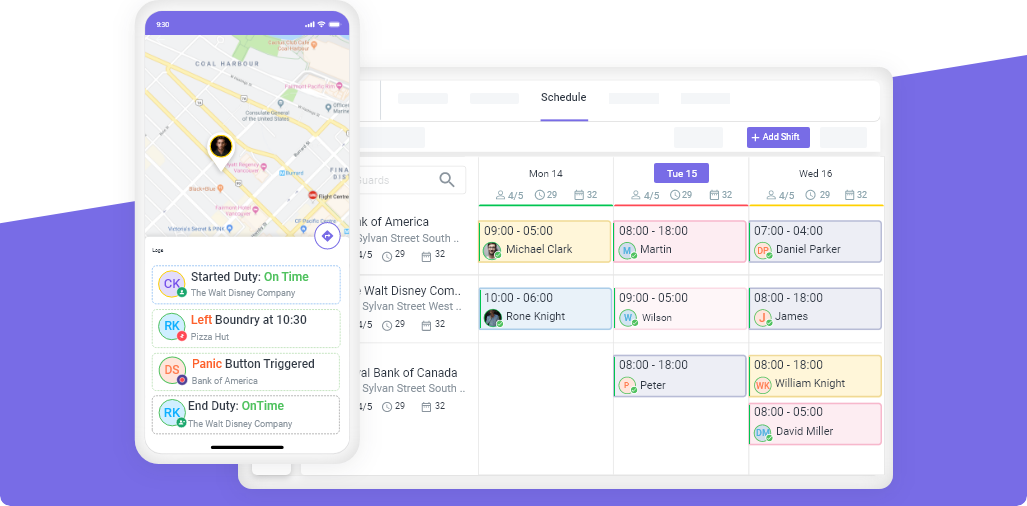
Novagems employee scheduling shows each guard’s weekly hours in real time during the scheduling process, so dispatchers can make informed decisions before overtime occurs.
Strategy 2: Set Overtime Threshold Alerts
Do not wait until a guard hits 40 hours to react. Set alerts at 32, 36, and 38 hours so you have time to redistribute shifts.
Implementation:
- 32-hour alert (Yellow): This guard is approaching the threshold. Avoid assigning additional shifts unless necessary.
- 36-hour alert (Orange): This guard will hit overtime if they work one more standard shift. Actively look for alternatives.
- 38-hour alert (Red): Do not assign any more hours unless approved by a manager.
This tiered alert system gives your schedulers a 2-3 day window to prevent overtime instead of reacting to it after the fact.
With Novagems alerts and notifications, you can configure custom overtime threshold alerts that notify dispatchers and managers before guards cross the overtime line.
Strategy 3: Use Open Shifts to Balance Workload
Instead of assigning every shift to a specific guard, post some shifts as “open” and let available guards claim them.
Why it works:
- Guards who are under 40 hours are more likely to pick up open shifts
- It naturally distributes hours across your workforce instead of concentrating them on a few guards
- Guards feel more in control of their schedule, which improves retention
Best practices:
- Post open shifts at least 48 hours in advance
- Set eligibility rules: only guards under 36 weekly hours can claim the shift
- Require manager approval for guards above 36 hours
This approach works especially well for filling call-off gaps without defaulting to whoever is already on-site (and already close to overtime).
Strategy 4: Schedule Based on Location (Reduce Travel Overtime)
Travel time between sites during a shift counts as hours worked under the FLSA. If a guard travels 45 minutes between two sites in the middle of their day, that is 45 minutes of non-billable time that pushes them closer to overtime.
How to fix it:
- Assign guards to a primary location and minimize cross-site assignments during a single shift
- When a guard must cover two sites, schedule them back-to-back at the same location cluster
- Use geographic scheduling to group nearby sites and assign guards based on proximity
- Track travel time separately so you can identify which site combinations are creating the most non-billable hours
Companies that switch to location-based scheduling typically reduce travel-related overtime by 15-25%.
Strategy 5: Copy Recurring Schedules to Prevent Drift
“Schedule drift” happens when a well-planned base schedule gets modified week after week until it no longer reflects the original design. A shift that was supposed to be 8 hours becomes 10. A guard who was supposed to work 4 days is now working 5.
How to prevent it:
- Build a master schedule template that keeps every guard under 38 hours
- Copy this template each week instead of building from scratch
- Only make modifications for specific, documented reasons (call-offs, client requests, etc.)
- Review actual vs. planned hours weekly using reporting and analytics to catch drift early
When you copy a proven schedule instead of rebuilding it, you start each week with a controlled baseline. Overtime only occurs from intentional changes, not from gradual drift.
How Workforce Management Software Prevents Overtime
Spreadsheets and manual scheduling cannot solve overtime because they lack real-time visibility. By the time you discover overtime in a spreadsheet, the hours have already been worked and the money is already spent.
Workforce management software attacks overtime at the prevention stage, not the reporting stage.
What the Software Does That Spreadsheets Cannot
| Capability | Spreadsheet | Workforce Management Software |
|---|---|---|
| Show guard’s weekly hours during scheduling | ✗ | ✓ |
| Alert when a guard approaches overtime | ✗ | ✓ |
| Post open shifts with eligibility rules | ✗ | ✓ |
| Track actual clock-in/out vs. scheduled times | ✗ | ✓ |
| Flag early clock-ins and late clock-outs | ✗ | ✓ |
| Generate overtime cost reports by site | ✗ | ✓ |
| Calculate billable vs. non-billable overtime | ✗ | ✓ |
| Prevent shift assignment when guard is over threshold | ✗ | ✓ |
The ROI Calculation
If your company spends $250,000/year on non-billable overtime and software helps you reduce that by 35%, you save $87,500/year. Most workforce management platforms cost between $3,000 and $15,000/year for a 50-guard operation — a payback period of less than 2 months.
Start a free trial with Novagems to see how much overtime you can eliminate with real-time scheduling visibility and automated alerts.
Building an Overtime Policy for Your Security Company
Having the right tools is only half the solution. You also need a clear, written overtime policy that every manager and guard understands.
What Your Policy Should Include
1. Overtime Definition and Rates State explicitly which overtime rules apply (federal, state, or both). Include the specific rate multipliers and when they apply.
2. Authorization Process Define who can authorize overtime and how. A typical structure:
- Site supervisors can authorize up to 2 hours of overtime for emergency coverage
- Operations managers must approve any overtime above 2 hours
- All overtime above 8 hours/week requires director-level approval
3. Maximum Weekly Hours Set a company-wide maximum. Many security companies cap guards at 48-52 hours per week to control costs and reduce fatigue-related incidents.
4. Fair Distribution Require that overtime is distributed equitably among qualified guards. This prevents a small group of guards from accumulating excessive hours while others want more work.
5. Documentation Requirements Every overtime event should be documented with:
- Reason for the overtime
- Who authorized it
- Whether it is billable or non-billable
- Which client site it occurred at
6. Consequences for Unauthorized Overtime Make clear that working unapproved overtime is a policy violation. Note that you must still pay for unauthorized overtime under the FLSA — you cannot withhold pay — but you can address it through progressive discipline.
7. Review Cadence Review overtime data weekly. Do not wait for monthly payroll reports. The best security companies review overtime every Monday morning for the previous week and adjust the upcoming schedule accordingly.
Overtime Compliance Checklist
Use this checklist to audit your company’s overtime practices. Address any items marked “No” immediately — they represent compliance risk and potential financial liability.
| Compliance Item | Yes | No | Action Needed |
|---|---|---|---|
| All guards classified as non-exempt (unless they meet both salary and duties tests) | Review job descriptions and pay structure | ||
| Overtime calculated on a single workweek basis (no averaging across weeks) | Update payroll procedures | ||
| Travel time between sites during a shift counted as hours worked | Audit time records for travel gaps | ||
| Pre-shift and post-shift activities (briefings, equipment checks) counted as hours worked | Review clock-in/out policies | ||
| State-specific rules followed (daily OT in CA, higher minimum wage in NY, etc.) | Consult state labor department or attorney | ||
| Overtime records retained for at least 3 years | Check record retention policy | ||
| Written overtime policy distributed to all guards | Create or update policy document | ||
| Overtime authorization process documented and enforced | Implement approval workflow | ||
| Payroll system correctly calculates blended overtime rate for guards working at different rates | Test payroll calculations | ||
| Manager training on overtime rules completed annually | Schedule compliance training |
Key Takeaways
Overtime management is not a payroll issue. It is an operations issue that must be solved at the scheduling stage, not after the fact.
Here is what to do this week:
- Calculate your current non-billable overtime cost using the burdened rate formula above. The number will be higher than you expect.
- Audit your compliance using the checklist. Fix any gaps before they become lawsuits.
- Implement overtime threshold alerts at 32, 36, and 38 hours. This single change typically reduces non-billable overtime by 15-20%.
- Move from spreadsheets to scheduling software that shows weekly hours in real time during the scheduling process.
- Write and enforce an overtime policy with clear authorization levels and weekly review cadence.
Security companies that take overtime management seriously protect their margins, reduce guard fatigue, stay compliant with federal and state laws, and build a more sustainable business.
The math is simple: every hour of non-billable overtime you prevent goes straight to your bottom line. For a 100-guard company, a 40% reduction in non-billable overtime can mean $250,000+ back in annual profit.
The first step is knowing the numbers. The second step is getting the right tools to control them.
See Novagems in action
Join 500+ security & cleaning companies that replaced spreadsheets with Novagems.
✓ 14-day free trial · ✓ Free onboarding · ✓ Cancel anytime