A guard does not show up for a Monday morning shift at a commercial property in Dallas. The client calls at 6:15 AM asking where the guard is. The operations manager starts making phone calls, trying to find someone, anyone, who can cover. By the time a replacement arrives at 8:30 AM, the client has been without security for over two hours.
The next day, the client asks for a meeting. Not to discuss the incident. To discuss whether they want to continue the contract.
This is not a rare scenario. It happens every week at security companies across North America. And the damage goes far beyond the cost of one missed shift.
In this guide, you will learn exactly why guards no-show, what each no-show actually costs your business, and 8 strategies that can reduce your no-show rate by 40-60%.
The Real Cost of No-Shows for Security Companies
No-shows are not just an inconvenience. They are a compounding financial problem.
Here is what a single no-show actually costs:
| Cost Component | Amount |
|---|---|
| Lost billable hours (avg 4 hrs until replacement) | $120-$200 |
| Emergency replacement premium (1.5x-2x rate) | $80-$160 |
| Manager time spent finding coverage | $50-$100 |
| Client relationship damage | Hard to quantify |
| Potential contract loss | $2,000-$10,000+/month |
| Total per incident | $250-$460+ |
Now multiply that by frequency. A 50-guard company with a 10% weekly no-show rate experiences roughly 5 no-shows per week. That is 260 no-shows per year, costing $65,000-$120,000 in direct costs alone, before accounting for lost contracts.
Why Security Guards Don’t Show Up (Root Causes)
Before you can fix no-shows, you need to understand why they happen. In our experience working with 500+ security companies, the reasons fall into predictable categories:
Scheduling issues (40% of no-shows)
- Guard was not aware of the shift (poor communication)
- Schedule changed and the guard was not notified
- Guard was double-booked and chose the other site
- Shift was too far from the guard’s home
Personal reasons (30%)
- Illness or family emergency (legitimate)
- Transportation problems
- Childcare issues
- Second job conflict
Disengagement (20%)
- Guard does not feel valued or accountable
- No consequences for previous no-shows
- Poor relationship with site supervisor
- Low pay relative to alternatives
System failures (10%)
- Guard never confirmed the shift
- No reminder was sent
- Manager forgot to assign the shift
- Miscommunication about start time
Notice that 50% of no-shows, scheduling issues and system failures, are entirely preventable with better processes and technology. The other 50% can be significantly reduced with the right policies.
Strategy 1: Require Shift Confirmations 24 Hours Before
The single highest-impact change you can make. When you assign a shift, the guard must confirm they will attend.
How it works:
- Guard receives shift notification with full details (site, time, post)
- Guard taps “Confirm” or “Decline” in the app
- Unconfirmed shifts get flagged to the manager 24 hours before start
- Manager reassigns only the flagged shifts, not the entire schedule
This turns a reactive process (finding out at shift start) into a proactive one (knowing 24 hours ahead). You go from managing 100% of your guards to managing only the 5-10% who have not confirmed.
Strategy 2: Set Up Automated Reminders (24hr + 2hr)
Human memory is unreliable. Guards who confirmed on Monday may genuinely forget about a Wednesday night shift.
Send two automated reminders:
- 24 hours before: Full shift details with confirm/decline option
- 2 hours before: Quick reminder with site address and start time
The 2-hour reminder catches the guards who confirmed but might have forgotten. It also gives you a 2-hour window to find a replacement if someone suddenly cannot make it.
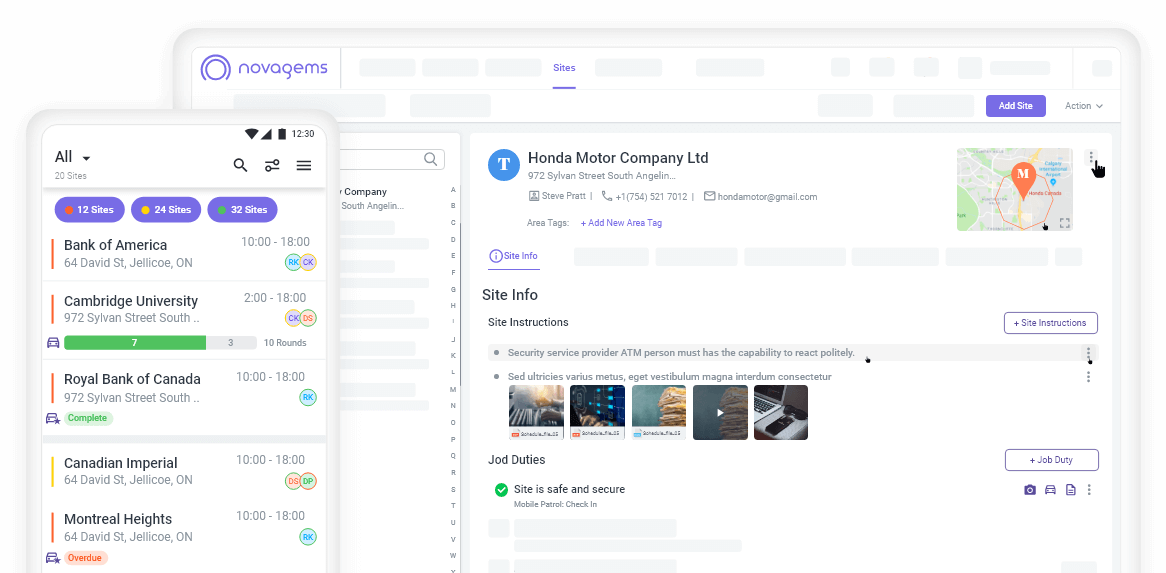
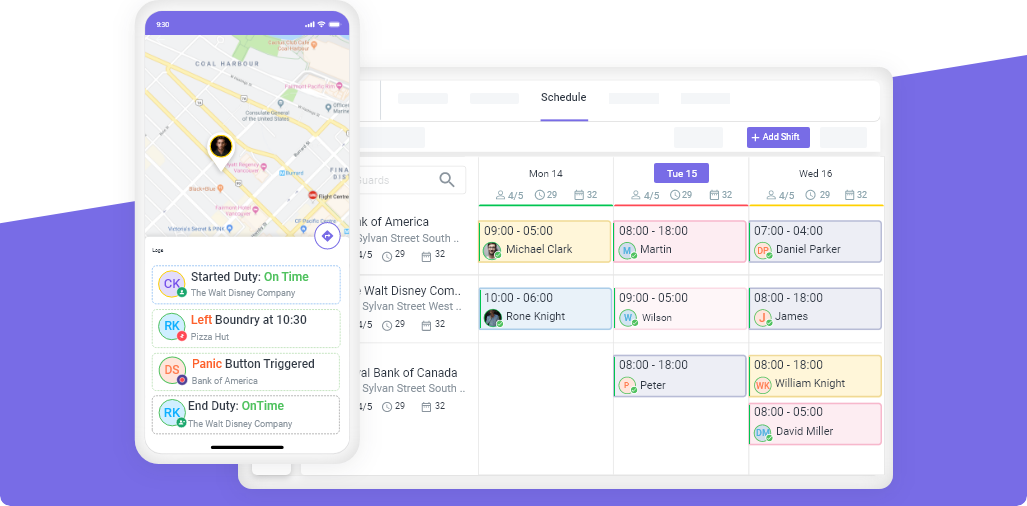
Scheduling software like Novagems automates both reminders. No manual texts, no phone calls, no hoping the guard remembers.
Strategy 3: Build a Backup Guard List for Every Site
When a no-show happens, the speed of your response determines the damage. If it takes 3 hours to find a replacement, the client suffers for 3 hours.
Build a standby list:
- Identify 3-5 guards per region who are available for last-minute shifts
- Prioritize guards who live close to multiple sites
- Include both full-time guards with open availability and part-time guards who want extra hours
- Keep the list updated weekly
When a no-show occurs, send an open shift notification to the standby list. First qualified responder gets the shift. This fills gaps in minutes, not hours.
Strategy 4: Use GPS-Verified Clock-In to Catch Late Arrivals Early
A no-show and a late arrival cause the same problem for the client: there is no guard on site when there should be.
GPS-verified clock-in catches both:
- If a guard has not clocked in within 15 minutes of shift start, an alert fires
- The manager sees it immediately and can start the replacement process
- No more waiting until the client calls to discover the problem
David, who manages 120 guards across 15 sites in Southern California, reduced his response time to no-shows from 2.5 hours to 35 minutes by implementing GPS clock-in alerts. The system tells him immediately when someone has not shown up, instead of waiting for a phone call.
Strategy 5: Track No-Show Patterns Per Guard
Not all no-shows are equal. A guard who no-shows once in six months is different from a guard who no-shows every other Monday.
Track patterns:
- Frequency: How many no-shows per guard in the last 90 days?
- Timing: Which days and shifts see the most no-shows?
- Sites: Do certain sites have higher no-show rates?
- Reasons: Are the reasons legitimate or pattern-based?
When you see that 80% of your no-shows come from 15% of your guards, you know exactly where to focus your attention. Some need coaching. Some need consequences. Some need to be replaced.
Strategy 6: Create a Clear No-Show Policy With Consequences
Guards need to know what happens when they do not show up. A clear policy, communicated during onboarding and reinforced consistently, sets expectations.
Sample no-show policy:
| Offense | Consequence |
|---|---|
| 1st unexcused no-show | Verbal warning, documented |
| 2nd unexcused no-show (within 90 days) | Written warning, loss of preferred shift priority |
| 3rd unexcused no-show (within 90 days) | Termination |
| Excused absence (with 4+ hours notice) | No penalty, documentation only |
| Pattern of last-minute cancellations | Performance review |
Important: Distinguish between unexcused no-shows (no contact, no reason) and excused absences (guard called ahead with a valid reason). Punishing legitimate emergencies destroys trust. Ignoring habitual no-shows destroys your business.
Strategy 7: Schedule Based on Proximity to Job Site
A guard who lives 45 minutes from a site is statistically more likely to be late or no-show than a guard who lives 10 minutes away. Traffic, weather, and transportation issues multiply with distance.
When assigning shifts, factor in:
- Guard’s home address relative to the site
- Public transit availability for guards without vehicles
- Travel time during the specific shift start time (6 AM traffic is different from 6 PM traffic)
This does not mean you can only assign local guards. It means you prioritize proximity for early morning shifts and sites with chronic no-show problems.
Strategy 8: Offer Incentives for Perfect Attendance
Consequences reduce bad behavior. Incentives encourage good behavior. You need both.
Effective incentives:
- Monthly bonus for zero no-shows ($50-$100)
- Priority access to preferred shifts and sites
- First pick on overtime and holiday shifts (higher pay)
- Public recognition (guard of the month)
- Annual attendance bonus
The cost of a $100 monthly bonus for perfect attendance is far less than the cost of replacing no-shows. If a bonus program prevents even one contract loss, it pays for itself many times over.
How Technology Eliminates Most No-Show Problems
Every strategy above works better with the right technology. Here is how the pieces connect:
- Shift confirmations and reminders are automated, not manual
- GPS-verified clock-in catches no-shows in real time, not hours later
- Alerts and notifications go to managers immediately when a guard has not clocked in
- Open shift notifications go to backup guards automatically
- Pattern tracking shows you which guards are reliable and which are not
- Proximity scheduling assigns guards based on distance to site
Companies using workforce management software report 40-60% reduction in no-shows within the first 90 days. The technology does not eliminate the human element. It eliminates the system failures that cause half of all no-shows.
Building a No-Show Response Playbook
Even with all 8 strategies in place, some no-shows will happen. Have a response playbook:
Minute 0-5: Alert fires that guard has not clocked in. Manager receives notification.
Minute 5-15: Manager contacts the guard directly. If no response, activate backup plan.
Minute 15-30: Open shift notification sent to standby list. First qualified responder assigned.
Minute 30-60: Replacement guard en route. Client notified with ETA.
After shift: Document the no-show. Update the guard’s record. Trigger the appropriate consequence from your no-show policy.
The difference between a company that loses contracts to no-shows and one that does not is not the absence of no-shows. It is the speed and professionalism of the response.
Start Reducing No-Shows This Week
You do not need to implement all 8 strategies at once. Start with the highest-impact changes:
- This week: Set up shift confirmations and 24-hour reminders
- Next week: Build your standby guard list for every region
- This month: Implement your no-show policy and communicate it to all guards
- Ongoing: Track patterns and adjust
Ready to automate shift confirmations, GPS clock-in alerts, and backup guard notifications? Start your free 14-day trial with Novagems and see how much time you save in your first week.
See Novagems in action
Join 500+ security & cleaning companies that replaced spreadsheets with Novagems.
✓ 14-day free trial · ✓ Free onboarding · ✓ Cancel anytime