Residential security services are professional security operations protecting homes, apartments, gated communities, and HOA-managed properties through on-site guards, mobile patrols, access control, and incident response. For most HOAs and property managers, the right setup is mobile patrol 3-6 times per night with GPS-verified checkpoints, paired with a dedicated access guard at the main gate during peak hours. This guide covers what residential security actually does, how much it costs, how to hire a vendor that shows up (most don’t), and the technology every property manager should demand in 2026.
The dirty secret of residential security: most HOAs are paying for patrols that aren’t happening. A recent audit of one mid-size HOA found their security vendor was billing for 6 nightly patrols but GPS data showed an average of 2.3. The residents felt safe because the guard company said so, not because the patrols were verified.
This guide is written for HOA board members, property managers, and community association executives who need residential security that works, not security theater.
What Residential Security Services Cover
Residential security isn’t one service, it’s a menu. Most communities use 2-4 of the following based on risk, budget, and property layout:
| Service | What It Does | Typical Use |
|---|---|---|
| Gate / access control | Verifies residents, logs visitors, checks deliveries, operates gates | Gated communities, high-rises |
| Mobile patrol | Scheduled drive-throughs, foot patrols, property inspections | HOAs, apartment complexes, condo associations |
| On-site dedicated guard | 8-24 hour post at a specific location | High-value communities, after incidents, special events |
| Alarm response | Dispatches guards when alarms trigger | Single-family homes, properties with fire/intrusion systems |
| Concierge-security | Hybrid role, resident services plus safety patrols | Luxury high-rises, condo buildings |
| Rule enforcement | Parking, noise, pool hours, pet rules | HOAs with strict CC&Rs |
| Amenity oversight | Pool, gym, clubhouse, playground monitoring | Communities with shared amenities |
| Event coverage | HOA meetings, holiday parties, resident gatherings | Any community hosting events |
| Incident response | Trespass, disturbance, suspicious activity | All properties |
| Reporting | Nightly activity logs, incident reports, maintenance alerts | All properties |
A well-run community uses 3-5 of these together. A mid-size gated community (200-500 homes) might pair a full-time gate guard with nightly mobile patrols and on-call alarm response. A high-rise condo might use 24/7 concierge-security at the lobby plus interior patrols every 2 hours.
Types of Residential Security by Property Type
Not every residential property has the same needs. The right setup depends on density, layout, and risk profile.
Gated Communities
Gated communities have a clear perimeter and one or more controlled entry points. The typical setup:
- Main gate — 24/7 or peak-hours guard for visitor verification, delivery processing, and resident recognition
- Mobile patrol — 3-6 randomized patrols per night covering streets, common areas, pool, clubhouse, mail facility
- Checkpoint scans, guards scan QR/NFC tags at fixed locations to prove patrols happened
- Resident/visitor app, digital visitor passes, guest lists, delivery pre-authorization
For communities of 200-500 homes, expect $120,000-$250,000/year for this setup. Communities over 1,000 homes often run $400,000-$800,000/year.
Apartment Complexes / Multifamily
Apartments typically don’t have gates but have controlled entries, mail rooms, parking garages, and shared amenities. The typical setup:
- Evening/overnight courtesy patrols — 3-5 hours per night, usually 8pm-1am
- Parking enforcement, tow authorization, permit checks
- Pool/amenity monitoring, hours enforcement, guest limits
- Incident response, noise complaints, trespass, disturbance
Most multifamily properties spend $2,000-$8,000/month depending on size and hours. Larger Class A properties (300+ units) may run $10,000-$20,000/month.
HOA Communities (Non-Gated)
Non-gated HOAs, typical suburban subdivisions, rely almost entirely on mobile patrol since there’s no perimeter. The typical setup:
- Mobile patrol — 3-6 drive-throughs per night
- Parking/violation documentation, photo evidence for enforcement
- Amenity monitoring, pool, clubhouse, park areas
- Alarm response, if the HOA has monitored systems
Non-gated HOAs typically spend $500-$2,500/month. The biggest risk is paying for patrols that don’t happen, which is why GPS verification is non-negotiable.
Condominium Buildings / High-Rise
Condo buildings have the most concentrated risk, hundreds of residents in one structure with shared elevators, hallways, parking, and amenities. The typical setup:
- 24/7 concierge-security at lobby
- Scheduled interior patrols, every 2-4 hours through hallways, parking, amenities
- Package management, secured delivery rooms, chain-of-custody logs
- Visitor management, digital logs, elevator access control, guest escort
Expect $200,000-$500,000/year for a typical 150-300 unit building. Luxury buildings (concierge + security guard + doorman separately) can run $800,000-$1.5M/year.
Luxury / High-Net-Worth Communities
High-net-worth communities, private estates, ultra-luxury HOAs, celebrity enclaves, layer multiple services:
- Dedicated gate guards (armed or unarmed depending on threat profile)
- 24/7 roving patrols
- CCTV command center monitoring
- Close relationships with local law enforcement
- Executive protection integration for residents as needed
Budgets start around $500,000/year and can exceed $3M for large estates with multiple entry points.
Residential Security Pricing in 2026
Pricing varies by region, service type, and contract volume. These ranges reflect national averages; expect 15-25% premiums in major metros (NYC, LA, SF, Chicago, DC, Miami).
Hourly Rates
| Service Level | Unarmed | Armed |
|---|---|---|
| Standard residential guard | $18-$28/hr | $28-$42/hr |
| Gated community access guard | $22-$32/hr | $32-$48/hr |
| Concierge-security (high-rise) | $28-$40/hr | N/A |
| Supervisor / account manager | $35-$55/hr | $45-$65/hr |
Mobile Patrol Packages
| Patrol Frequency | Monthly Cost (per property) |
|---|---|
| 1-2 patrols/night | $300-$600 |
| 3-4 patrols/night | $600-$1,200 |
| 5-6 patrols/night | $1,200-$2,000 |
| Hourly patrols (8-12/night) | $2,000-$4,000+ |
Mobile patrol is shared across multiple clients in the same area, the same patrol vehicle might cover 15-25 properties in a single night. That’s why it’s cost-effective for HOAs but requires GPS verification to confirm your property was actually visited.
Dedicated Post Pricing
A 24/7 dedicated guard post (168 hours/week) at $25/hour:
- Weekly cost: $4,200
- Monthly cost: ~$18,200
- Annual cost: ~$218,400
Add a second guard for busy shifts and overlap coverage: ~$280,000-$340,000/year. This is why most communities use mobile patrol for routine coverage and reserve dedicated posts for high-traffic times.
What Drives Pricing Up
- Armed vs unarmed (1.5-2x premium)
- Union labor markets
- Large property footprint (more time per patrol)
- 24/7 vs business hours
- Specialized training (CPR, AED, de-escalation, firearms)
- Technology requirements (some companies charge extra for GPS, apps, dashboards, though this should be standard in 2026)
- Risk level (recent incidents, high-profile residents)
Patrol Frequency: How Often Should Security Actually Visit?
This is the most common HOA board question, and the answer depends on deterrence value vs cost.
| Property Type | Recommended Patrols/Night | Why |
|---|---|---|
| Small HOA (under 100 homes) | 2-3 randomized | Cost-effective deterrent |
| Mid-size HOA (100-500 homes) | 3-5 randomized | Standard industry baseline |
| Large HOA (500-1,500 homes) | 5-8 randomized + dedicated gate | Multiple zones need separate coverage |
| Luxury / high-risk | Hourly + dedicated post | High asset value, threat profile |
| Apartment complex | 3-5 per evening | Focus on 8pm-1am window |
| Condo high-rise | Every 2-4 hours (interior) | Shared spaces need regular presence |
Critical rule: patrols must be randomized. If a patrol always happens at 10pm, 12am, and 2am, criminals learn the schedule in a week. Good residential security uses randomized intervals, anywhere between 45 minutes and 3 hours apart, with GPS-tracked checkpoints to verify each visit.
Verifying Patrols Actually Happen
This is where most HOAs get ripped off. Vendors bill for patrols that never occurred. Prevention:
- Require GPS tracking on every patrol vehicle and guard.
- Mandate checkpoint scans at 4-8 fixed locations (gate, pool, clubhouse, mail room, back entrance, parking lots).
- Demand nightly automated reports showing: time arrived, time departed, checkpoints scanned, incidents observed.
- Random audits, spot-check 1-2 nights per month against GPS logs.
- Never accept paper logs, they’re trivially falsified.
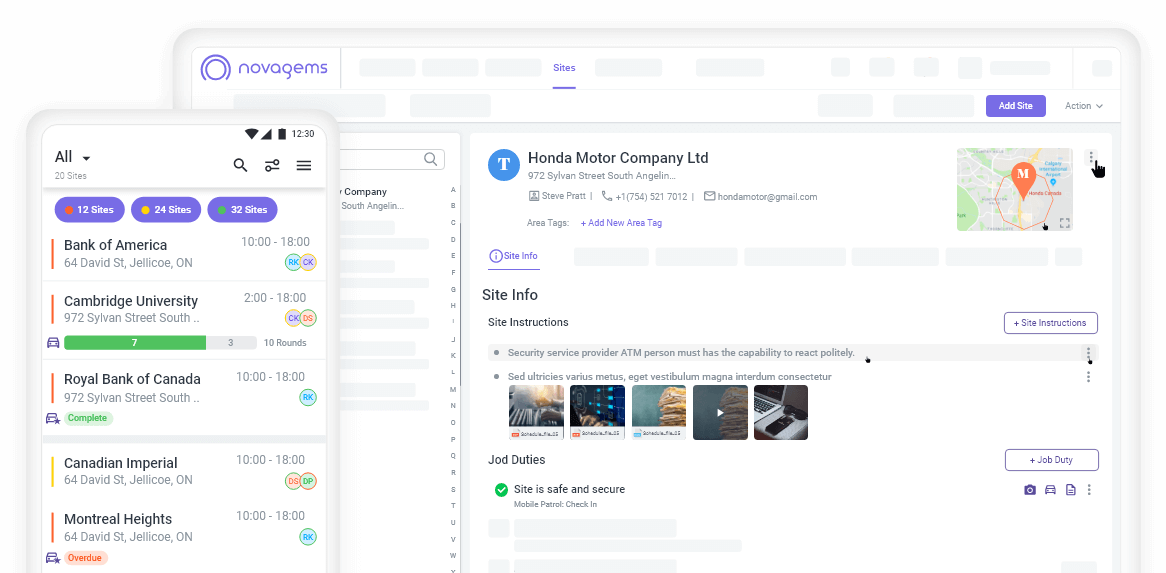
Modern platforms like Novagems give property managers live dashboard access so they can see patrols happening in real time. If your vendor can’t offer this, ask why.
Gate Operations for Gated Communities
For communities with gates, gate operations are the most visible, and most abused, part of residential security. Common failure modes:
| Failure | What Happens | Fix |
|---|---|---|
| Guards wave residents through without checking | Ex-residents, unauthorized ex-spouses, stalkers get in | Mandatory credential check every entry |
| Delivery drivers buzz in with generic “delivery” | Cargo theft, mail theft, scam door-to-door | Require delivery confirmation via resident app |
| Guard leaves post for breaks without coverage | 30-90 min gaps with no one at gate | Schedule overlap shifts; enforce break rotation |
| Paper visitor logs lost, illegible, or fake | No audit trail after incidents | Digital visitor management with photo capture |
| Guard socializes with residents for long periods | Delays at gate, missed threats | Training on professional distance |
What a Well-Run Gate Looks Like
- Resident lane, fast scan of decal, transponder, or plate recognition; under 10 seconds.
- Visitor lane, verification via resident pre-authorization, ID check, photo capture, gate pass printed or emailed.
- Delivery lane, confirmed against resident order list; signature/photo for larger packages.
- Denied entry protocol, clear de-escalation script; supervisor escalation; police dispatch if refused.
- Overnight protocol, stricter visitor rules (resident must pre-authorize or come to gate); increased suspicion for unknown vehicles.
Technology Modern Residential Security Should Use
If your vendor is still using pen and paper, fire them. In 2026, residential security should include:
GPS-Verified Patrols
Every patrol vehicle and guard should be GPS-tracked. You should see, on a live dashboard, where the patrol car is right now, what route it took last night, and how long it spent at each stop. See how GPS tracking and geofencing works in practice.
Checkpoint / Tour Verification
Guards scan NFC tags or QR codes at fixed locations (gate, pool, back fence, clubhouse, mail room). If a checkpoint was missed, the dashboard flags it. This prevents the “drive through the parking lot and leave” fake patrol. Read about NFC tags for guard tours.
Digital Incident Reporting
Guards file incident reports from a mobile app with photos, video, timestamps, and GPS location. Property managers get incident notifications within minutes, not the next morning. See checkpoint tours for details.
Visitor Management Systems
Residents pre-authorize visitors in an app; visitors scan a QR code at the gate; entry is logged automatically. No paper, no illegible handwriting, no “I forgot to list my guest.”
Real-Time Supervisor Dashboards
Property managers and HOA boards should have view-only access to a dashboard showing:
- Guards currently on duty
- Recent patrols with GPS breadcrumb trails
- Incident count by type (trespass, noise, vehicle issue, maintenance alert)
- Monthly patrol completion rate
Platforms like Novagems are built exactly for this. If your vendor uses it (or something equivalent), you have verification. If they don’t, you have hope.
Automated Nightly Reports
A summary emailed every morning: patrols completed, checkpoints scanned, incidents logged, anything unusual observed. Residents don’t need to read this, but the HOA board does.
How to Hire a Residential Security Vendor (and Not Get Burned)
Most HOA boards hire the first or cheapest vendor. That’s how they end up with paid-for patrols that don’t happen. Better process:
Step 1. Define Your Scope Clearly
Before asking for quotes, write a 1-2 page scope document including:
- Property type, size, number of units
- Current security setup (if any)
- Desired services (patrol frequency, gate hours, incident response)
- Key pain points (specific past incidents, chronic issues)
- Budget range (share it, smart vendors will give you honest options; evasive ones won’t)
Vague scopes produce vague bids.
Step 2. Request Proposals from 3-5 Vendors
Include: at least two established regional companies, one national chain (for comparison pricing), and one local/smaller firm (often highest service quality). Give all vendors the same scope document and a consistent deadline.
Step 3. Evaluate Beyond Price
A checklist for comparing proposals:
| Criterion | What to Look For |
|---|---|
| State licensing | Verify current with state regulator (BSIS in CA, DOS in NY, etc.) |
| Insurance | $1M-$2M general liability minimum; COI naming HOA as additional insured |
| References | 3+ similar properties; actually call them and ask about response time, retention, and billing accuracy |
| Training | Documentation of state-required training plus company-specific training |
| Technology | GPS tracking, mobile app, real-time dashboards, digital reporting |
| Supervision | Named supervisor, escalation process, availability outside business hours |
| Contract terms | Clear cancellation clause, rate change notice (60+ days preferred), no auto-renewal traps |
| Turnover | Ask about guard retention rate, under 40% annual turnover is good; 80%+ is a red flag |
| Pricing transparency | Itemized, no “all-inclusive” pricing that hides overtime and holiday premiums |
Step 4. Site Visits and Interviews
Invite top 2-3 finalists to walk the property with the HOA president and property manager. How they engage with the property, asking questions about traffic patterns, identifying weak spots, proposing specific routes, tells you more than any proposal document.
Step 5. Start with a Pilot Period
Sign an initial 90-day term with clear performance metrics (patrol completion rate, incident response time, report quality). Reassess before extending to a 1-3 year contract. Never sign a long-term contract before proving the vendor performs.
Red Flags and Green Flags
After reviewing 50+ residential security proposals, these patterns predict vendor quality:
Red Flags
- “Call for pricing” on their website, usually means prices are inflated and vary by what they think you’ll pay
- No GPS tracking or “we can add it if you want”, it should be standard
- Paper logs or PDF scans of handwritten reports, guaranteed data loss and falsification
- Guard photos in marketing with photoshopped uniforms, outsourced to low-budget marketing, likely outsources everything
- Pressure to sign long contracts before pilot, confident vendors offer pilots
- Vague references (“we work with lots of HOAs in the area”) without specific names
- No supervisor named, you’ll be dealing with whoever answers the phone
- Rapid turnover stories from current clients, guards change monthly; quality impossible
Green Flags
- Live demo of their GPS dashboard during the sales process
- Specific examples of incidents handled well at similar properties
- Transparent pricing with clear hourly breakdowns
- Honest about what they can’t do (e.g., won’t commit to arrest authority, won’t claim armed response if not licensed)
- Named supervisor and clear escalation path
- Pilot period offered without pressure
- Multi-year retention on reference calls (guards staying 2+ years is rare and valuable)
- Technology partnership, they use professional workforce management platforms (like Novagems or equivalent), not homemade spreadsheets
HOA Legal Considerations
HOAs using security services face unique legal constraints. Consult your HOA attorney before making any policy decisions.
What Private Security Can Do on HOA Property
- Observe and document rule violations (parking, noise, trespass)
- Issue warnings and notices per HOA CC&Rs
- Verbally direct people to leave common areas
- Call law enforcement for criminal matters
- Execute citizen’s arrest only if a felony is witnessed (high liability, most companies prohibit)
What Private Security Cannot Do
- Arrest or detain individuals for non-criminal matters
- Enter private units without owner consent or emergency (fire, medical)
- Tow vehicles without proper HOA authorization and signage
- Carry weapons without state firearms licensing
- Enforce rules not in the CC&Rs or local law
Liability Risks
HOAs can be held liable for security contractor actions through negligent hiring or supervision. Key protections:
- Verify licensing and insurance annually, not just at contract signing
- Name the HOA as additional insured on vendor’s liability policy
- Require vendor indemnification for guard actions
- Document all board decisions about scope and policy in meeting minutes
- Review use-of-force policies annually with HOA attorney
Common Residential Security Mistakes
| Mistake | What Goes Wrong | Fix |
|---|---|---|
| Paying for patrols without GPS verification | Vendor bills for visits that didn’t happen | Require GPS data in monthly reports |
| Accepting paper visitor logs | No audit trail after incidents | Digital visitor management required |
| No supervisor named | No escalation path when guards underperform | Contract must name primary supervisor |
| Long contract with no pilot | Locked into underperforming vendor | 90-day pilot, then 1-3 year term |
| Choosing cheapest bid | Quality and turnover collapse | Budget for the mid-range vendor |
| No incident reporting standard | Inconsistent documentation; legal exposure | Require standardized digital reports |
| Armed guards without clear justification | Insurance and liability explode | Use armed only when risk-assessed |
| HOA board micromanaging | Guards get conflicting orders | Single point of contact (property manager) |
| No annual review | Vendor performance drifts | Quarterly check-ins, annual review |
| Not communicating with residents | Residents don’t know rules, criticize vendor | Clear communication about what security does and doesn’t do |
Getting Started: Residential Security Checklist
If you’re starting from scratch or overhauling your current setup:
- Risk assessment, walk the property at night with HOA board and property manager. Identify dark spots, blind corners, unsecured areas, past incident locations.
- Resident survey, what do residents actually worry about? (Often different from what the board assumes.)
- Scope document — 1-2 pages defining services, hours, and expected outcomes.
- Vendor outreach. RFP to 3-5 companies.
- Proposal review, use the criteria table above.
- Site visits, top 2-3 finalists.
- Pilot contract — 90 days with performance metrics.
- Technology verification, confirm GPS, checkpoints, digital reporting work as promised.
- Monthly review, first 3 months, meet monthly with vendor supervisor.
- Annual review, scope, pricing, performance, contract extension.
Wrapping Up
Residential security is not a commodity. Two vendors with the same hourly rate can deliver wildly different outcomes based on training, technology, and supervision. The HOAs and property managers getting the best value aren’t finding the cheapest vendor, they’re finding the vendor who proves their patrols happen, documents everything digitally, and treats the property manager as a partner rather than an account number.
For property managers and HOA boards evaluating their current setup, the single most important question is: “Can you show me a live dashboard of last night’s patrols?” If the answer is yes, with GPS traces, checkpoint scans, and incident logs, you have a real security program. If the answer is “We’ll send you a report in the morning,” you have security theater.
Novagems helps residential security companies deliver the technology-verified operations that property managers expect. If you’re a security company serving HOAs or a property manager looking for tools to keep your current vendor honest, start a free 14-day trial and see how it works.
Further Reading
- Types of Security Guard Services: A Complete Guide, pillar article covering all 12 security service categories
- Event Security Services: Complete Guide, for HOAs hosting community events
- NFC Tags for Guard Tours, how checkpoint verification works
- GPS Tracking and Geofencing, the technology behind verified patrols
- Workforce Management for Security Companies, the operations platform residential security vendors should be using
Frequently Asked Questions
How much does residential security cost?
Residential security costs vary widely by service type. Dedicated on-site guards run $20-$35/hour unarmed and $30-$50/hour armed, typically billed 24/7 for gated communities ($175,000-$300,000/year for continuous coverage). Mobile patrol (random drive-throughs 2-6 times per night) ranges from $300-$1,500 per month depending on frequency. Alarm response is usually charged per dispatch ($50-$150 per call). Most HOAs and apartment complexes use a combination: mobile patrol nightly + on-call response for incidents.
How often should security patrol a residential community?
For most gated communities, 3-6 random patrols per night is the sweet spot, enough frequency to deter without the cost of a dedicated post. Patrols should be randomized (never same time) and verified with GPS-tracked checkpoints to prove they actually happened. High-risk properties (luxury communities, recent incidents, larger footprint) may need hourly patrols or a dedicated overnight post. Daytime patrols are usually less frequent (1-2 per shift) since residents are active.
What's the difference between a concierge, doorman, and security guard?
Concierge focuses on resident services, package handling, visitor greeting, reservations, amenity bookings. Doorman is primarily access control and courteous presence at the main entrance. Security guard is safety-focused, patrolling, enforcing rules, responding to incidents, reporting suspicious activity. Many luxury buildings combine the roles (concierge-security hybrid) but the training and liability differ significantly. Security guards need state licensing; concierges and doormen typically do not.
Should residential security guards be armed or unarmed?
For most residential settings, gated communities, apartment buildings, HOAs, unarmed guards are standard and appropriate. Armed guards increase liability, insurance costs (3-5x higher), and legal risk. Consider armed guards only if: the property has experienced violent incidents, cash is handled on-site, residents include high-net-worth or threatened individuals, or local law enforcement response times exceed 15 minutes. Most insurers and HOAs prefer unarmed guards paired with strong incident reporting and rapid police dispatch protocols.
Can HOAs legally enforce rules through private security?
HOAs can legally use private security to observe, document, and report violations, but security guards have no arrest authority beyond a citizen's arrest (which has strict limits and creates liability). Guards cannot physically remove trespassers, tow vehicles without the owner's authorization, or enter private units without cause. They can issue warnings, document violations with photos/reports, and call police for criminal matters. HOA CC&Rs and state laws govern what private security can enforce; always consult an HOA attorney before writing security into governing documents.
What technology should a residential security company use?
Modern residential security should include GPS-verified patrols (proof guards actually walked the property), checkpoint scanning at key locations (gate, pool, parking, mail room), real-time incident reporting with photo/video uploads, visitor management systems (digital logs replacing paper), and 24/7 supervisor visibility into live patrol data. Property managers should receive automated nightly reports summarizing patrols completed, incidents, and unusual activity. If a vendor can't provide this, they're 10 years behind.
How do I switch residential security companies without a coverage gap?
Plan a 30-60 day transition: (1) give your current vendor required notice per contract (usually 30 days), (2) sign the new vendor 2-3 weeks before cutover so they can onboard, (3) have the new vendor shadow existing patrols for 3-5 nights to learn the property, (4) coordinate key/access handover on cutover day with both vendors present, (5) notify residents via HOA communication 1-2 weeks before the switch so they know uniforms and vehicle markings will change. Never let a contract expire without a signed replacement.
What should I look for in a residential security proposal?
A complete proposal includes: exact scope (patrol count, duration, routes, posts), pricing clearly broken down (no 'call for quote' tiers), state licensing documentation, proof of insurance naming the HOA/property as additional insured ($1M-$2M minimum), guard training details, incident reporting process (what format, how fast), technology stack (GPS, mobile app, dashboard access), references from 3+ similar properties, supervisor structure (who manages the guards, how you escalate), and contract terms (cancellation, rate changes, liability limits). Reject any vendor missing these.
See Novagems in action
Join 500+ security & cleaning companies that replaced spreadsheets with Novagems.
✓ 14-day free trial · ✓ Free onboarding · ✓ Cancel anytime