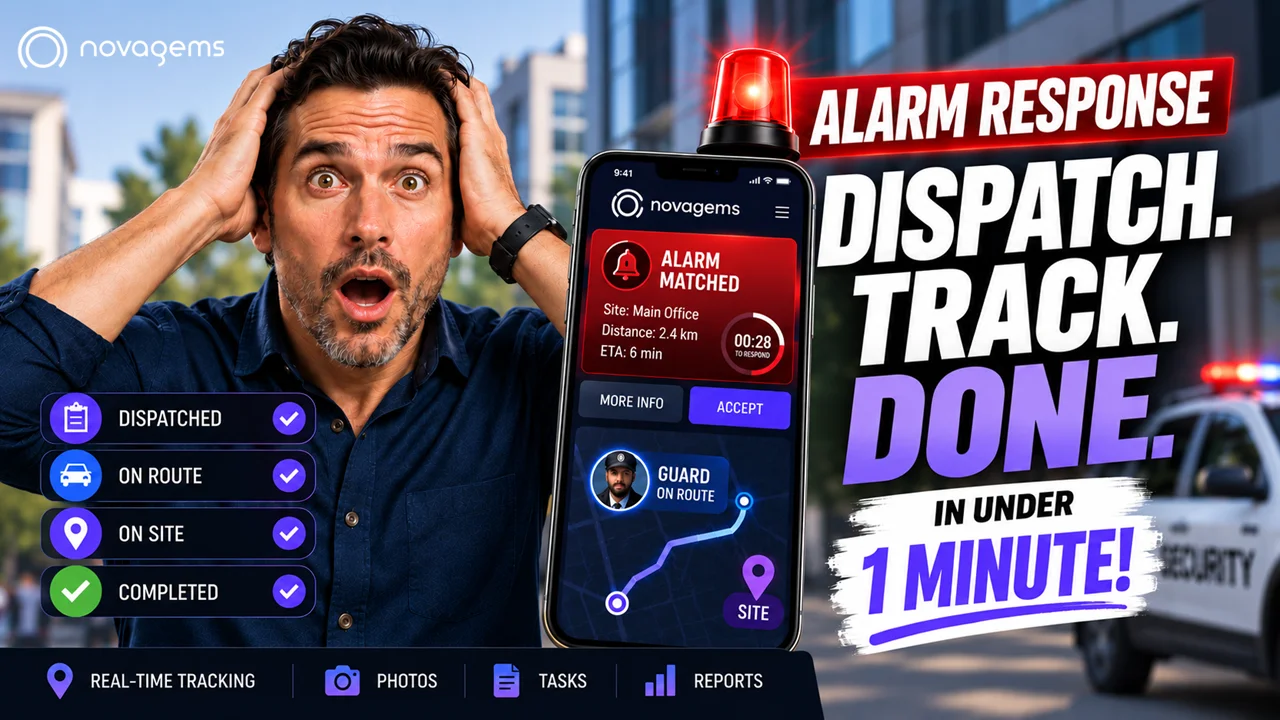
In 2026, human security guards, autonomous patrol robots, and security drones each occupy distinct operational niches, humans handle interaction-heavy work ($25-$45/hour), robots handle repetitive patrol at fixed sites ($7-$11/hour service cost), and drones handle rapid verification at large-acreage sites ($5-$15 per flight). None of the three replaces the others wholesale. The security operations that deliver the best value in 2026 blend all three, using each for what it does best. This guide breaks down real-world cost, capability, and deployment guidance, not the hype version.
Security buyers, corporate security directors, facilities managers, HOA boards, are asking a genuinely hard question: how should I deploy security in 2026? The traditional answer (hire guards) is still right for most sites, but at specific properties, robots and drones now offer dramatic cost savings for narrow use cases. Getting the mix right can cut security spending 20-40% while improving coverage; getting it wrong wastes capital on technology that doesn’t fit the site.
This guide is written for facility directors, corporate security leaders, property managers, and security company owners making real deployment decisions with real budgets.
Cost Comparison at a Glance
| Resource | Cost/Hour Equivalent | Best Use | Key Limitation |
|---|---|---|---|
| Human unarmed guard | $20-$35 | Customer-facing, de-escalation, emergency response | Expensive; fatigue; turnover |
| Human armed guard | $32-$50 | High-risk static posts, armed response | More expensive; liability |
| Quadruped patrol robot (Spot-class) | $7-$11 service, $80K-$150K purchase | Overnight patrol, industrial monitoring | Can’t interact with people; requires maintenance |
| Wheeled indoor patrol robot | $6-$10 service, $50K-$100K purchase | Indoor repetitive routes (warehouses, offices) | Limited to smooth surfaces |
| Stationary alarm-tower drone | $3,000-$10,000/month program | Alarm verification at large sites | Weather-limited; FAA regulated |
| Executive protection officer | $75-$150 | VIP protection | Cost; scheduling complexity |
These costs are indicative for 2026 US market. Metropolitan and unionized markets may be 15-25% higher.
What Human Guards Actually Do
Despite all the robot and drone headlines, human guards remain the core of private security, and for good reasons.
What humans do uniquely well
| Function | Why Humans |
|---|---|
| De-escalation | Verbal conflict management requires cultural and contextual awareness |
| Physical intervention | Legal and ethical constraints on autonomous force |
| Customer service | Concierge-security, lobby presence, brand ambassador |
| Emergency medical response | CPR, AED, first aid, coordination with EMS |
| Novel situations | Adaptive judgment for unprecedented events |
| Credential judgment | “Is this delivery legit?” requires contextual thinking |
| VIP / close protection | Relationship-based protection |
| Arrest / detention authority | Citizen’s arrest or sworn officer authority |
| Witness interviews and investigations | Interviewing, rapport, nuance |
The economics of human guards
A 24/7 staffed post (168 hours/week) at $25/hour billing:
- Weekly: $4,200
- Monthly: ~$18,200
- Annual: ~$218,400
For a mid-size corporate campus running 3 guards per shift × 3 shifts × 7 days, that’s ~$1.3M-$1.8M annually. Any technology that can reduce headcount without reducing coverage saves real money.
Where humans are overpriced
Honest assessment: human guards are overpriced for repetitive, low-interaction work. Examples:
- Overnight patrol of a 100-acre data center fence line, walking the same route every hour seeing nothing
- Static monitoring at an unmanned industrial gate where cameras already detect vehicles
- Perimeter patrol at a 500-acre solar farm where events are rare
- Overnight lobby coverage at an empty corporate building
At these posts, a quadruped robot or drone-based approach delivers equal or better coverage at one-third the cost.
What Autonomous Patrol Robots Do
Two categories of autonomous patrol robots dominate the 2026 market.
Quadruped robots (Boston Dynamics Spot and competitors)
Form factor: Four-legged, ~70 lbs, can navigate stairs, gravel, uneven terrain.
Cost: $80,000-$150,000 purchase per unit. Service/lease models $7-$11/hour.
Capabilities:
- Autonomous patrol of predefined routes
- Thermal imaging and high-resolution video streaming
- Obstacle avoidance and stair navigation
- Gas and radiation detection sensors (with attachments)
- Integration with security operations dashboards
Major deployments in 2026:
- Data centers (fastest-growing segment. Boston Dynamics confirms major interest surge)
- Power plants and substations
- Bomb squads and SWAT (60+ US/Canada agencies using Spot as of late 2025)
- Research facilities with hazardous materials
- Oil and gas facilities
Limitations:
- Battery: ~90 minutes per charge, requires docking station for swap
- Maintenance: 4-8 hours per month typical
- Weather: limited in heavy rain, snow, extreme cold
- Capital cost barrier keeps deployment at enterprise tier
Wheeled indoor patrol robots (Knightscope, Cobalt, and others)
Form factor: 3-5 foot tall wheeled robots, ~300 lbs, designed for flat indoor surfaces.
Cost: $50,000-$100,000 purchase per unit. Service/lease models $6-$10/hour.
Capabilities:
- Autonomous patrol of indoor environments
- 360-degree HD video + thermal imaging
- License plate recognition for parking garages
- Two-way audio (can broadcast warnings, connect caller to remote operator)
- People detection and classification
Major deployments:
- Large warehouses and distribution centers
- Corporate lobbies and atriums
- Parking garages
- Airports (limited)
- Shopping centers (declining, customer experience concerns)
Limitations:
- Can’t handle stairs or uneven surfaces
- Limited off-road capability
- Hostile reception in public-facing environments (customers find them off-putting)
- Limited retail use after early Knightscope deployments received mixed consumer reviews
Where robots make economic sense
Run the math for a 24/7 overnight patrol post at a 200,000 sq ft data center:
Human guard option:
- 1 guard × $25/hour × 24 hours × 365 days = $219,000/year
- Covers: patrol, access control, incident response, occasional interaction
Quadruped robot option:
- Robot lease: $8/hour × 24 × 365 = $70,080/year
- Plus 1 remote operator overseeing 3-5 robots = $50,000-$75,000/year allocated
- Plus human guard on-call for incidents = $40,000-$60,000/year retainer
- Total: $160,000-$205,000/year
At this scale, robot savings are $15,000-$60,000 per post annually. Multiply across multiple sites and the savings justify the capital investment.
For smaller or more interactive sites, the math doesn’t work, a single robot at a 20,000 sq ft office building doesn’t justify the capital cost or complexity.
What Security Drones Do
Drones are seeing the fastest growth of any security technology segment, with the security drone market projected to grow at 17.8-21.5% CAGR through 2031.
Drone-as-First-Responder (DFR)
The primary security drone model. An autonomous drone docked on-site launches on alarm triggers or dispatch command, flies to the target location, transmits live video back, and either lands and self-recharges or returns when dispatched elsewhere.
How it works:
- Alarm triggers (motion sensor, glass break, perimeter breach)
- Security operations center receives alert
- Operator launches drone from docking station
- Drone flies autonomously to coordinates (1-5 minute flight)
- Live video streams to operator
- Operator verifies: false alarm, wildlife, actual intrusion
- If intrusion: dispatch guard or police; if false: cancel response
- Drone returns and recharges
Cost structure:
- Initial setup: $50,000-$200,000 per site
- Drone hardware: $15,000-$75,000
- Docking station: $20,000-$80,000
- Software/integration: $10,000-$30,000
- FAA Part 107 licensing and training: $5,000-$15,000
- Operational: $3,000-$10,000/month per site
- Per-flight cost: ~$5-$15 (power, wear, software)
Where drones make economic sense
The math works at large-acreage outdoor sites where vehicle-based response is slow.
Example: 500-acre solar farm, avg 3 alarms/night (80% false from wildlife/weather).
Human guard response:
- Guard drives truck from guard shack to alarm location: ~15-20 minutes round trip
- Verifies alarm: ~5 minutes
- 3 alarms × 20-25 minutes = 60-75 minutes/night on false alarms
- Cost of lost productive time: ~$150-$200/night
- Annual: $55,000-$73,000 in response labor alone
Drone-as-first-responder:
- Drone reaches location: 2-4 minutes
- Verification: 2 minutes
- 3 alarms × 5 minutes = 15 minutes/night
- Drone operating cost: ~$30-$45/night
- Annual operational: ~$15,000
- Plus $60,000-$100,000 amortized capital (5-year)
Net annual savings: $10,000-$40,000+ per site, plus faster response time.
Limitations of security drones
| Limitation | Impact |
|---|---|
| Weather | Rain, snow, high wind ground operations |
| Battery | 20-40 minute flight time typical; fleet rotation for continuous coverage |
| FAA regulations | Part 107 compliance, night flight waivers, BVLOS waivers |
| Privacy concerns | Public and regulatory resistance to drone surveillance in urban areas |
| Hardware failure | Crashes, component wear; fleet backup required |
| Insurance | Higher premiums; specialized aviation coverage |
| Public perception | Some clients and communities reject drone surveillance |
| Anti-drone countermeasures | Adversaries may jam or spoof GPS |
Regulatory landscape
In the US, commercial security drones operate under FAA Part 107 rules. Key requirements:
- Licensed remote pilot (Part 107 certification)
- Registration of the aircraft
- Standard daytime, below 400ft, within visual line of sight operations
- Waivers required for: night operations, flights over people, beyond visual line of sight (BVLOS)
In 2024-2025, FAA announced streamlined pathways for DFR programs. Expect continued evolution of regulations through 2026-2028.
Some states and cities impose additional restrictions. California, Texas, and Florida have state-level drone laws; cities like Los Angeles and Chicago have local rules. Always consult an aviation attorney before launching a drone security program.
The Hybrid Model: How to Combine All Three
The security operations delivering best value in 2026 use humans, robots, and drones in combination, each doing what it does best.
Example 1: Large Industrial Campus (500 acres, 24/7)
Traditional model (humans only):
- 6 guards per shift × 3 shifts = 18 guards/day
- 1 gate supervisor per shift × 3 = 3 supervisors
- 2 mobile patrol vehicles
- Annual cost: $1.8M-$2.2M
Hybrid model:
- 3 guards per shift × 3 shifts = 9 guards (gate + roving response)
- 2 quadruped robots overnight (covering interior patrol)
- 1 drone for outdoor alarm response
- 1 dispatcher/operator overseeing tech
- Annual cost: $1.2M-$1.5M
- Savings: ~30%
Example 2: Data Center (200,000 sq ft, 24/7)
Traditional model:
- 2 guards per shift × 3 = 6 guards/day
- Annual cost: ~$450K-$550K
Hybrid model:
- 1 guard per shift at reception + 1 quadruped robot per shift for interior patrol
- Remote operator shared across 4-5 sites
- Annual cost: ~$300K-$400K
- Savings: ~25-30%
- Plus: thermal imaging and sensor data the robot provides that humans couldn’t
Example 3: Corporate Campus (Urban, 500,000 sq ft, 5-day business hours)
Traditional model:
- 4 concierge-security in lobby, 2 roving patrol, 2 parking structure coverage, 1 overnight × 7 days
- Annual cost: ~$1.4M
Hybrid model:
- 4 concierge-security in lobby (unchanged, human interaction required)
- 2 roving patrol (unchanged)
- AI video analytics on parking structure cameras (replaces 1 guard)
- Overnight: 1 guard + 1 wheeled indoor robot (replaces 1 overnight guard)
- Annual cost: ~$1.1M
- Savings: ~20%
The savings pattern: more savings at bigger/more remote sites, fewer savings at customer-facing urban sites.
Decision Framework: When to Deploy Each
Use human guards when…
- Customer interaction is part of the job (lobby, retail, hotels, residential concierge)
- De-escalation is likely (bars, events, crowded environments)
- VIP protection is required
- Emergency medical response is a core function
- Arrest authority or physical intervention may be needed
- Client relationship matters (executive floors, luxury residential)
- The site is small enough that the human is going to be there anyway
Use patrol robots when…
- The site has long repetitive patrol routes
- Interaction is minimal (overnight industrial, data centers)
- Capital budget supports $80K-$150K+ per unit
- IT infrastructure supports integration (network, power, docking)
- Operations scale justifies the tech (single-site probably doesn’t; multi-site does)
Use security drones when…
- The site is large acreage (500+ outdoor)
- Vehicle-based response is slow (15+ minutes)
- Alarm volume is high with majority false (wildlife, weather, equipment)
- Clear airspace (not dense urban, not near airports)
- Operations budget supports monthly program costs
- Management willing to invest in FAA compliance and remote pilot staffing
Don’t deploy robots/drones when…
- The site requires human interaction as core function
- Capital investment can’t be amortized over 3-5 years
- Clients will react poorly (some residential, most retail)
- Weather conditions don’t support the hardware (heavy snow regions for drones, rough terrain for wheeled robots)
- IT/network infrastructure is inadequate
- Management can’t support the operational complexity
What This Means for Security Companies
If you own or run a security company, three strategic implications.
1. Small/Mid-Market: Focus on Software, Not Hardware
If most of your clients are HOAs, apartments, small commercial, and retail, the economics of robots and drones don’t work at your scale. Don’t try to compete on hardware.
Instead, compete on software-enabled operations: GPS-verified patrols, real-time reporting, client dashboards, digital incident documentation. A modern workforce management platform gives you the capabilities that justify a 10-20% pricing premium over non-tech competitors.
2. Enterprise Clients: Partner, Don’t Try to Own
If your portfolio includes data centers, power plants, industrial facilities, or large corporate campuses, clients will increasingly expect robot and drone integration. Rather than buying $500K of Spot robots yourself:
- Partner with robot-as-a-service providers (Boston Dynamics, Knightscope, et al.)
- Partner with DFR service providers (Skydio, Brinc, et al.)
- Position yourself as the human layer + operations coordinator
- Bundle human patrol + robot service + drone program into one contract
- Charge management fee on top of hardware costs
3. Price-Sensitive Segments Will Shrink
The lowest-margin security segments, overnight static posts, basic perimeter patrol, simple monitoring, are the segments AI is absorbing. Companies competing primarily on price in these segments will face margin compression.
Shift toward higher-interaction, higher-skill verticals: executive protection, healthcare security, event security, luxury residential, concierge-security. These grow while basic posts shrink.
For full pricing guidance in this transition, see How to Price Security Guard Contracts in 2026.
What This Means for Facility Directors and Security Buyers
If you manage security for a large facility, three action items:
1. Run the Numbers for Hybrid Deployment
Don’t assume “we hire guards because we always have.” Run the math for your specific site. At large/remote/overnight-heavy sites, hybrid deployment can save 20-40% while improving coverage.
2. Start With Pilots, Not Full Rollouts
Replace one shift, one post, or one specific function with robots/drones first. Measure results over 3-6 months. Expand what works, retire what doesn’t.
3. Keep the Human Core
The biggest mistake facility directors make is going too far too fast. Replacing all guards with technology creates coverage gaps and client experience problems. The 2026 best practice is reducing guard headcount 20-40% while shifting the remaining guards to higher-value work (response, interaction, supervision).
What Guards Should Do
For working security guards reading this: the industry is changing, but skilled guards are more valuable than ever.
- Embrace technology, if you can operate drones, manage a robot fleet, or use AI video analytics, you’re valuable
- Specialize into high-interaction roles (executive protection, healthcare, events, concierge)
- Build technology literacy into your daily work
- Get certified in skills AI can’t replicate: de-escalation, first aid, crisis intervention
- Stay current, the tech stack changes every 2-3 years
See AI in the Security Guard Industry for the full guide to the skills guards need in 2026.
Wrapping Up
Security in 2026 is no longer a single-solution problem. Human guards, patrol robots, and security drones each offer distinct capabilities at distinct cost profiles, and the right answer is almost always some blend of all three. The facility directors and security companies winning in 2026 aren’t choosing between robots and humans, they’re orchestrating a layered security program that uses each for what it does best.
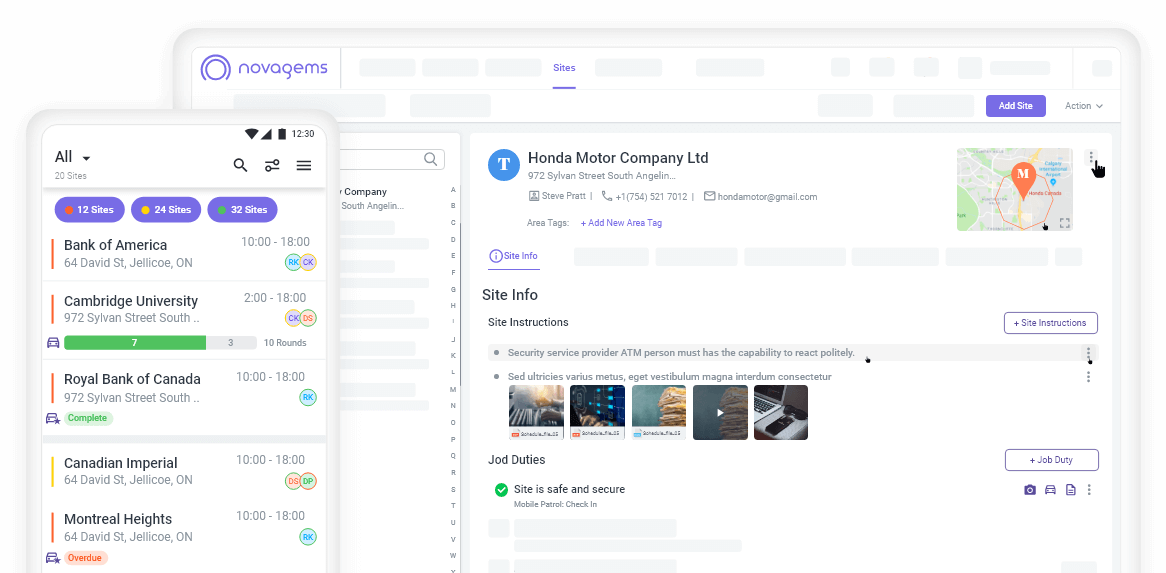
The single most important decision isn’t which technology to buy, it’s building the operations platform that coordinates all three. GPS-verified patrols, digital incident reporting, real-time dashboards, and integrated video analytics aren’t optional anymore, they’re the baseline capability clients expect and the infrastructure that lets you actually manage a hybrid security program.
Novagems provides that platform, purpose-built for security companies transitioning to technology-enabled operations. If you’re evaluating how to deliver better security at lower cost, start a 14-day free trial and see how the right operations foundation changes what’s possible.
Further Reading
- AI in the Security Guard Industry: 2026, the broader AI shift reshaping security
- Types of Security Guard Services: A Complete Guide, pillar article on security service categories
- How to Price Security Guard Contracts in 2026, pricing guidance for hybrid deployments
- Security Dispatch Software, the software backbone of hybrid operations
- NFC Tags for Guard Tours, checkpoint verification that works alongside robots
- GPS Tracking and Geofencing, coordinating humans and autonomous units
- Workforce Management for Security Companies, platform for coordinating hybrid security programs
Frequently Asked Questions
What's the actual cost of a security robot vs a human guard in 2026?
Robotic patrol service costs $7-$11/hour including software and support, compared to $25-$45/hour for a licensed human guard (with company margin). Purchase pricing for quadruped robots like Boston Dynamics Spot runs $80,000-$150,000, plus annual maintenance of $8,000-$15,000. That sounds dramatically cheaper, but the numbers hide real limitations, robots can't de-escalate conflicts, can't provide customer service, and have downtime for maintenance and battery changes that humans don't.
How much does a security drone program cost?
Drone-as-first-responder (DFR) programs typically run $50,000-$200,000 in initial setup (drone hardware, docking station, software, FAA Part 107 compliance), plus $3,000-$10,000/month in operational costs. Per-flight cost is around $5-$15. Most cost-effective at large-acreage sites (solar farms, data center campuses, industrial facilities) where sending a guard by vehicle takes 15+ minutes. Small sites don't justify the capital investment.
Can a security robot replace a human guard?
For specific functions, yes. For holistic security, no. Robots can replace: overnight perimeter patrol at low-interaction sites, wide-area surveillance, repetitive indoor checks at data centers, and loitering detection. Robots cannot replace: conflict de-escalation, customer service, VIP escort, emergency medical response, adaptive decision-making during novel incidents, or any work requiring physical intervention. The right model is hybrid, robots handle the repetitive work, humans handle the situational work.
Are security drones legal?
Yes, under FAA Part 107 rules in the US, commercial drone operations are legal with a licensed remote pilot. Night flights, flights over people, and flights beyond visual line of sight (BVLOS) require additional waivers. Most DFR programs operate under Part 107 with appropriate waivers. State and local laws may impose additional restrictions, some cities ban drone surveillance entirely. Always consult a drone operations specialist and aviation attorney before launching a security drone program.
What's the best use case for a security robot?
Data centers, power plants, warehouses, factories, and large corporate campuses with defined indoor patrol routes and limited human interaction. At those sites, quadruped robots like Spot handle overnight patrol, thermal inspection, and intrusion detection at roughly one-third the cost of human guards. Avoid robots at sites requiring customer service (hotels, retail, healthcare reception), robots are technically capable but deliver a poor client experience.
What's the best use case for a security drone?
Large-acreage outdoor sites where response time matters and where sending a vehicle-based guard takes too long. Primary use cases: solar farms (500+ acres), industrial complexes, data center campuses, mining operations, and public safety first-response. A drone can reach an alarm site in 3-5 minutes vs 15-30 for a vehicle, transmitting live video that lets dispatch decide whether to send a guard or police. Small urban sites don't benefit, a guard walks faster than drone setup time.
Should my security company invest in robots and drones?
Depends on your client mix. If your clients are multifamily residential, retail, HOAs, and small commercial, no, the economics don't work at that scale. If your clients include data centers, power plants, large industrial sites, or luxury developments, yes, you'll lose contracts to competitors who offer these capabilities. Most mid-market security companies should start with AI workforce management and video analytics, then evaluate robots/drones only as specific client requirements emerge.
How do human guards, robots, and drones work together?
Effective hybrid security layers the three: drones provide rapid initial verification of alarms, robots handle repetitive patrols and overnight monitoring, and humans handle incident response, de-escalation, customer service, and emergency situations. A 500-acre corporate campus might run 3 guards per shift (down from 6), supplemented by 2 quadruped patrol robots overnight and 1 drone for alarm response, delivering equal or better security at 30-40% lower cost, with better incident data.
See Novagems in action
Join 500+ security & cleaning companies that replaced spreadsheets with Novagems.
✓ 14-day free trial · ✓ Free onboarding · ✓ Cancel anytime