Warehouse and industrial security services are specialized security operations that protect distribution centers, manufacturing facilities, cold storage, trucking yards, and port-adjacent logistics from cargo theft, internal shrinkage, organized crime, and unauthorized access. Effective programs blend on-site guards, mobile patrols, license plate recognition at gates, GPS-verified patrol routes, and AI-powered video analytics. With cargo theft losses surging 60% to $725 million in 2025 and average per-theft values reaching $273,990, every warehouse operator now faces real pressure to upgrade physical security beyond cameras and locks. This guide covers everything distribution managers, 3PL executives, and security vendors need in 2026: the threat landscape, service categories, regulatory framework (including California SB 652), 2026 pricing benchmarks, technology stack, and a vendor evaluation checklist.
Here’s the stat that’s reshaping warehouse security in 2026: in 2025, organized criminal groups stole $725 million worth of cargo across 2,646 confirmed incidents in the United States and Canada, a 60% jump in losses despite the total number of supply chain crime events staying nearly flat year-over-year (CargoNet/Verisk). Translation: thieves got dramatically more efficient. Average value per theft rose 36% to $273,990. Food and beverage theft increased 47%. Metal theft surged 77% on copper demand.
Most warehouse security programs were built for a world where cargo theft was a rounding error on the insurance balance sheet. That world ended in 2025. This guide is for distribution center operators, 3PL executives, manufacturing site managers, cold-chain logistics directors, and security company owners serving the industrial vertical, the people now sitting across the table from insurance carriers, board members, and shipping clients asking what they’re doing about it.
What Warehouse & Industrial Security Services Cover
Industrial security is broader than most operators realize. A complete program spans five layers:
| Function | What It Covers | Typical Delivery |
|---|---|---|
| Gate / access control | Vehicle screening, driver verification, visitor management, manifest checks | On-site guard + LPR + visitor management software |
| Perimeter security | Fence-line patrol, lighting, motion detection, breach response | Mobile patrol + alarm response |
| Yard / loading dock | Trailer monitoring, dock door supervision, loading verification | On-site guards + cameras + AI analytics |
| Interior security | Inventory area patrols, employee shrinkage prevention, internal investigations | Roving guards + cameras + access control |
| Cargo / transit | Trailer seal verification, GPS tracking, escort service | Specialist CIT-style providers |
| Cold chain / pharma | Temperature monitoring + theft prevention for high-value perishables | Specialist pharma security firms |
| Emergency response | Fire, medical, weather, active threat | All guards + facility EHS team |
| Compliance reporting | OSHA, DOT, FDA (food/pharma), state-specific (SB 652) | Documented through workforce platforms |
| Insurance documentation | Audit-ready evidence of patrols, response times, incident reports | GPS-verified digital reporting |
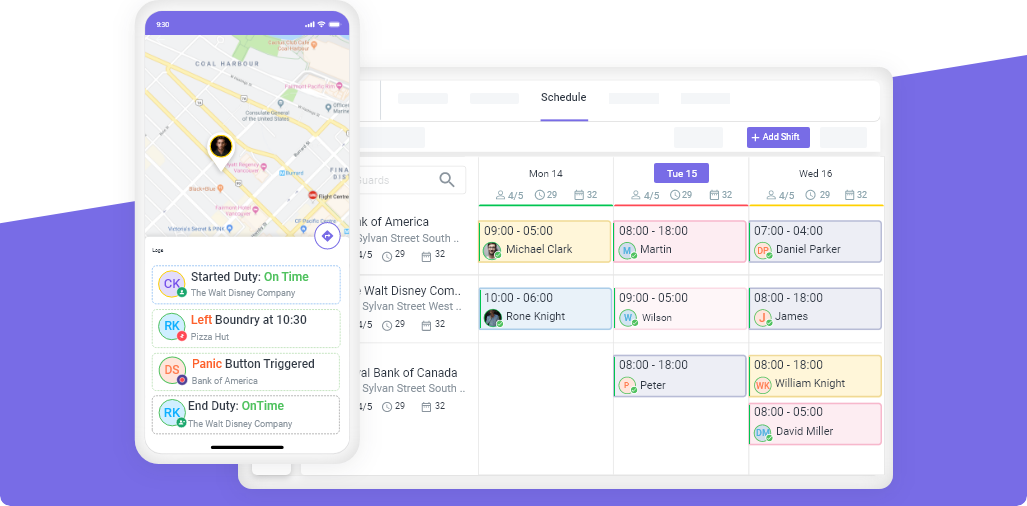
Modern warehouses don’t manage these as separate programs, they orchestrate them through a single workforce management platform. A properly run industrial security operation can route a yard alarm to the nearest mobile patrol, push the resulting incident report to insurance documentation, and update the WMS exception log within 5 minutes.
The 2025 Cargo Theft Surge. Why Industrial Security Matters Now
Understanding the threat landscape is the foundation of every other security decision. Here’s what changed in 2025 and what it means for 2026 planning.
The Headline Numbers (CargoNet/Verisk, full-year 2025)
| Metric | 2024 | 2025 | Change |
|---|---|---|---|
| Total supply chain crime events | 3,607 | 3,594 | -0.4% |
| Confirmed cargo theft incidents | 2,243 | 2,646 | +18% |
| Total estimated losses | ~$453M | $725M | +60% |
| Average value per theft | $202,364 | $273,990 | +36% |
The number of crimes barely changed, but the dollar value exploded. That’s organized crime targeting bigger fish, more strategically.
What Thieves Are Targeting
| Category | 2025 Trend |
|---|---|
| Enterprise computing hardware | Top-tier OCG target |
| Cryptocurrency mining equipment | New high-value category |
| Food and beverage | +47% (meat, seafood, tree nuts) |
| Metals (copper) | +77% (industrial demand) |
| Electronics | Sustained high target |
| Pharmaceuticals | High-margin, hard to recover |
| Solar panels | Rising target (renewable demand) |
The Tactical Shift
This is the most important development for 2026 planning. Organized criminal groups are abandoning complex fraud schemes, proof-of-delivery fraud, motor carrier authority takeovers, double-brokering, in favor of simpler direct theft of unattended loaded trailers.
Why? Logistics platforms (Uber Freight, project44, FreightWaves SONAR) deployed anti-fraud tools throughout 2024-2025 that made fraud schemes harder. So criminals went back to basics: identify a high-value loaded trailer, wait until it’s parked unattended at a truck stop or yard, and steal it directly.
This puts physical security back at the center of cargo theft prevention. A guarded yard with verified perimeter patrol is now a meaningful deterrent again.
Geographic Hotspots (2025)
- Southern California (LA / Long Beach port complex, Inland Empire)
- San Francisco Bay Area
- Phoenix metro
- Lake Tahoe (cross-border to Nevada)
- Atlanta (Eastern hub)
- Dallas-Fort Worth
- Chicago (rail intermodal)
- Memphis (FedEx hub)
If your facility is in any of these zones, your security investment math changed in 2025.
Types of Warehouse & Industrial Security Services
Different facilities need different security mixes. Here’s what each vertical typically requires.
Distribution Center / 3PL
Threat profile: Cargo theft, internal shrinkage, fraud at gate, dock-side theft.
Recommended setup:
- 24/7 gate guard with LPR system
- Mobile yard patrol every 30-60 min
- Access control on dock doors with badging
- AI video analytics covering loading docks
- Visitor management software at admin entry
Typical cost: $300,000-$1.2M annually for a 200,000 sq ft DC.
Manufacturing Facility
Threat profile: Equipment theft, intellectual property exposure, employee safety, OSHA compliance overlap.
Recommended setup:
- Static gate guard during operating hours
- Mobile patrol overnight + weekends
- Access control on R&D and sensitive areas
- Visitor escort protocol for non-employees
- Coordination with safety/EHS team
Typical cost: $150,000-$600,000 annually.
Cold Chain / Pharmaceutical Warehouse
Threat profile: Pharmaceutical theft (extremely high margins), temperature integrity, regulatory compliance (FDA, DSCSA).
Recommended setup:
- 24/7 armed gate guard (justification: pharma value)
- Continuous temperature monitoring with alerts
- Tamper-evident sealing protocols
- Integration with pharma traceability systems
- Escort for all non-employees
Typical cost: $400,000-$1.5M annually. Higher for vaccine and biologic storage.
Trucking Yard / Truck Stop
Threat profile: Direct trailer theft (the #1 2025 trend), driver safety, fuel theft.
Recommended setup:
- 24/7 gate guard with driver verification
- Mobile yard patrol with GPS-verified routes
- LPR at gates matching against shipment manifests
- Trailer seal verification on entry/exit
- AI video analytics on parking areas
Typical cost: $250,000-$800,000 annually.
Port-Adjacent / Intermodal
Threat profile: Cargo theft, TWIC compliance, customs coordination, container yard supervision.
Recommended setup:
- TWIC-credentialed security personnel
- 24/7 gate operations with TWIC reader integration
- Container seal verification
- Coordination with port authority and Coast Guard
- High-resolution surveillance with retention per port requirements
Typical cost: $500,000-$2M annually.
E-Commerce Fulfillment Center
Threat profile: Internal theft (highest in industry), package theft, return fraud, peak-season surges.
Recommended setup:
- Strict access control with badging at all entries
- Visible surveillance throughout pick zones
- Random package audits at outbound dock
- Bag/personal-belonging policies (no bags in pick area)
- Seasonal surge staffing for peak
Typical cost: $300,000-$1.5M depending on scale.
High-Value Storage (Electronics, Metals)
Threat profile: Targeted organized crime, ram-raid, internal collusion.
Recommended setup:
- Armed 24/7 gate guard
- K-9 unit for off-hours patrol
- Bollards and ram-raid prevention at vehicle entries
- Vault-style storage for highest-value items
- Background-check standards beyond state minimum
Typical cost: $500,000-$3M annually.
Industrial Security Pricing in 2026
Pricing varies by service level, region, and risk profile. These ranges reflect 2026 US market data.
Hourly Rates
| Service Level | Hourly Rate |
|---|---|
| Standard unarmed industrial | $25-$40 |
| Mid-tier commercial/industrial | $45-$65 |
| High-risk / specialized | $65-$100+ |
| Armed industrial guard | $35-$50 |
| K-9 unit | $75-$125 |
| Supervisor / account manager | $45-$65 |
| Mobile patrol (per visit) | $50-$150 |
| Off-hours / holiday premium | +25-50% |
Monthly Coverage Cost (160 hours)
| Tier | Monthly Cost |
|---|---|
| Standard unarmed (160 hrs/mo) | $4,000-$6,400 |
| Mid-tier commercial (160 hrs/mo) | $7,200-$12,000 |
| High-risk specialized (160 hrs/mo) | $10,400-$16,000 |
| 24/7 single-guard post (~720 hrs/mo) | $15,000-$30,000 |
| 24/7 dual-guard + supervisor | $50,000-$80,000 |
Annual Cost by Facility Size
| Facility Size | Annual Security Spend |
|---|---|
| Small warehouse (under 50K sq ft) | $50,000-$200,000 |
| Mid-size DC (50K-200K sq ft) | $250,000-$800,000 |
| Large DC (200K-500K sq ft) | $800,000-$2,000,000 |
| Mega DC / fulfillment (500K+ sq ft) | $2,000,000-$10,000,000+ |
| Multi-site network (5-20 facilities) | Scale by facility count |
Hidden Cost Factors
| Factor | Impact |
|---|---|
| California (especially LA/Inland Empire) | +20-30% over national average |
| New York / NYC metro | +25-35% |
| 24/7 coverage premium | +30% over 9-5 |
| Armed personnel | +40-60% over unarmed |
| Specialized training (TWIC, hazmat, K-9) | +15-25% |
| High guard turnover (under 50% retention) | Hidden cost in retraining |
| Insurance compliance documentation | Often charged separately |
For complete pricing methodology, see our How to Price Security Guard Contracts guide.
Regulatory Framework
Industrial security operates under more compliance overlays than most security verticals. Here’s what applies.
California SB 652 (Effective 2026)
California’s most significant 2026 security legislation directly affects warehouses, distribution centers, and trucking yards operating in the state. The law:
- Elevates training requirements for security personnel at logistics facilities
- Mandates cargo-theft-specific training modules
- Requires formal incident response protocols with documentation
- Strengthens access control documentation for vendor/visitor entry
- Creates audit trail requirements for security operations
Insurance carriers writing California cargo policies increasingly require SB 652 compliance certification before binding coverage. If you operate in California, verify your security vendor’s SB 652 documentation before contract renewal.
TWIC (Transportation Worker Identification Credential)
Federal credential issued by TSA, required for unescorted access to:
- Maritime port secure areas
- Rail intermodal yards (regulated facilities)
- Certain energy facilities (LNG, oil)
- Vessels operating in regulated waters
Cost: $125.25 for a 5-year credential plus FBI background check.
If your warehouse, distribution center, or trucking yard is inside a port footprint or handles regulated maritime cargo, you need TWIC-credentialed security personnel. Most port-adjacent warehouses confirm TWIC requirement at lease signing, but if you’re not sure, ask your port authority.
OSHA Compliance Overlap
Warehouses face OSHA requirements that intersect with security:
- Fall protection (loading dock work)
- Forklift / powered industrial truck operations
- Emergency action plan
- Fire prevention plan
- Hazmat (where applicable)
- Workplace violence prevention (newer focus)
Security guards are often the front line for emergency response, first to notice a fire, fall, or medical emergency. Coordinate security training with EHS/safety leadership.
DOT / FMCSA (Trucking)
Trucking yards and freight terminals face Federal Motor Carrier Safety Administration requirements:
- Driver hours-of-service tracking (electronic logging device)
- Drug and alcohol testing programs
- Vehicle inspection records
- Hazmat handling
Security personnel often verify driver DOT compliance at gate entry, checking ELD status, valid medical certification, and DOT physical card.
State Licensing Overlay
Beyond federal/state-specific cargo regulations, every guard at every site needs current state licensing:
- California. BSIS guard card
- Texas. DPS Level II/III/IV
- New York. NYS DOS registration
- Florida. FDACS Class D / Class G
- Colorado. HB25-1262 (effective Aug 1, 2026, see our Colorado guide)
For warehouses with operations in multiple states, every guard at every location must hold the proper state credential.
Insurance Carrier Requirements
Cargo insurance carriers increasingly require:
- 24/7 on-site guarding for high-value cargo coverage
- GPS-verified mobile patrol logs
- Documented incident response within specific timeframes
- Background check standards beyond state minimum
- Annual security audit by approved third party
Some carriers offer 10-25% premium discounts for facilities meeting these standards. Discuss with your broker before contract renewal.
Technology Stack for Modern Warehouse Security
The “cameras + locks + guards” model of 2010 doesn’t work in 2026. Here’s what a current-generation industrial security stack looks like.
License Plate Recognition (LPR) at Gates
Every vehicle entering or leaving the facility is captured and matched against:
- Authorized vendor list (your WMS or TMS)
- Driver dispatch manifests
- Watch lists (banned, suspicious, prior incidents)
- Stolen vehicle databases
LPR is the single highest-impact technology investment for cargo theft prevention. Modern LPR systems integrate with shipment data so a truck arriving without a matching scheduled load triggers an alert.
AI Video Analytics
Replaces “someone watching 40 monitors” with automated detection:
- Weapon detection
- Loitering at sensitive areas (loading docks, fuel pumps)
- Unusual behavior (someone climbing a fence vs. walking past)
- Vehicle and license plate cross-referencing
- Forklift operator safety violations
- After-hours motion in restricted zones
Cost: $5-$30/camera/month as add-on to existing camera systems. ROI is high, typical reduction in false alarms is 70-90%.
GPS-Tracked Mobile Patrols
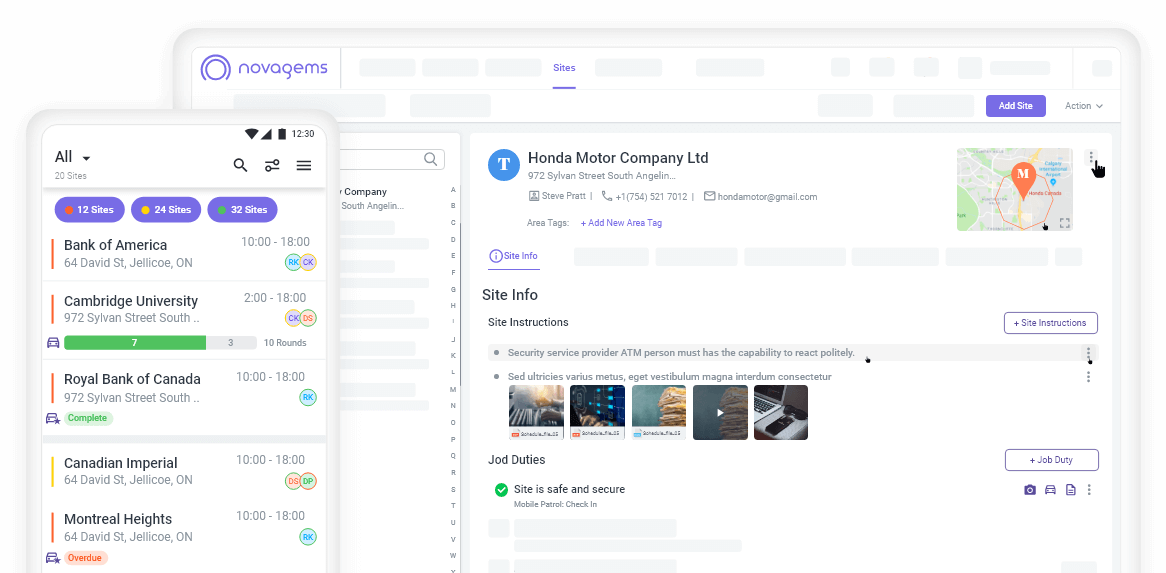
Modern industrial security companies use platforms like Novagems to:
- Track patrol vehicles and walking guards in real time
- Verify patrol routes were actually completed
- Generate insurance-ready documentation of every patrol
- Send real-time alerts when patrols deviate or are missed
- Provide client portal access for transparency
For warehouses, this is the technology insurance carriers increasingly require for cargo coverage discounts. See GPS Tracking and Geofencing for implementation details.
Checkpoint Verification (NFC / QR)
Fixed checkpoint tags at critical locations (fence corners, dock doors, fuel pumps, vault entry) require guards to physically scan to prove they were there. This prevents “drive past at 50 mph” fake patrols. See NFC Tags for Guard Tours.
Access Control with Mantraps
Critical zones (drug storage, electronics vault, IT/server rooms) get mantrap-style entry, single-person turnstile with badge + biometric. Prevents tailgating, the #1 cause of unauthorized entry in warehouses.
Visitor Management Systems
Every visitor (driver, vendor, inspector, board member) is logged with:
- Government-issued ID scan
- Photo capture
- Purpose of visit
- Host name (escort if required)
- Time in / time out
- Watchlist and sex offender registry check
Modern systems integrate with WMS so a delivery driver checking in at the gate auto-creates a dock assignment.
Integration with WMS / TMS
Best-in-class warehouse security platforms integrate with:
- Warehouse Management Systems (Manhattan, Blue Yonder, Oracle WMS)
- Transportation Management Systems (Manhattan TMS, Oracle TMS)
- ERP systems (SAP, Oracle, NetSuite)
- Insurance documentation platforms
The integration matters because alerts can’t sit in a security silo, a yard incident needs to flag the WMS, generate an insurance record, and update the TMS exception log all at once.
Drone-as-First-Responder (DFR)
For large yards (100+ acres), drone patrols provide rapid alarm verification. A drone reaches a perimeter alarm in 2-4 minutes vs. 15-30 minutes for a vehicle patrol. See our guards vs robots vs drones breakdown.
AI Adoption
For the broader AI shift in security operations, see AI in the Security Guard Industry.
How to Hire a Warehouse Security Vendor
Industrial security vendor selection is more specialized than retail or commercial. Here’s the process.
Step 1. Risk Assessment
Document the threat profile of each facility:
- Cargo value at any given time
- Geographic risk (CargoNet hot zone? near port?)
- Historical incidents (prior thefts, attempted breaches)
- Employee count and shift patterns
- Vendor and visitor traffic
- Emergency response considerations
- Insurance carrier requirements
Step 2. Scope Document
Write a 3-5 page scope covering:
- Facility size, layout, and entry points
- Hours of coverage needed (often 24/7)
- Armed vs unarmed (with justification)
- Mobile patrol frequency
- Specific compliance requirements (SB 652, TWIC, OSHA)
- Insurance and licensing thresholds
- Technology requirements (LPR, GPS, AI video, integration)
- Reporting cadence and format
- Performance metrics
Step 3. RFP to Qualified Vendors
Invite 3-5 vendors. Industrial-specific must-requirements:
| Requirement | Why |
|---|---|
| 3+ active warehouse/DC clients | Industrial-specific experience |
| California SB 652 compliance (if applicable) | Legal/insurance requirement |
| TWIC capability (if port-adjacent) | Regulatory requirement |
| State licensing in every operating state | Legal requirement |
| Insurance — $2M+ liability, cargo coverage | Industry standard |
| Cargo-theft-specific training | OCG threat |
| GPS-tracked patrol capability | Insurance requirement |
| Digital incident reporting | Documentation standard |
| Supervisor 24/7 availability | Industrial operations are 24/7 |
| Integration capability with WMS/TMS | Modern operations |
| Cargo theft response protocol | Industry-specific |
Step 4. Evaluate Beyond Price
| Criterion | Weight |
|---|---|
| Industrial-sector experience and references | 25% |
| Compliance documentation (SB 652, TWIC, licensing) | 20% |
| Technology stack | 20% |
| Cargo-theft training and response capability | 15% |
| Supervisor structure | 10% |
| Pricing transparency | 10% |
Step 5. Pilot Period
Sign a 90-day initial term with metrics:
- Patrol completion rate (target >95%)
- Incident response time (target under 5 minutes)
- Guard retention (no unplanned turnover)
- Documentation quality (insurance-ready reports)
- Supervisor responsiveness
If the pilot succeeds, extend to 1-3 year master agreement.
Insurance and Cargo Theft Prevention
The connection between security operations and insurance economics is one of the biggest changes in 2026 industrial security.
Carriers Offering Discounts
Major cargo insurance carriers now offer 10-25% premium discounts for facilities with:
- 24/7 on-site security personnel
- GPS-verified mobile patrols (with documented logs)
- AI video analytics on loading docks
- Access control documentation
- Quarterly security audits
Carriers Mandating Coverage Conditions
For high-value cargo (electronics, pharma, metals), some carriers now mandate:
- 24/7 armed gate guard
- LPR at every entry
- Specific patrol frequencies
- Real-time alerting to insurer for incidents above threshold
- Annual third-party security audit
If your carrier raises premiums or restricts coverage in 2026, the lever to pull is investing in technology and personnel that meet these standards.
Internal Theft (Often Underestimated)
30-50% of warehouse losses are internal, employee theft, sweethearting (employee-customer collusion), and inventory exception fraud. A robust security program addresses this through:
- Pre-employment background checks beyond state minimum
- Random package audits at outbound docks
- Anonymous tip lines
- Bag policies (no personal bags in pick zones)
- Mantraps at high-value storage
- Internal investigation capability
Internal theft typically costs warehouses 1.5-2.5% of inventory value annually. For a $50M inventory, that’s $750K-$1.25M in losses, often more than your entire physical security budget.
10 Common Warehouse Security Mistakes
| # | Mistake | Fix |
|---|---|---|
| 1 | Treating security as a commodity | Industrial security needs specialized vendors, not generic guards |
| 2 | No California SB 652 compliance verification | Required documentation before contract renewal |
| 3 | Paper-only patrol logs | Easily falsified; insurance carriers reject |
| 4 | No LPR at gates | Single highest-impact tech for cargo theft prevention |
| 5 | Ignoring internal theft (30-50% of losses) | Pre-employment screening + random audits |
| 6 | Generic security vendor without DC experience | Demand 3+ similar references |
| 7 | No integration with WMS/TMS | Security data trapped in silos |
| 8 | Over-reliance on cameras without analytics | Cameras alone don’t detect; AI does |
| 9 | No insurance carrier review | Missing 10-25% premium discount opportunity |
| 10 | Annual security review only at audit time | Quarterly review with security partner |
Getting Started Checklist
For a new operations manager, security director, or 3PL executive:
- Inventory all facilities, addresses, square footage, hours, current security setup
- Risk-tier each facility, high (CargoNet hot zones, port-adjacent, high-value), medium (standard DC), low (small distribution)
- Audit existing security contracts, when does each expire, what’s the spend, what’s the performance?
- Review insurance policies, what does your cargo carrier require? What discounts are available?
- Verify state licensing, every guard at every facility holds current state credential
- California SB 652 check, if any CA operations, verify vendor compliance documentation
- TWIC check, if port-adjacent, verify TWIC-credentialed coverage
- Technology gap assessment. LPR, GPS-tracked patrols, AI video, access control
- WMS/TMS integration, can security data flow to/from operational systems?
- Vendor consolidation, fewer vendors with deeper relationships outperform many with thin coverage
Wrapping Up
Warehouse and industrial security is now a strategic business function, not a back-office expense. The 60% surge in cargo theft losses in 2025, combined with insurance carrier pressure, California SB 652, and the tactical shift in organized crime toward direct trailer theft, means every distribution center and 3PL operator needs to revisit their security program in 2026.
The operators getting this right share three patterns: they invest in technology (LPR, GPS-verified patrols, AI analytics) that makes operations measurable and verifiable; they choose vendors with documented industrial experience and compliance credentials, not the cheapest bid; and they treat security as integrated with operations (WMS/TMS-connected), not a separate silo.
For warehouse security companies, this is one of the highest-margin, highest-retention verticals in the security industry, but the bar for entry is real. You need cargo-theft training, technology stack, insurance coverage, and (if operating in California) SB 652 documentation. If you have those, industrial security is one of the most stable revenue streams available.
For warehouse operators evaluating their current setup: ask your security vendor for a live demo of GPS-verified patrols, recent CargoNet data on your geographic area, and SB 652 compliance documentation. If they can’t provide all three, you have a vendor gap.
Novagems provides the workforce management platform that industrial security companies use to deliver the technology-verified operations warehouses now demand. Start a 14-day free trial and see what modern warehouse security operations look like.
Further Reading
- Types of Security Guard Services: A Complete Guide, pillar covering all security service categories
- Bank Security Services: 2026 Compliance Guide, adjacent regulated vertical
- How to Price Security Guard Contracts, full pricing framework
- AI in the Security Guard Industry (2026). AI video analytics for warehouses
- Security Guards vs Robots vs Drones, drone patrol for large yards
- Colorado Security Guard License (HB25-1262), adjacent state licensing
- GPS Tracking and Geofencing, tech behind verified patrols
- NFC Tags for Guard Tours, checkpoint verification
Sources: CargoNet/Verisk 2025 Cargo Theft Trends report; Verisk Q3 2025 Supply Chain Risk Trends; California Senate Bill 652; TSA TWIC program documentation.
See Novagems in action
Join 500+ security & cleaning companies that replaced spreadsheets with Novagems.
✓ 14-day free trial · ✓ Free onboarding · ✓ Cancel anytime