The robot can watch the camera. It still cannot walk an angry customer to the door at 2 a.m.
Search “will AI replace security guards” and you will see headlines about robots patrolling parking lots and one AI system “replacing sixteen people.” It is enough to worry any guard, or any security company owner, about the next few years.
Here is the honest answer, backed by real data: AI is not replacing security guards. It is making them better at their jobs. The technology takes over the boring, screen-watching parts of the work so guards can focus on the parts only a person can handle.
This guide cuts through the hype: what AI does well, what it still cannot do, how the guard’s job is changing, and how the best security companies use both together instead of picking one.
The short answer: AI helps guards, it doesn’t replace them
The numbers tell the real story. The U.S. Bureau of Labor Statistics says the number of security guard jobs will barely change from 2024 to 2034, but the field will still have about 162,300 openings every year, mostly to replace people who move on or retire. That is not a job being wiped out by machines. That is a job with steady demand.
What is changing is how the work gets done, not how many guards are needed. As one industry report put it, AI is not replacing guards. It is fixing the blind spots, tired eyes, and slow responses that people alone cannot avoid. The best security plans in 2026 are not AI versus people. They are AI plus people.
Think of it like a plane’s autopilot. Autopilot flies the easy part of the trip, but no airline gets rid of the pilots. The system handles the routine so the people stay fresh and ready for the moments that matter.
Why the “robots are replacing guards” headlines spread
The worry is not made up. The technology is real, and it is getting better fast.
AI camera systems can now watch thousands of feeds at once and flag a threat without anyone staring at a wall of screens. Reports on office buildings using security robots say they can save around $79,000 a year compared with paying a guard for a 24/7 post, based on Forrester Research figures covered by outlets like Axios. When a company says one AI system replaces sixteen people, that gets attention.
But the headlines leave out three things.
First, almost all of these systems still need a person watching over them. Patrol robots have been shown, again and again, to work best next to guards, not on their own. There are real cases of mall robots bumping into people and patrol bots getting stuck, because the real world is messier than any training data.
Second, “replacing sixteen people” usually means replacing people who sit and watch monitors, which is exactly the task AI should take over. It does not mean replacing the guard at the gate, the officer who runs to an alarm, or the person a scared employee walks up to in a dark parking garage.
Third, these cost comparisons rarely count the cost of being wrong. A real threat a robot cannot stop, or a true alarm the software ignores, can cost far more than the salary it “saved.”
What AI does better than a human guard
This only works if we are honest about where AI wins. In a few areas, it is not close. The machine is better.
Watching without getting tired. A person watching twenty camera feeds loses focus in about 20 minutes. AI watches every feed, every second, with no tiredness and no checking a phone, and it flags trouble the instant something looks off. This is where AI helps the most.
Spotting odd activity. AI learns what a normal day looks like on a site, then points out what does not fit: a door left open after hours, a car circling the lot, someone in an off-limits area. It catches small things a tired eye misses.
Covering more ground. Drones and patrol robots let one guard keep an eye on a huge site, port, or campus, checking the far fence without leaving the control room.
Cutting the paperwork. This is the quiet win guards love. AI can turn quick notes into clean incident reports, cutting the after-shift admin everyone hates. Pair it with a tool that already has the patrol and clock-in data, like Novagems incident reporting, and the report almost writes itself.
Picture a mid-size firm guarding a 40-acre warehouse. Before, two officers spent the night going back and forth between a monitor wall and slow fence walks. Now AI watches the cameras and a drone checks the fence, while the same two officers stay on the move, deal with the few alerts that matter, and finish the shift without an hour of report writing. Same number of guards. Much more cover.
What AI still can’t do, and probably never will
Now the other side, and the reason guards are not going away.
Calming people down. The heart of the job is talking a tense moment down before it turns into an incident. Reading body language, picking the right tone, knowing when to be firm and when to ease off. No robot is trained for this, and a screen cannot calm an upset person.
Making the call when things are unclear. Real situations are messy. Is that a lost delivery driver or someone who should not be there? Is that smell a burnt snack or a fire? People weigh the situation in seconds. AI gives a score; a guard makes the call.
Stepping in. Software can spot an intruder. It cannot put itself between that person and someone in danger, walk a patient to their car, or give first aid until help arrives. And a guard in uniform simply standing there stops trouble in a way a camera never will.
Being a calm, human face. Guards are often the first friendly face at a hospital door or the steady voice a worried employee finds after dark. That human side is part of what clients pay for.
Being responsible. Someone has to be the responsible person. For armed security, the law still needs a licensed human behind the decision. Clients, courts, and insurers all want a trained, accountable person involved. A 2025 ASIS International survey found security pros strongly agree that human judgment is still vital in risky moments (ASIS International).
You can hand over the watching. You cannot hand over the responsibility.
The real change: the guard’s job is getting better, not going away
The clearest way to see this: AI is not deleting the guard’s job. It is upgrading it.
When software handles the watching and the paperwork, the guard’s time shifts to more important work: responding, fixing problems, talking with clients, and handling emergencies. The guard stops being a screen-watcher and becomes a responder and a decision-maker.
That is good for guards and for the companies that hire them, but there is a catch. The guard of 2026 needs to be at ease with technology: a phone app for clock-in and patrol, a screen of AI alerts, digital reports. The companies that win will train their people on these tools instead of treating tech like a threat.
Take a security company owner we will call Marcus, who runs a 60-guard firm. Two years ago he worried AI would undercut his prices. Instead he leaned in. He added AI cameras to his sites and started pitching his guards as “trained responders backed by 24/7 AI monitoring.” He raised his rates, won two new contracts, and lost no guards. The tech did not replace his team. It made his team worth more.
How smart security companies use AI and guards together
The real question is not “AI or guards.” It is “how do I run AI and guards well together.” Here is the simple playbook.
Let AI watch, let guards respond. Use AI cameras and sensors to spot trouble. Send every real alert to a person who decides and acts. Never make a guard do the watching a machine does better, and never make a machine make the call a guard does better.
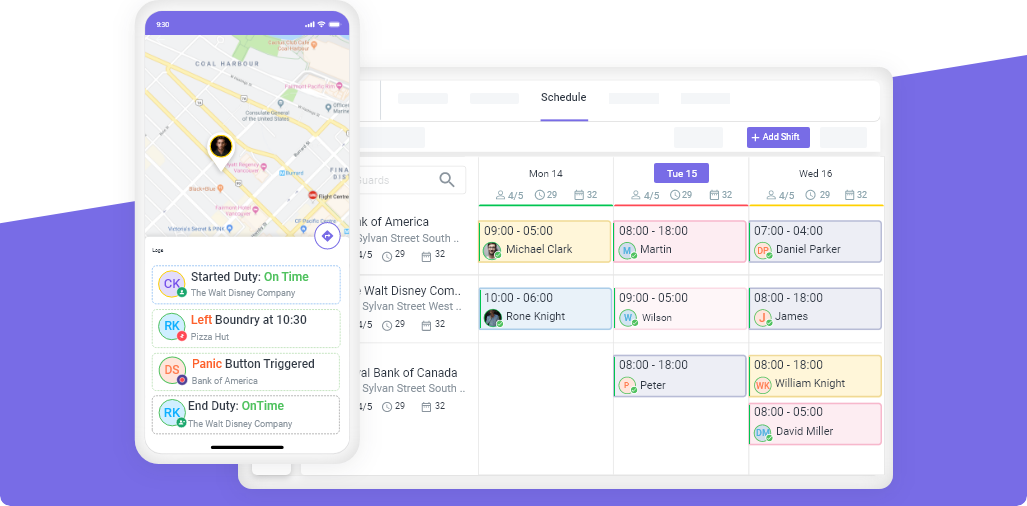
Make sure your guards are really on post. This whole plan falls apart if you cannot trust your own cover. GPS tracking and geofencing confirm a guard is on site before the shift starts, and checkpoint tours prove the patrols happened. Clients want this proof more and more.
Automate the busywork, not the people. Hand scheduling, clock-in, and reports to software so your officers spend their time on patrol and response, not paperwork. Tools like guard scheduling and time tracking and attendance take away the manual scramble without taking away a single guard.
Train guards to use the tech. Give every officer a short, simple walkthrough of the app and the alerts. A guard who trusts the tools uses them; one who does not goes back to old habits.
Sell the combined model to clients. “Licensed guards, backed by AI cameras and proven patrols” is a stronger pitch than either on its own, and it earns better rates.
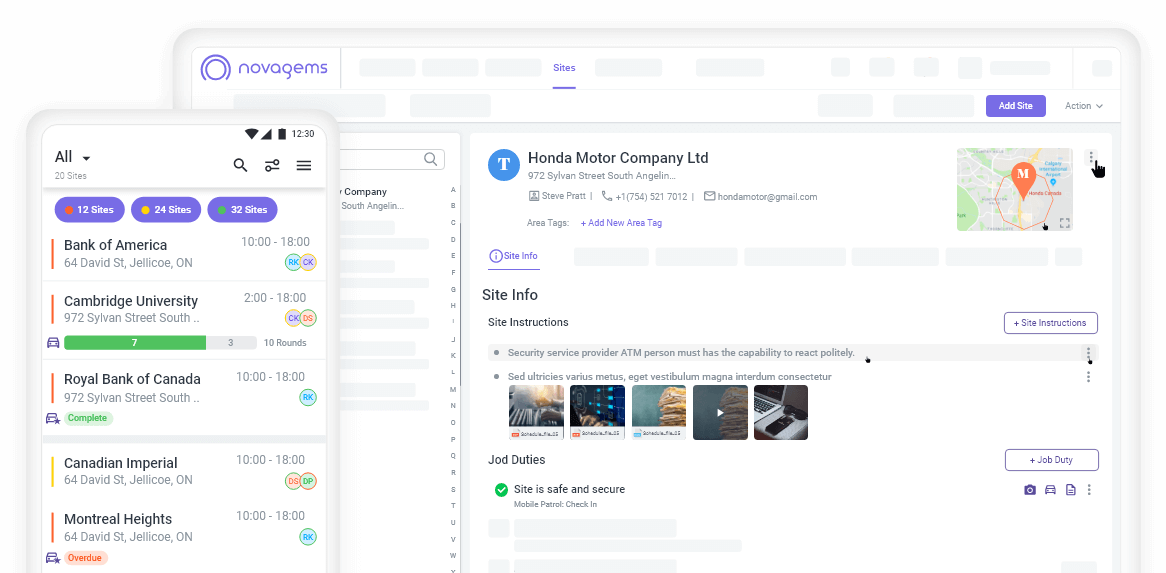
This is exactly the gap a tool built for the job fills. Novagems connects guard scheduling, GPS clock-in, checkpoint tours, and incident reports in one place, so the tech and the people work as one team instead of two separate systems. It is used by 500+ security and cleaning companies for this reason.
The bottom line
AI is changing security work, but it is not getting rid of the guard. Demand is steady, the technology still needs people watching over it, and the most important parts of the job, making the calls, calming people down, stepping in, and being responsible, stay human.
The real risk is not that AI replaces guards. It is that companies who stick to all-manual ways get beaten by those who pair sharp, well-trained guards with smart software.
Three things to do:
- This week: List the tasks your guards do that a machine could do better (watching screens, keeping logs, formatting reports). Those are what to automate.
- This month: Put one tool in place, scheduling, GPS clock-in, or digital reports, so your guards spend more time on patrol and less on paperwork.
- This quarter: Start pitching your service as a guards-plus-AI model and price it for the value.
The future of security is not robots instead of guards. It is better-equipped guards, backed by AI, doing the work that really keeps people safe.
Give your guards the tools to win
AI is only half the answer. Your guards need a system that ties the tech and the people together, and that is exactly what Novagems was built for.
- Your guards get one simple app to see their shifts, clock in with GPS, scan checkpoints, and file reports straight from their phone.
- You get one clear screen to build schedules in minutes, see who is on site right now, and catch a missed patrol or overtime before it costs you.
- Your clients get proof that patrols happened, with time-stamped reports and photos they can trust.
That is why 500+ security and cleaning companies run on Novagems, which holds a 4.5-star average rating across the major review sites.
Stop choosing between people and technology. Get both working as one team. Start your free 14-day trial of Novagems and see how much time your team gets back this week.
See Novagems in action
Join 500+ security & cleaning companies that replaced spreadsheets with Novagems.
✓ 14-day free trial · ✓ Free onboarding · ✓ Cancel anytime