Effective Overtime Management Strategies for Security Companies
Wed, Dec 10, 2025
Read in 15 minutes
Over time management strategies for security companies are important so that they can adhere to compliance laws and regulations. This helps them retain the top-performing security guards.
If you’re running a security company, you’ve probably had that sinking feeling when you look at your payroll report and see overtime costs spiraling out of control. You’re not alone. According to recent industry data, over 61% of security service providers cite rising hourly pay rates and overtime expenses as their top operational challenge.
The thing is, overtime isn’t just a number on a spreadsheet. It’s real money that directly impacts your bottom line. When your guards work beyond their scheduled 40-hour week, you’re paying time-and-a-half for every extra hour. And if you’re not tracking it properly? That’s when things get really expensive.
But here’s the good news. With the right overtime management strategies for security companies, you can significantly reduce overtime costs for security company operations without sacrificing service quality.
Key Takeaways
- Under the Fair Labor Standards Act, you must pay overtime at 1.5 times the regular rate for hours worked beyond 40 in a workweek. There’s no way around this, and violations come with hefty fines.
- Modern guard scheduling and overtime tools can prevent costly mistakes before they happen. We’re talking about real-time tracking, automated alerts, and GPS verification that keep everyone honest.
- It’s cheaper to stop overtime before it happens than to manage it after the fact. Smart scheduling, proper workforce planning, and clear policies can cut your overtime expenses by 30-40%.
- When your security guards work excessive overtime, their performance drops, turnover increases, and your service quality suffers. Finding the right balance isn’t just good for your team—it’s good for business.
Understanding the Legal Framework
First, let’s discuss the law. This is where many security firms are having problems. “The Fair Labor Standards Act is not merely a guideline or recommended standard. It is the law. This act applies almost universally to all security firms within the United States.”
Here’s what you have to remember:
If your security personnel exceed 40 hours per workweek, you must begin paying them 1.5 times their rate for each hour worked beyond the 40 hours. Whether your security personnel work for you for one site every day and night or multiple sites for your clients, the determination of whether they get any hours of overtime is calculated based on the number of hours they work for your company.
But here’s the thing that snares many security company owners: you can’t calculate averages on a two-week cycle. A security guard puts in 50 hours one week and 30 the next. He is still owed overtime pay for the extra 10 hours in the first week. The FLSA does its overtime calculations on a week-by-week basis only.
There may also be state laws that add complexity. For instance, California law requires overtime pay after eight hours in the same day, not just after 40 hours in the same week. There are also laws requiring double-time pay after 12 hours in the same day. If you are doing business in multiple states, you must follow the most liberal law applicable to the employee.
But what about breaks and meal periods? Breaks and meal periods are not mandatory under federal law, though many states have laws requiring them. The law in the state of California calls for a meal period of at least 30 minutes following five hours of work and an additional meal period if the shift exceeds 10 hours.
The price of making a mistake with this is high. The Labor Office could perform audits, make orders regarding past wages, and charge hefty penalties. Apart from this, it also affects your business in that it affects your reputation and makes it even harder to find qualified guard personnel in a competitive market.
Strategies on Managing Overtime for Security Companies
Now that we’ve discussed the legal considerations, it’s finally time to share some effective strategies for managing security guard overtime in the real world.
Use Real-Time Attendance Tracking
But this is a typical way things might play out:
- Your guard arrives at the customer’s location, gets to work, and neglects to clock out.
- They clock in early, racking up overtime hours that haven’t been authorized.
- Without the capability to track this in real-time, you won’t know what’s going on until it’s too late, and at this point, you’re obligated to pay up.
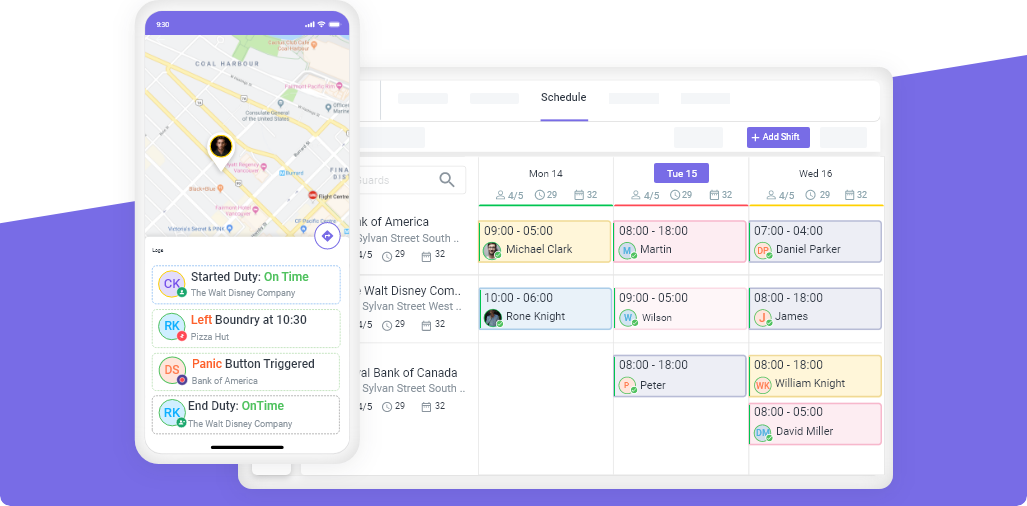
It’s at this point that the use of guard management software makes a huge impact. Today’s workforce management solution has the ability to monitor all clock-in and clock-out actions in real time. You are notified immediately when the guard reaches the limit for overtime. Allowing you to adjust before the costly hours add up.
However, it is not limited to time tracking. The best scheduling tools for security companies must contain features such as photo verification of attendance, ensuring the guard is physically present at the assigned post when punching in. It fixes the issue of buddy punching and subsequent payroll fraud, increasing your overtime costs.
Consider this: if you’re dealing with a staff of 20 guards spread over different sites, doing the task of monitoring everyone’s hours manually would be impossible. Real-time monitoring does the entire process for you and allows you to oversee the entire system from a single interface.
Monitor Shifts Using GPS and Geofencing
It’s not a matter of micromanaging your guard force, but it’s a matter of making sure that they are where they’re supposed to be when they’re supposed to be there. This is important for controlling overtime.
This is how it all comes together: Firstly, you create virtual boundaries or ‘geofences’ around your clients’ businesses. When the guards arrive at this site, they are able to check in through an app on their phones. They won’t be able to check in early even if they want to, since it won’t let them outside of the ‘geofence.’
The GPS tracking system also assists you in pointing out some inefficiencies that you may have in your schedules. Perhaps you have a security guard who is spending 45 minutes traveling between sites, and due to that travel time, they are working overtime.
The GPS tracking information is also extremely valuable in billing the clients. You can demonstrate to them the time your guards were present on their premises, how long they were present, and even their rounds.
Current studies have found that security companies employing GPS and geofencing solutions have seen a 25-35% decrease in unauthorized overtime. This is an important savings that directly affects your bottom line.
Develop Effective Overtime Approval Policies
One of the biggest common mistakes among the owners of security companies is the lack of clear policies regarding work. Security guards must know exactly when they are allowed to work more and when they require the manager’s approval.
Begin by establishing a policy on your work and make sure your staff understands that any kind of overtime has to be pre-approved with the exception of a situation when an emergency arises. Explain an emergency scenario and the chain of command when the staff has to work overtime.
Your policy should consider the following situations:
- Shift Extensions: If a client requires an extension of coverage, who approves it, and what is the procedure involved?
- Early Arrival: Guards are not supposed to arrive before the reporting time by more than 5-10 minutes.
- Late Departures: Similarly, the same applies to staying late.
- Break periods: Should the break periods be considered paid or unpaid?
- Travel time: Is travel time between sites considered to be work time?
These policies should be communicated during the orientation process and specified in your employee manual. The guards should sign an acknowledgement that they have read and comprehended the OT policy. This will protect you and spell out the guidelines right from the start.
However, here is the catch: policies will only be effective if you’re enforcing them. If you let some of your guards get by with unauthorized overtime while you punish others, you’re opening the door to possible claims of discrimination.
Minimize Employee Call-outs with Improved Workforce Planning
Each time a guard calls in sick, no-shows, or simply does not arrive for work, your choices are limited and costly. You could scramble to find a last-minute substitute, possibly having to pay the price with a premium rate for someone to fill the gap. Or, the position for the client could remain unfilled.
A better solution is a proactive approach to workforce planning to minimize the number of call-ins in the first place. This can be done in the following way:
- Create a strong backup staff: Look for the guards who are quickest to take on additional hours. Keep this information updated in your guard scheduling and overtime tracking system. Then, when someone calls out sick, you can check right away who is able to come in without having to play phone tag.
- Monitor call-outs: When some guards call in excessively, especially during weekend or holiday times, it may be an alarm. Deal with attendance problems before they develop into something else.
- Incentivize reliability: Think about bonus incentives for perfect attendance or availability on short notice to provide emergency coverage. Some security companies use a system where guards with good attendance are offered first choice in scheduling desired shifts.
- Train your employees to work at all sites: The more sites that each security guard is cross-trained to work at, the easier it is to move employees between sites when a void pops up.
- Make use of your scheduling software properly: Modern platforms can predict coverage gaps based on historical data and even suggest optimal shift patterns that minimize the risk of understaffing.
A recent study of the industry shows that security firms that are adept at labor planning and attendance solutions can reduce their rate of emergency overtime incidents by 40-50%. This is a total game-changer when it comes to budgets.
Balance Shifts to Prevent Guard Burnout
Here is a tip that many security company owners find out the hard way. Working your security guards to exhaustion may save you money now, but it will cost you big time in the end.
If security guards are always working 50, 60, or even 70-hour weeks, it has the following effects, and none of these are positive. The guard becomes drowsy, leading to security breaches at the clients’ offices. The guard will call in sick or simply fail to report for duty. The security guard will underperform. The guard will leave your company, leading to training costs that could easily outweigh the benefits you realized by pushing the guards too hard.
The security field faces a turnover rate of over 40% currently. Overuse and resulting guard burnout are factors contributing to this issue. Each time a qualified and dependable guard leaves, it costs you to advertise, screen, hire, and train his or her replacement, which could be over $5,000 per guard.
Smart shift balancing refers to:
- Rotating shifts: Do not have the same group of night guard patrols every day or double night shifts. Allow them to rest in between exhausting shifts.
- Honor time off: When corrections officers ask for time off, grant it when possible. Refusing requests for time off or obliging them on their days off leads to resentment and turnover.
- Total Hours of Monitoring: Use your scheduling software to mark those guards who are driving excess hours on a regular basis. Even out the workload.
- Developing a sufficient staffing force: If you find that your ongoing need is met on a regular basis through overtime, you are not staffed sufficiently. You may increase your costs slightly by adding more security guards, but it is certainly not as costly as your overtime rates.
- Communication is an art: Take stock of your guards by communicating with them. Do they feel overwhelmed? Do they need more support? This can save you problems down the line. Research has shown that security companies with well-balanced scheduling models retain their guards by 30% compared to other scheduling models. This translates to satisfied clients and increased profits for your company.
Guard Scheduling Software to Manage Overtime
At this point, you might be thinking, “This all sounds great, but how do I actually implement these strategies across my entire operation?” That’s where scheduling software for security companies becomes essential.
Manual scheduling, whether it is spreadsheet, whiteboard, or even paper-and-pencil, is simply not sophisticated enough to manage today’s security operations complexity. You need technology that will automate the drudgework and provide you with real-time views into your whole security staff.
Here are the ways in which quality security guard scheduling software helps manage overtime:
Automated overtime calculation: This system records the minutes worked and automatically calculates when the guards are getting close to or actually working over 40 hours. You are alerted before issues develop.
Built-In Compliance Rules: You can create rules based on federal and state laws regarding overtime. You cannot assign guards in a manner not comply with these rules as specified in the software to avoid costly errors.
Live budget tracking: View actual labor expenses, including overtime, at all locations and contracts. Compare actuals to budget amounts and adjust accordingly in the event of deviation.
Intelligent Schedule Optimization: Smart scheduling software relies on AI algorithms that point towards optimized employee schedules with minimal overtime hours and sufficient coverage. The software adapts to patterns and improves with time.
Mobile accessibility: Guards have access to shift schedules, swap shifts, and clock in/out using mobile phones. Managers can authorize overtime and change shift schedules anywhere and anytime.
Reporting & Analysis: Provide analysis and generate reports regarding patterns of overtime, expenses, and locations/supplies, to name a few.
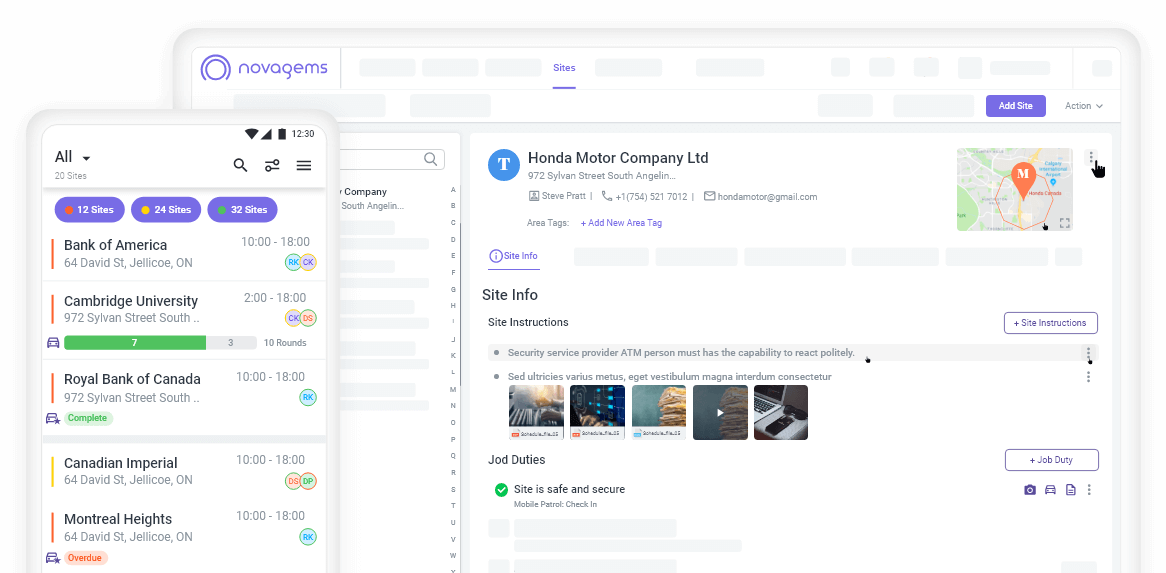
Look at platforms like Novagems, for instance. They provide end-to-end guard management solutions tailored to the needs of security services. They enable drag-and-drop scheduling, GPS tracking along with geofencing, automated calculations of timesheets, and notifications for overtime discrepancies. All of this with your payroll solution, eliminating the need to enter information twice.
The companies that use this kind of technology can expect a reduction in their overtime expenses by 25-40% in the first few months. Of course, the money you save goes directly to your profit. Besides the savings, you will enjoy other benefits. First, you will end up getting more accurate scheduling.
This is coupled with the fact that the security guard will receive their schedules earlier. Their morale will improve. Also, the coverage of the clients will be reliable. Finally, you will be able to expand the business without being overwhelmed by paperwork.
Final Thoughts
Managing overtime in a security company isn’t easy. But it’s absolutely critical for profitability and sustainability. Between rising labor costs, strict compliance requirements, and intense competition for qualified guards, you need every advantage you can get.
The strategies we’ve covered—real-time attendance tracking, GPS monitoring, clear policies, proactive workforce planning, and balanced scheduling—all work together to create a system that controls costs while maintaining service quality. But implementing these strategies manually is nearly impossible once you reach any meaningful scale.
That’s why investing in security guard scheduling software isn’t optional anymore—it’s essential. The right technology automates overtime tracking, prevents compliance violations, optimizes your schedules, and gives you the data you need to make better business decisions.
Start by assessing your current overtime situation. Pull your payroll reports for the past three months. How much are you spending on overtime? What patterns do you see? Where are the biggest problems?
Then, evaluate your tools and processes. Are you still scheduling manually? Do you have real-time visibility into where your guards are and how many hours they’re working? Can you quickly identify and fix coverage gaps before they become expensive overtime problems?
If the answer to these questions is “no,” it’s time to upgrade your approach. The security industry is evolving rapidly, and companies that embrace modern security guard management technology are the ones that will thrive in an increasingly competitive market.
Remember: every dollar you save on unnecessary overtime is a dollar that can go toward better wages, improved training, marketing to attract new clients, or straight to your bottom line. The time to act is now.
FAQ
What is the overtime law for security guards?
Under the Fair Labor Standards Act, security guards must be paid at least 1.5 times their regular rate for all hours worked over 40 in a workweek. Some states have additional requirements or requirements for double-time pay. Always check your state’s labor laws for specific requirements that may exceed federal standards.
How can security companies reduce overtime costs?
The most effective ways to reduce overtime costs include implementing real-time attendance tracking and GPS monitoring, using scheduling software to prevent over-scheduling, creating clear overtime approval policies, and building adequate staffing levels to avoid constant overtime dependency.
What are the best practices for security guard scheduling?
Best practices include posting schedules at least two weeks in advance for predictability, rotating shift assignments to prevent burnout, using technology to track hours and prevent compliance violations, and maintaining a backup roster for emergency coverage.
Is scheduling software necessary for security companies?
While small companies with just a few guards might manage with manual methods, scheduling software becomes essential as you grow. Once you’re managing 10+ guards across multiple sites, manual scheduling creates too many opportunities for errors.
What happens if a security company doesn’t pay overtime?
Failing to pay required overtime is a serious violation of federal labor law. Consequences can include back-pay orders for all unpaid overtime (often going back 2-3 years), additional liquidated damages equal to the unpaid wages, legal fees if employees file lawsuits, Department of Labor fines and penalties, and significant reputation damage that makes recruiting difficult. The costs of non-compliance far exceed the costs of proper security guard overtime management.
How do you calculate overtime for security guards working at multiple sites?
Overtime is calculated based on total hours worked for the employer in a workweek, regardless of how many different sites a guard works. If a guard works 25 hours at one location and 20 hours at another location in the same week, they’ve worked 45 total hours—40 at regular pay and 5 at overtime rates.
Sign up For Newsletter
Latest Blog Posts



Get Started
Start being productive & grow your business
with Novagems